Yet we know art is the answer.
Here are eleven ideas that helped guest blogger Barbara Muir work through her grief. Perhaps they might help you feel your way back to your studio.
The post Working Through Grief and Returning to the Studio appeared first on Art Biz Success.
]]>

The post Working Through Grief and Returning to the Studio appeared first on Art Biz Success.
]]>The short answer is "No."
The longer answer is that most artists are not going to have their art taken by someone like Richard Prince who has commercial stature and deep pockets. The threat to most artists is from every day Internet "sneak thieves" - lazy non-creatives who right click, copy and paste. Prince did more than that, but not much more.
Copyright is still useful for artists despite the actions of Richard Prince and the expansion of the defense of fair use.
Richard Prince — Pushing the Envelope, or Taking Advantage?
When it came to light that Richard Prince appropriated wholesale the work of Instagram users, added a few phrases of his own to the comment thread, enlarged the images and charged $90,000 for a print, many in the art world (and the legal world) were troubled by his actions. Others, not so much.
Some of the original creators of the Instagram images have sought revenge of sorts by selling the image they created for $90 in an attempt to undermine Prince’s market. The effectiveness of that strategy is questionable. Without Richard Prince’s actions, those Instagram artists would have continued operating in relative obscurity.
Many agree that obscurity is a bigger problem for artists than infringement.
The post Has Richard Prince Killed Copyright Protection For Artists? appeared first on Art Biz Success.
]]>The short answer is “No.”
The longer answer is that most artists are not going to have their art taken by someone like Richard Prince who has commercial stature and deep pockets. The threat to most artists is from every day Internet “sneak thieves” – lazy non-creatives who right click, copy and paste. Prince did more than that, but not much more.

Copyright is still useful for artists despite the actions of Richard Prince and the expansion of the defense of fair use.
Richard Prince — Pushing the Envelope, or Taking Advantage?
When it came to light that Richard Prince appropriated wholesale the work of Instagram users, added a few phrases of his own to the comment thread, enlarged the images and charged $90,000 for a print, many in the art world (and the legal world) were troubled by his actions. Others, not so much.
Some of the original creators of the Instagram images have sought revenge of sorts by selling the image they created for $90 in an attempt to undermine Prince’s market. The effectiveness of that strategy is questionable. Without Richard Prince’s actions, those Instagram artists would have continued operating in relative obscurity.
Many agree that obscurity is a bigger problem for artists than infringement. [ Tweet this. ]
The reality of the Instagram situation is that none of those photographs was registered with the Copyright Office by the creators. The speed and volume with which digital photography is created and pushed out into the world through social media tends to prevent a meaningful and systematic methodology for protecting rapid-fire creation using copyright law.
By the time the Instagram users discovered the infringement of their work, the Prince piece was sold. The money was in his pocket.
The original creator’s opportunity to stop the infringement or seek statutory damages (up to $150,000) had passed. An application for copyright registration must be filed before an infringement takes place in order to recover the big dollars.
One recommendation for protection from Prince would be to block him (his handle is richardprince4) from following you on Instagram. Or quickly filing a copyright application on any image Richard Prince leaves a comment. Unfortunately, I feel sure that horse has already left the barn. His next venture in appropriation is unlikely to be on Instagram.
This is not the first time Richard Prince has raised the ire of artists, specifically photographers. Recall the notorious case in which the Second Circuit decided that the image on the right created by Prince after copying the photograph by Cariou did not violate Cariou’s copyright:

The court considered the work transformative. Prince created something different and new, although he was unable to articulate his motivation or the meaning of the work.
The court wasn’t so sure about this creation, though:

The question that remains unanswered is whether a “reasonable observer” would find the image on the right to be transformative of the original photograph and therefore protected from a claim of infringement by fair use. The case settled before that open issue was decided, so we’ll just never know.
Protection vs. Fair Use: Natural Tension
On one side of the coin, Copyright law (and the Digital Millennium Copyright Act) continues to provide powerful tools for the protection of offline art and online digital images. Those tools include the recovery of statutory damages and attorneys’ fees.
The other side of the coin is that by helping to expand the idea of what is “transformative” in the visual arts, Richard Prince has enhanced protection for artists who otherwise would not have created their art for fear of being sued for infringement.
Appropriation artists and collage artists, in particular, are living in a new world of opportunity where once there was a “chilling effect.” Fair use is being freshly applied to protect those who use the work of other artists as component parts, or elements, to create something new and different in their own work.
Transformative use has become the most important element in determining whether the use of someone else’s work is fair and not infringing. This is true despite the fact that courts are required to consider three other factors before finding fair use.
The Center for Social Media at American University recently issued its Code of Best Practices for Fair Use in the Visual Arts. In it, the Center urges that the use of a pre-existing work, “… should be justified by the artistic objective, and artists who deliberately repurpose copyrighted works should be prepared to explain their rationales both for doing so and for the extent of their uses.”
The Center for Social Media requires a higher standard than was required of Richard Prince. Prince never had to articulate a rationale for his appropriation of Cariou’s work.
Copyright Law at Its Most Basic
Most artists have a solid understanding that copyright law exists to protect their art from copyists. But how copyright law really works is, for many, a mystery.
A work does not need to be registered in order to be protected by copyright. The moment a creative work is fixed in a tangible form of expression, copyright protection attaches. That includes a digital file.
Registration is needed to enforce those rights in court.
Those rights are:
- the right to reproduce your work;
- the right to distribute your work;
- the right to make derivatives or create new works based on your protected work; and
- the right to perform or display your work in public.
With the expansive notion of transformative use subject to protection by the fair use defense, the question is whether copyright registration is worth the time, trouble and expense?
If the right to create new works based on your earlier protected work is yours alone (the right to create derivatives), then why is another artist permitted under the guise of transformative use to create new and different works of their own based on your work? The fact of the matter is that the artist who is going to steal from you generally does so without any individual creative intent or motivation and will not have the benefit of the fair use defense.
If the artist who has taken your work is commercially successful, having a copyright registration will enable you to recover damages and stop the infringement. If the artist who has misappropriated your work is not commercially successful, you may not get any money from them, but you certainly will be able to shut them down. Without a registration, you might get them knocked off Facebook or other online venues, but you will not be able to stop physical reproduction or sale.
If you license your work and exploit it commercially through different revenue streams, a copyright registration should be a fundamental part of your business model. To the extent you aspire to become that kind of artist, incorporating copyright registration into your workflow is a business requirement.
The expense of the application ($35 each with a mechanism for registering collections) is a part of doing business, like paying rent or buying a hosting service.
When used thoughtfully, appropriation of another’s work can result in new creation. But whether something is new, or just a thinly veiled rip-off, is now in the eyes of the “reasonable observer.”
Regardless, copyright registration is still a solid business practice for artists.
 About Our Guest Blogger
Kathryn Goldman is an intellectual property attorney who represents writers, artists, and businesses, protecting them from having their work and art ripped off. Since she’s a lawyer, she has to mention that she’s not *your* lawyer (so these articles aren’t technically legal advice), but you’re still invited to download her Rip-Off Protection Report for Creative Professionals. Follow @KathrynGoldman on Twitter or Charm City Legal on Facebook.
The post Has Richard Prince Killed Copyright Protection For Artists? appeared first on Art Biz Success.
]]>After researching, comparing and gathering information on what you need to know to make a choice between WordPress, Squarespace, Wix or Weebly, I have come to the conclusion that there is no conclusion.
Each of these services has something to offer depending on your needs.
For example, if you're a hobby artist, a free Weebly site, which includes their paid ads, may suffice.
An artist with little or no computer skills may want a simple drag-and-drop interface, which is available with all services (drag-and-drop themes are available for WordPress).
A professional artist may, and probably should, prefer the power that the WordPress platform offers.
In all honesty, I find it very difficult to compare Squarespace, Wix or Weebly with WordPress the self-hosted version (WordPress.org).
WordPress is different. It's a robust, scalable, open source (free) application that can be whatever you need it to be.
The post Website Wars: WordPress vs Squarespace vs Wix vs Weebly appeared first on Art Biz Success.
]]>After researching, comparing and gathering information on what you need to know to make a choice between WordPress, Squarespace, Wix or Weebly, I have come to the conclusion that there is no conclusion.
Each of these services has something to offer depending on your needs.

For example, if you’re a hobby artist, a free Weebly site, which includes their paid ads, may suffice.
An artist with little or no computer skills may want a simple drag-and-drop interface, which is available with all services (drag-and-drop themes are available for WordPress).
A professional artist may, and probably should, prefer the power that the WordPress platform offers.
In all honesty, I find it very difficult to compare Squarespace, Wix or Weebly with WordPress the self-hosted version (WordPress.org).
WordPress is different. It’s a robust, scalable, open source (free) application that can be whatever you need it to be.
Comparing WordPress to these other platforms is like comparing Michelangelo’s studio with all his apprentices to an artist that works alone in solitude. I use this analogy because WordPress and other open source content management systems (CMS) not only build community, but they also create small businesses.
There’s an entire cottage industry that has evolved because of WordPress. Entrepreneurs that design themes, developers that create free (by donation) plugins, so you can do whatever you want, and the worldwide phenomenon WordCamps, where you can learn from other WordPress users developers and exchange ideas.
You’ll see how hard it is to compare WordPress with the others in the table below. But first I think it’s important to understand how the other services work.
Backups and Accessing Data
Squarespace, Wix, Weebly and similar website platforms are proprietary, which means you don’t own your website. They own it. These companies can shut down tomorrow and your site goes with it.
All of those years creating content and attracting followers can go Poof!
As unlikely as this scenario is, it can happen. Remember when Apple shut down iWeb? Then there was Posterous that left 60,000 clients in the cold.
SquareSpace is the only one of these services that will let you export a XML backup of your content that could be imported into WordPress, but you don’t get everything. It’s not an easy import either as you have to save the export as Livejournal or Typepad, which may or may not work when brought into WordPress.
Wix allows you to duplicate your site but it stays on the Wix server, as that is the only place it will work.
Weebly allows you to download a zip backup of your site but has a disclaimer that your blog posts are not part of it because they are in the database, which can not be accessed. They go on to say that your site probably won’t work as expected unless it’s on the Weebly server.
If you’re an avid blogger or just have lots of content and don’t want to go through the hassle of recreating all that content elsewhere, you’re better off using WordPress.com (the hosted version) or Blogger. When you have outgrown these platforms or need extensibility you can easily import into the self-hosted version of WordPress (WordPress.org).
What about WordPress backups?, I hear you asking. No worries! You can export, migrate, save in the Cloud, or download a complete backup of your WordPress site. You can use this to migrate to another host provider should you ever need to do so.
A Fact-Based Comparison
Just conduct a simple Google search if you want opinions on how easy each platform is to use. These types of comparisons are subjective depending on the authors, their skill levels, and their biases.
You’ve probably figured out by now that I am pro WordPress (see my bio below), but even I have to say that all the proprietary services mentioned in this article are fairly easy to use. This makes them particularly seductive for artists who aren’t thinking about their future usefulness.
So just the facts based on the basic entry package of each. All these services provide upgrades such as more space and e-commerce options.
| Yearly Plan | $8.25 | $8.25 | $8.00 | Varies $3.95 and up, depending on the hosting company | |
| Monthly Plan | $9.90 | N/A | $10.00 | Varies | |
| Bandwidth | 2GB | Unlimited | 500GB | Varies | |
| Storage | 3GB | Unlimited | 2GB | Varies | |
| Number of Websites | 1 | 10 | 1 | Varies | |
| Number of Pages | Unlimited | Unlimited | 20 | Unlimited | |
| Email Service | Google Apps | Google Apps | Google Apps, Zoho Email | Varies | |
| Max UploadFile Size | 15MB (audio)10MB (images) | 100MB | 120MB (audio)20MB (images) | Varies | |
| Hosting | Grid Hosting | Cloud Hosting | Cloud Hosting | Grid, Cloud, Shared, VPS, Dedicated | |
| Domain Name | FREE (1 Year Plan) | Not Included | FREE (1 Year Plan) | Depends on provider. I recommend to keep them separate. | |
| Drag n’ Drop | Yes | Yes | Yes | Yes, depends on theme | |
| Free Themes | 100+ | 100+ | 25 | 1945 + premium | |
| Support | Phone – 24/7 Email – 24/7 Forums Knowledge Base |
Email – 24/7 Chat – 11am – 9pm Forums Webcasts Knowledge Base |
Email – 24/7 Chat – 11am – 7pm Forums Workshops Knowledge Base |
Community Forums, WordCamps, free & paid resourcesaround the world | |
| Analytics | Google Analytics | Weebly Analytics Google Analytics | Squarespace Analytics Google Analytics | Google Analytics plus many other plugins to chose from | |
| SEO Optimized | Yes | Yes | Yes | Yes | |
| Mobile Website | Yes | Yes | Yes | Yes, depends on theme | |
| Social Sharing | Yes | Yes | Yes | Yes, plugin or theme supported | |
| Image Editor | Yes | Yes | Yes | Yes | |
| Form Builder | Yes | Yes | Yes | Yes – plugin | |
| Custom HTML/CSS | HTML Only | HTML and CSS | HTML and CSS | Open source so all code is accessible | |
|
|
As you can see it is very difficult to compare WordPress with the other services. All these services can provide you with a basic portfolio site, a blog or e-commerce, including WordPress.
But only one is unlimited in its functions and can be as small or as BIG as required.
About Our Guest Blogger
Design is Kim Bruce’s background; art, her passion; digital technologies, her tools. Kim is a visual problem solver who helps fellow artists with their online presence using WordPress.
Kim has presented WordPress for fine art at WordCamp, as well as professional development seminars for artists on setting up functional websites and blogs.
When Kim isn’t at the computer, you’ll find her in the studio creating art with her own unique visual voice. View her sculpture at KimBruce.ca.
Find Kim on Facebook at Kim Bruce at Artbiz and Twitter @ArtbizKimBruce.
The post Website Wars: WordPress vs Squarespace vs Wix vs Weebly appeared first on Art Biz Success.
]]>The post Get Over Blog Envy and Learn to Love Your Blog Again appeared first on Art Biz Success.
]]>There’s a certain someone in my field who has a huge following. This certain someone also has a great blog.
I found myself constantly referring to the blog as an example of what a good blog should be.
And I admit it, I had blog envy.

Rather than stew in a green swamp of jealousy, I decided to learn from this savvy blogger. I analyzed her blog.
You can do the same thing with blogs you admire. Look at:
- What is the blogger doing that you aren’t?
- What is he or she doing that you love?
After this exercise, you’ll have a handy (and long) to-do list for pumping up your blog.
Not only will it guide you to better blogging, it should empower you. Your blog envy will be tempered because you have a plan for improvement.
You will learn to love your blog once again.
Happy Valentine’s Day.
 About Our Guest Blogger
Through her company Original Impulse, Cynthia Morris helps writers, artists and entrepreneurs get out of their own way so they can make things that matter. Cynthia publishes a newsletter, Impulses, to help creative people stay happily on track. Subscribe here.
The post Get Over Blog Envy and Learn to Love Your Blog Again appeared first on Art Biz Success.
]]>The post Build Your Own Website In 10 Minutes (Not) appeared first on Art Biz Success.
]]>I read in several places that you could “create your own website in 10 minutes” [link removed at author’s request] with WordPress. While I never believed it would take 10 minutes, I never imagined it would take 100 hours.
Perhaps you can benefit from my experience.
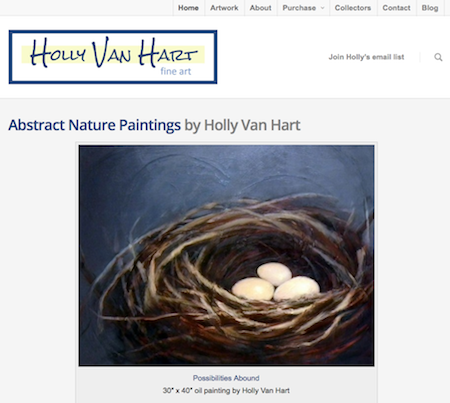
I already had an art website, a contract with a web hosting service, a domain name, and a blog hosted by Google (Blogger). But my site was 5 years old and needed to be totally overhauled with new, fresh content and current styling. It also needed to be integrated with my blog.
The objective was to get a very professional, crisp and clean looking website that leveraged the excellent advice from I’d Rather Be in the Studio by Alyson Stanfield, Guerilla Marketing for Artists by Barney Davey, and Starving to Successful by Jason Horejs.
I debated between using a DIY website platform and creating a self-hosted website. Self-hosted means you own your website and have full control over it. It also means more work to set up and maintain.
 Full control means complete responsibility.
Nevertheless, I opted for a self-hosted WordPress website (WordPress.org) in order to have more options and functionality for my site.
Like most artists, I am very selective about the look and feel of my website. I want to be sure that it shows off my art well, so I put a high value on having the control of a self-hosted website.
WordPress is used widely and here to stay. Because I learned a valuable skill set, I will be able to maintain and update my website for years to come. Websites need to be living things and constantly infused with new images and content.
The Specs
Here are the technical solutions implemented for HollyVanHart.com, along with the costs.
| TECHNICAL SOLUTION |
COST |
| WordPress.org software | Free |
| Hosting service (Linux) | ~$6/month |
| ‘Salient’ theme for WordPress | $55 one-time fee |
| 18 WordPress plug-ins for special purpose functions | Free |
| My time to learn WordPress and create the website | 100 hours of my time |
Why 100 Hours?
Why did it take me 100 hours?
My investment of time included learning WordPress and creating all-new content. It also included tweaking the site until it had the look and feel I wanted. Still . . . 100 hours of my time was way too much!
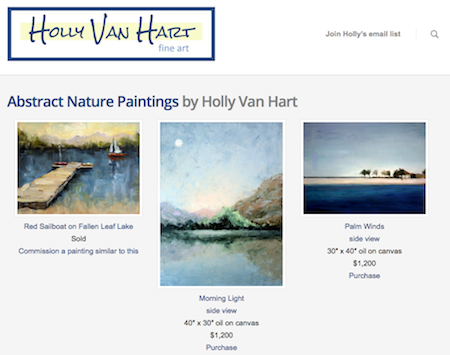
WordPress is a wonderful solution and is used by 19% of websites today. But it’s not for the inexperienced. I didn’t realize the needed functionality would require not only WordPress.org software but also a custom WordPress theme, no less than 18 special purpose plug-ins, and a lot of research on how to piece it all together.
Benefit From My Experience
The response to my new site has been all positive and encouraging, but I can’t recommend building a website on your own.
If you need a new website for your art and, like me, don’t have prior website experience, I recommend using a DIY website platform or hiring a consultant who knows what they are doing. Just be sure that you can add/edit your images easily and make other simple changes on your own.
Our time is better spent in the studio.
Did you DIY your site? What is your experience?

About Our Guest Blogger
Holly Van Hart is an award-winning artist based in the Silicon Valley. She paints abstract nature paintings that surprise us with unusual colors and textures, and ignite new excitement about a particular slice of nature. Click here to learn more about Holly and her work.
The post Build Your Own Website In 10 Minutes (Not) appeared first on Art Biz Success.
]]>The post Friendsourcing for a Successful Gallery Opening appeared first on Art Biz Success.
]]>My first solo exhibition last November in Boston was a spectacular success. I sold 19 paintings on opening night alone!
My secret: I let my friends pitch in any and every way that made sense.
I’m a bit of a control freak, so letting go of certain things was very challenging at first, particularly when those tasks involved the art itself. But as the opening date grew closer and the to-do list kept getting longer, I realized that accepting help from others was the only way to get it all done.
Not only that, but my friends had skills, expertise, and connections that I knew I didn’t have.
Here’s how they helped.

Joe designed my invitation.
I sent my friend Joe, a graphic designer, a half-dozen photos of my work, along with the event details, and asked him to come up with some ideas for the invitation. In my mind, the process would flow something like my day job, where I give my staff a rough idea of something, they come back with a few ideas, and I continue to edit and refine different versions until we land where we need to be.
But later that same day, Joe sent a “final” proof, along with a list of recommended printers. He hadn’t included all of my work on the invite, and had put pieces together in a way that I wouldn’t have done myself.
The bottom line: It didn’t at all look like what I would have done, which made me uneasy.
I shared the photo with a friend to see what she thought. She took a quick glance at it and said: “It looks fantastic. Leave it alone. He’s a pro.” Hearing her opinion, I realized the invitation was different from what I would have done precisely because I don’t know a thing about graphic design, and that’s what Joe does for a living.
Trine Marie cleaned and painted the gallery.
The exhibition was in a co-op gallery, so there’s no professional staff.
To make money, we rent the space to anything vaguely arts-related. The studio had just been rented to a dance class, and there were scuffmarks all over the walls and floor.
The walls also hadn’t been spackled or painted in some time, and the last show seemed to have been hung with tent stakes, the holes were so huge.
Here, I was lucky. We had recently hosted an exchange student from Norway for a month and had become close friends with her. She loved Boston and wanted to return for a visit, particularly since she had some college friends here.

I asked if she’d be willing to help with my show if we bought her a ticket to Boston. She eagerly agreed; we found a cheap flight; and Trine Marie spent several days before the show scrubbing the gallery floor, spackling and painting the walls, and running errands.
Jeanne served as exhibition designer.
While many artists would never delegate hanging their art, this one was easy for me.
My friend Jeanne is an interior designer, and I had hung group shows with her before. I have always been impressed by her skill at creatively arranging art.
When I picked my show date I had asked her to help me out.
We have a very different work style – she measures everything five times before putting in a single nail, and uses a level to ensure everything looks perfect. I believe in eyeballing things and moving the nail around later if things are off.
Jeanne’s way always looks better in the end, so I took on the role of her assistant. She spent hours laying out the show and thinking about what pieces worked best together, and it looked amazing when she was done.
Renata catered the reception.
A close college friend moved to Boston the summer before the show and she and her family had spent several weekends staying with us while job and house hunting.
As a return favor, Renata offered to cater the entire reception. Her sister is a professional caterer, and Renata is quite the party thrower.
She planned the whole menu, hired local college students to serve the wine and food, and arranged all of the décor for the evening, including candles and flowers.

Everyone expanded the invite list.
Whenever anyone extended a vague offer of help, I’d hand them some postcards with this request: “If you could invite five friends to the show who love art, I’d really appreciate it!” Opening night was packed, and I made plenty of new friends.
Julia, Tim, and Paula added the finishing touches.
There were still lots of last-minute tasks on the day of the opening, including printing and hanging labels. And, all of the painstakingly hung art was starting to get out of kilter because I hadn’t added rubber grippers to the back of the frames.
A group of college friends had come in from out of town and they were eager to help out. I was so used to handing things over at this point that I let Julia, Tim, and Paula finish up.
Husband Scot served as #1 fan.
My husband supported me as I painted and framed like mad in the months leading up to the show.
He did all of the grocery shopping, cooking, and housework without complaint. He also wrote personal emails and postcard invites to lots of friends and made sure everyone had a great time on opening night.
Niece greeted guests.
My nine-year-old niece Kate was really excited about my opening, and wanted play a role, so I found something for her to do that perfectly suited her love of performance. She was the official greeter, along with Trine. Together they greeted every guest and made sure they signed the guest book before entering the gallery.
Even with all of this help, having a show was far more work than I anticipated, and was especially challenging juggling around a full-time job.
How do you friendsource various aspects of your art career?
About Our Guest Blogger

Marcia Crumley is a Boston-based artist known for infusing bold and unexpected colors into her interpretive landscapes. She works primarily in acrylics, exploiting their saturated hues to full advantage. Read more about her on her Facebook page.
The post Friendsourcing for a Successful Gallery Opening appeared first on Art Biz Success.
]]>The post Vacation Leads to Quadrupling Art Sales appeared first on Art Biz Success.
]]>In 2006, I went on vacation, accidentally got into a new gallery while there, and wound up quadrupling my art sales.

Over the years I have come to the conclusion that having your work in exactly the right location – a very specific type of place – can change your success as an artist dramatically.
At the time, pure serendipity led my husband and me to vacation at a very upscale, yet small and discreet community where people have vacation homes.
I wandered into an attractive but small gallery and was looking closely at the work. The friendly gallery owner kept telling me info about the art or artist I was looking at until I finally told her I was an artist, not a buyer.
She surprised me by asking if I had a website, sitting down, and looking at my paintings in my presence. She took me on right on the spot!
I didn’t know at the time how this would change my life. Only years later, looking back at my sales records, am I able to see how dramatically my art income had gone from $5000-10,000 a year (net profit) to consistently more than $30,000.
I’ve been in over a dozen galleries over a span of twenty-six years, and many have been beautiful, enthusiastic about my work, of excellent reputation, well established or up-and-coming.

But only one has sold the stew out of my paintings – twenty and thirty per year, in the $600 to $3600 range.
And it has made the difference between struggling and making a living at art, for me.
Why It Works
I have come to believe that it is the location of the gallery that is key.
This gallery is in a high-end vacation destination, but not touristy. It’s a place where people own vacation homes.
Think coastal areas or mountains.
And consider this: It’s a place where couples go shopping together.

My gallery owner explains this is one of the reasons she sells so much: “Both members of the couple are right there to decide, with no having to go check with the other one [and probably not returning].”
Steps for Seeking a Vacation Destination Gallery
You can model my success.
1. Start by getting out a map and looking at what’s within comfortable day’s drive (as you will need to change out work a few times a year).
2. Once you’ve targeted a few areas, Art-Collecting.com is a great online resource for researching out-of-town galleries before you go.
3. Keep in mind that the gallery or perhaps even gift shop doesn’t have to be large, fancy, or even one that you’ve heard of.
There are surely many galleries in such locations that are off the radar. They are worth visiting! Just because they are new or you haven’t heard of them does not mean they don’t sell a lot of art.
4. Get in on the ground floor.
I broke my rule of not working with brand-new galleries. I took a risk and it paid off!
5. Seek to be a big fish in a small pond.
There are only about twenty of us in this gallery, compared to galleries with a stables of eighty or more artists.
6. Know how to pack and ship your artwork to a gallery to keep them supplied when work is flying off the walls. Be a productive artist with plenty of new work to offer.
7. Be flexible when working with any gallery, as they will often request more of a certain type of work that has received good response.
8. Finally, and most important in my original success, have an up-to-date website or a tablet with your newest images in case the gallery asks to see your work on the spot.
Have a great vacation while you’re at it!
I’d love to hear about your experience with galleries in vacation destinations.
About Our Guest Blogger
Rani Garner is a career oil painter living in rural Georgia. She paints light-filled landscapes that suggest a deeper reality just below the surface of things. Click here to learn more about Rani and her work.
The post Vacation Leads to Quadrupling Art Sales appeared first on Art Biz Success.
]]>The post Five Realities of Art Licensing appeared first on Art Biz Success.
]]>So you have heard about this thing called “art licensing” and it sounds pretty good! You can earn income by licensing the same art to multiple manufacturers to use on different products.
“Sounds great!” you think. “Where do I sign up?” you ask.
“Hold onto your paintbrushes!” I say.
Before you start putting a lot of time and energy thinking about the dream that is art licensing, you need to understand the reality of how to succeed in the industry. Creating art for licensing is a little different than the creative process many artists are used to and the day-to-day business might be as well.
So before you decide art licensing is for you, let’s talk about five realities of the business.
1. Mainstream art works best in art licensing.

If you think about art as a long line – with ultra-abstract styles of art on one end and ultra-traditional and portrait art on the other – art that will do well for licensing will fall in the middle of the spectrum.
I’ve said this many times but art that will do well in licensing has to appeal to the masses.
While you need one buyer for an original piece of art, a manufacturer has to believe that hundreds or thousands of people will want to buy a product with the art they choose on it. For that reason, you see less “risky” art on stuff. (That’s how I tell people what I do: “I create art for stuff you buy in the store.”)
If your art falls a bit outside the mainstream, does that mean you won’t make a dime in art licensing?
Not necessarily. You might license your work for a few products but it will be harder to make licensing your art a full-time profession.
[yframe url=’http://www.youtube.com/watch?v=3rUGWYEwXzU’]
It might need to be a piece of your income pie and not the whole thing. The more your art is in the middle of the art style spectrum, the more success I believe you will have in licensing your art.
At the end of the day, there really is no way to know if your art is a fit until you try. I look back at the art I was creating in the beginning and don’t think it is up to par, but if I’d been told it wasn’t good enough and didn’t keep trying, I wouldn’t be here today. Far be it for me to judge!
2. Art for licensing needs to be in collections.
Creating collections means thinking about the bits and pieces a manufacturer would need to create a product. When manufacturers see that you understand and can provide what they need, you are more likely to get an art licensing deal.
A collection could be 4 coordinating fine art images. A collection could be 4 main images with coordinating icons, borders and patterns that can be applied to products.
Each artist creates a little differently but the important thing to remember is that if a manufacturer wants to do a wide range of coordinated products, they need more than one image to work with.
Imagine a set of coastal dishes – complete with serving pieces, trivets, salt & pepper shakers. I mean the works. How exciting would it be on a table if there was one sailboat image on absolutely everything? Not exciting at all – which is why they would need different scenes, icons, maybe some rope borders to wrap around the edge of a gravy boat and a crab & lobster to put on the salt & pepper shaker.

You have to begin to think like a manufacturer – “What art do I need to create in order to give them what they need to make an interesting product line that will sell?” This brings us to reality.
3. The purpose of your art is to sell products.
This is a very commercial way to make money with your art and you need to be okay with that.
If it feels like selling out or you won’t want to be asked to make changes to your art, run away now and find something else to do. You won’t be happy in the art licensing industry.
Products don’t exist to showcase your art. Your art exists to help a product sell.
That’s how it works in art licensing. While we all probably have more than enough coffee mugs, you have probably bought a new one because you connected with the design – it made you feel good, you liked the colors, you liked the message. Something about the ART on the mug made you buy it, even though you could have gone on for years without a new one.
Our job is to create the art that makes consumers open their wallets.
4. You have to be an art creation machine!
Gone are the days where you get an art licensing deal and the product sells for 5-10 years and you sit back and watch the checks roll in.
Consumers want new designs so retailers want new designs so guess what? The manufacturers need new designs from artists like us. It is a “what’s new?” world we live in and the most successful artists in art licensing can create quickly and in quantity.
Speaking of quickly, there will often be times when you will need to create or adjust art on a tight deadline in order to have the chance at having your art licensed. If you don’t like deadlines or making changes in a matter of days (or hours!), then this might not be for you. If you love the challenge of getting your art aligned with what the market needs, you might love it!

5. It takes time to make money in art licensing.
If you have bills that are due next month, deciding to license your art today is not going to help you. It takes time to build your portfolio, connect with manufacturers, get a deal, etc. before you ever see any money coming in.
On average, it takes 9-18 months from the time you sign a contract to the time your royalties start coming in. There are some deals where you will be able to negotiate an advance on the royalties when you sign the contract but other companies who won’t pay advances.
It is up to the artist to decide if they want to work with or without advances or decide if the opportunity is worth the risk of waiting for the sales to go through.
There are many ways to make a living with your art and creativity – art licensing is just one.
Have you dipped your toes into licensing? How much of your income pie does it take up?
About Our Guest Blogger

If the idea of licensing your art still sounds interesting to you, Tara Reed can help. You can learn more on her blog.
Tara recommends artists start on the FAQ tab on the blog or at ArtLicensingInfo.com. There is a wide variety of information from eBooks to audios, teleseminars and more.
I am very proud that Art Licensing Info is a sponsor of the Art Biz Makeover workshop next week – and very grateful to Tara for sharing her expertise.
The post Five Realities of Art Licensing appeared first on Art Biz Success.
]]>The post Avoiding Hype in Your Art Marketing: Why and How appeared first on Art Biz Success.
]]>As a marketing expert, when I talk about “hype,” most people understand that I’m referring to an overexcited style of writing, as if from a loud, aggressive person standing outside a circus tent. Hype features lots of exclamation marks, hot-and-bothered promises and warnings not to miss the best whatever since the beginning of time.
As a visual artist, you probably aren’t a word person. You may lack the instinct to notice the difference between hype and a more honest and effective style of using words.
 If you hire someone to create the text for your website, you may not like their tone but get intimidated when told that that’s what will get you attention from the most readers. Or you may believe all marketing is hype, and therefore you shudder at the very idea of putting together words to attract buyers or gallery owners.
So I’d like to offer some help in understanding why and how you might want to keep hype at arm’s length.
Hype is more or less randomly chosen hot air, and therefore it isn’t specifically about you. It’s emotive and uninformative.
To some onlookers, it lowers your value to the level of the National Enquirer. Unless you have a campy or mass-market aesthetic, you and your art are best served by avoiding hype.
When you reject hype, you set the stage for better appreciation of what you’re actually up to in your art. [Tweet this.] People who become interested in your work with tuned-in expectations are more likely to stay interested and tell others about it.
Here, then, are some elements of hype to look out for in your customer emails, press releases, blog posts, tweets and your website – and what to substitute for them.
Emotion Without Content
Watch out for empty adjectives, such as “special,” “wonderful,” “lovely,” and their contemporary counterparts, like “awesome,” “epic,” or “killer.”
These convey praise but otherwise don’t really say anything. Therefore such words aren’t helpful to you.
If you find empty adjectives in what you wrote about yourself, your work or another artist you admire, choose more specific adjectives.
What was lovely about the work? What exactly did you find awesome about the show? Or try rewriting using no adjectives at all, just nouns and verbs.
Breathless Gushing
When you’re excited, it’s tempting to express that feeling with exclamation points, and maybe even more than one of them at the end of your sentences. Ditto for enthusiastic babbling, like “Oh my gosh” or “OMG.”
However, people take you more seriously when you get rid of nearly all of the exclamation points and cut the squealing.
Exaggeration and Boasting
It isn’t boasting to say verifiably true things about yourself or your art, such as “award-winning fiber artist” or “sculptor whose work has been widely exhibited.”
But beware of describing yourself or your work with qualities that are normally left for others to judge, such as “inspiring,” “profound” or “humorous.” [Tweet this.]
Avoid all superlatives (words ending in “-est”) unless you’re quoting a critic, review or media story.
Sheer Anticipation
If you’re unveiling new work in the near future or looking forward to an installation or exhibition, by all means let people know. Announce what will happen when. A little drumroll is fine.
Just don’t play a teasing game of “Something’s coming October 17 – stay tuned to find out what it is!” Everyone except your very closest buddies will consider that hollow hoopla.
When in doubt, use simple, straightforward words and phrases. Be conversational and down to earth. Sincerity appeals to people more than hype does!
About Our Guest Blogger

Marcia Yudkin is a copywriting and branding expert and the author of 6 Steps to Free Publicity, now in its third edition, along with 16 other books.
Her e-book No-Hype Copywriting: The Keys to Lively, Appealing and Truthful Sales Writing is available on Kindle, Nook, Smashwords and Audible.
Marcia invites you to the No-Hype Copywriting Telesummit. Telesummit has passed. Now available for download.
The post Avoiding Hype in Your Art Marketing: Why and How appeared first on Art Biz Success.
]]>The post Art Bloggers: Write for Your Readers appeared first on Art Biz Success.
]]>In a post earlier this year, self-described “creative badass” Justine Musk invited bloggers to write as if our readers were the heroes and heroines of our stories. She asked us to consider what we want our readers to become and to write to that.
After teaching Blog Triage with Alyson, I know that many artist-bloggers bemoan the fact that they don’t have the engagement they want on their blogs.
If you’ve been wondering why your posts aren’t encouraging comments and dialogue, you probably puzzle over why you’re spending your time blogging at all.
I understand, which is why I love Justine’s fresh perspective. It broadens and enhances the perception of the writer/reader relationship.

After all, we blog for others. We put a lot of time into our posts. They must impact our readers and we don’t know if we’ve accomplished this unless we hear from them.
Perhaps writing for the reader’s illumination – not our own – could bring the desired engagement.
But how?
If we’re writing about our art process, making announcements of upcoming shows, and writing about the artist’s life, where does the reader fit in?
Let’s start with what an artist-blogger might want for her reader. While I encourage you to generate your own list, here are five things I want for my readers.
1. To be moved emotionally.
Art often sparks an emotional response. Passing through an average day on the internet, we’re engaged intellectually.
That’s fine. But encountering a piece of art or a story about art that moves us emotionally? That’s a priceless gift to the reader.
2. To be inspired.
Art can offer a glimpse into another world. An artist overcoming a challenge, succeeding at a show, offering insights into how she is making it despite the odds – that’s inspiring.
We want to believe that the impossible is possible. Inspire your readers.
3. To recognize their taste or style.
Art moves us in mysterious ways, and the art we buy reflects what we love.
When we see art we love, we’re offered the chance to recognize and appreciate our taste: color palette, preferred style, or favorite subject matter.
An art blog offers the opportunity to claim our taste.
4. To feel like we’re part of something.
Again and again we hear “tell your story.” Why? Because stories connect us. They help us to relate to the storyteller.
When we relate to the storyteller or art blogger, we get to be part of something.
We get to be part of her story. We get to be part of her successes. We get to be part of her tribe of collectors.
5. To be educated and thus have a greater appreciation of (your) art.
Many people read to learn. When an art blog reader comes away from your site, does she feel like she’s learned something?
Have you offered her insights or information that makes her appreciate both your art and her own intelligence?
What Do You Want for Your Readers?
I hope this has helped you reflect on what you want for your reader. Not what you want her to do, but changes she may experience as a result of reading your art blog.
Try this yourself.
Make a list of the last five people who bought art from you. List three things you want for those people. You may or may not know them. That’s okay, just make it up.
How can you make them the heroes and heroines of your blog?
About Our Guest Blogger
Through her company Original Impulse, Cynthia Morris helps writers, artists and entrepreneurs get out of their own way so they can make things that matter.
The author of the Paris novel Chasing Sylvia Beach and the how-to guide Create Your Writer’s Life, Cynthia blogs and publishes a newsletter, Impulses, to help creative people stay happily on track. Find out more at originalimpulse.com
The post Art Bloggers: Write for Your Readers appeared first on Art Biz Success.
]]>