
Do pay attention to late in the episode when Kathryn mentions the new FARE Contract, an opportunity for you to protect the future financial interests of your work.
The post The Art Biz ep. 125: How to Legally Protect Your Creative Work with Kathryn Goldman appeared first on Art Biz Success.
]]>

The post The Art Biz ep. 125: How to Legally Protect Your Creative Work with Kathryn Goldman appeared first on Art Biz Success.
]]>David Paul Bayles tells us what his professional archives consist of, including his photos, writings, records, and audio files. He also gives us insight into the process of negotiating with an institution to preserve his work.
As you listen, pay careful attention to all of the people David has connected with along the way. His story is one of finding and nurturing connections.
The post Confronting your professional legacy with David Paul Bayles (15) appeared first on Art Biz Success.
]]>Last fall I received an email from David Paul Bayles, who was a member of my class at the time. The email read, in part:
Recently The Bancroft Library at UC Berkeley (third largest special collections library in the U.S.) created The David Paul Bayles Photographic Archive to create a home for my life’s work.
I am driving down to meet with them on Monday to place a large number of prints and oral history audio files into the Archive.
Whoa. How cool is that? A major institution deemed David’s work worthy of saving forever – all together under a single roof.

After peppering David with questions, I knew that his was a story that needed to be shared with you.
I have been concerned about artists’ legacies and what artists are doing to prepare themselves and their loved ones for their passing. What happens to the work and the records after they’re gone?
In this episode of the Art Biz Podcast, David tells us what his professional archives consist of, including his photos, writings, records, and audio files.
He also gives us insight into the process of negotiating with the Library – fascinating stuff. And, yes, it includes lawyers.
 |  |
Of course, we also talked about his art and why he chose to focus on photographing trees throughout his career. A better way to frame the question is how the trees chose him.
And we ended with a discussion of David’s next big goals. What comes after finding a permanent home for your entire life’s work? For David, it’s an artist residency and a traveling exhibition.
As you listen, pay careful attention to all of the people David has connected with along the way. His story is one of finding and nurturing connections.
And it all started with a fire …
Music: Keep It Simple by Wildermiss. Used with permission.
Listen to or subscribe on iTunes.
About My Guest
David Paul Bayles has been a working photographer since the 1970s.
His photographs have been published in numerous magazines and his prints included in the collections of The Portland Art Museum, the Santa Barbara Art Museum, and The Harry Ransom Center, among others.

Mentioned in the Interview
Mary Virginia Swanson – Photography Marketing Consultant
Jennifer Stoots – Photography & Art Appraiser

The post Confronting your professional legacy with David Paul Bayles (15) appeared first on Art Biz Success.
]]>That’s our topic for this Art Biz Podcast.
Listen in as Claudia McClain, founder of HomeBusinessInsurance.com, addresses the various levels of an artist’s career and the kinds of insurance you need at each point.
You never think about business insurance until someone asks to see your certificate of insurance or, more likely, until it’s too late. Until something bad has happened.
If you are an artist selling your art and you don’t have a specific policy for your business, this episode is for you. Refrain from clicking the Play button at your peril …
Level 1: Homeowners Insurance Only
This is the earliest phase in an artist's career and is for hobbyists only. You're making art just for yourself, not to sell.
At the point when you start selling, you are considered a business by the IRS and must take additional steps to protect your business.
Level 2: Incidental Business Occupancy Endorsement
This is a very affordable option for your home studio, which is tacked onto your homeowners' policy.
It doesn't cover the instances when you take your art outside of your home, and it might not cover liability when you have visitors to your home studio. That's when you need ...
The post The Art Biz ep. 7: 4 Levels of Business Insurance for Artists appeared first on Art Biz Success.
]]>That’s our topic for this Art Biz Podcast. Stay with me because this is important.
Claudia McClain addresses the various levels of an artist’s career and the kinds of insurance you need at each point. I loved the way she broke this down – explaining very clearly what type of insurance you need at each level.
You never think about business insurance until someone asks to see your certificate of insurance or, more likely, until it’s too late. Until something bad has happened.
If you are an artist selling your art and you don’t have a specific policy for your business, this episode is for you. Refrain from clicking the Play button at your peril …
Listen to or subscribe on iTunes.
Level 1: Homeowners Insurance Only
This is the earliest phase in an artist’s career and is for hobbyists only. You’re making art just for yourself, not to sell.
At the point when you start selling, you are considered a business by the IRS and must take additional steps to protect your business.
Level 2: Incidental Business Occupancy Endorsement
This is a very affordable option for your home studio, which is tacked onto your homeowners policy.
It doesn’t cover the instances when you take your art outside of your home, and it might not cover liability when you have visitors to your home studio. That’s when you need …
Level 3: Home-Based Business Policy
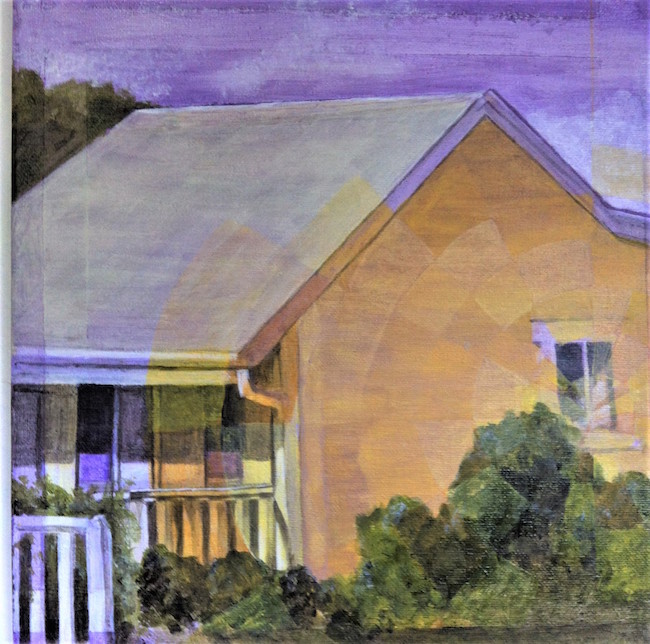
In this step, your home is still your base of operation, but you are taking your art to festivals or exhibitions outside of the home. These venues are likely to ask for a certificate of insurance. However, even if they don’t, you still want to protect yourself.
If you usually purchase insurance for a single event, it’s probably more cost-effective to insure your business for the whole year.
Level 4: Commercial Insurance
When you get to the point where you are earning significant revenue and/or you have a studio outside of the home, you need to look into commercial insurance.
Mentioned + Resources
Get a quote for what insurance might cost for your art business. (Rates based on Western U.S.)
About My Guest
Claudia McClain is founder of McClain Insurance which, serendipitously, she started in her own home in 1977.
Claudia came to my attention through a mutual artist-client (thanks, Cynthia Lait!) and clearly has a passion for helping artists make sure their businesses are protected.

Subscribe on iTunes and please leave us a rating there. We’d love to know that you’re listening and enjoying it!
The post The Art Biz ep. 7: 4 Levels of Business Insurance for Artists appeared first on Art Biz Success.
]]>The short answer is "No."
The longer answer is that most artists are not going to have their art taken by someone like Richard Prince who has commercial stature and deep pockets. The threat to most artists is from every day Internet "sneak thieves" - lazy non-creatives who right click, copy and paste. Prince did more than that, but not much more.
Copyright is still useful for artists despite the actions of Richard Prince and the expansion of the defense of fair use.
Richard Prince — Pushing the Envelope, or Taking Advantage?
When it came to light that Richard Prince appropriated wholesale the work of Instagram users, added a few phrases of his own to the comment thread, enlarged the images and charged $90,000 for a print, many in the art world (and the legal world) were troubled by his actions. Others, not so much.
Some of the original creators of the Instagram images have sought revenge of sorts by selling the image they created for $90 in an attempt to undermine Prince’s market. The effectiveness of that strategy is questionable. Without Richard Prince’s actions, those Instagram artists would have continued operating in relative obscurity.
Many agree that obscurity is a bigger problem for artists than infringement.
The post Has Richard Prince Killed Copyright Protection For Artists? appeared first on Art Biz Success.
]]>The short answer is “No.”
The longer answer is that most artists are not going to have their art taken by someone like Richard Prince who has commercial stature and deep pockets. The threat to most artists is from every day Internet “sneak thieves” – lazy non-creatives who right click, copy and paste. Prince did more than that, but not much more.

Copyright is still useful for artists despite the actions of Richard Prince and the expansion of the defense of fair use.
Richard Prince — Pushing the Envelope, or Taking Advantage?
When it came to light that Richard Prince appropriated wholesale the work of Instagram users, added a few phrases of his own to the comment thread, enlarged the images and charged $90,000 for a print, many in the art world (and the legal world) were troubled by his actions. Others, not so much.
Some of the original creators of the Instagram images have sought revenge of sorts by selling the image they created for $90 in an attempt to undermine Prince’s market. The effectiveness of that strategy is questionable. Without Richard Prince’s actions, those Instagram artists would have continued operating in relative obscurity.
Many agree that obscurity is a bigger problem for artists than infringement. [ Tweet this. ]
The reality of the Instagram situation is that none of those photographs was registered with the Copyright Office by the creators. The speed and volume with which digital photography is created and pushed out into the world through social media tends to prevent a meaningful and systematic methodology for protecting rapid-fire creation using copyright law.
By the time the Instagram users discovered the infringement of their work, the Prince piece was sold. The money was in his pocket.
The original creator’s opportunity to stop the infringement or seek statutory damages (up to $150,000) had passed. An application for copyright registration must be filed before an infringement takes place in order to recover the big dollars.
One recommendation for protection from Prince would be to block him (his handle is richardprince4) from following you on Instagram. Or quickly filing a copyright application on any image Richard Prince leaves a comment. Unfortunately, I feel sure that horse has already left the barn. His next venture in appropriation is unlikely to be on Instagram.
This is not the first time Richard Prince has raised the ire of artists, specifically photographers. Recall the notorious case in which the Second Circuit decided that the image on the right created by Prince after copying the photograph by Cariou did not violate Cariou’s copyright:

The court considered the work transformative. Prince created something different and new, although he was unable to articulate his motivation or the meaning of the work.
The court wasn’t so sure about this creation, though:

The question that remains unanswered is whether a “reasonable observer” would find the image on the right to be transformative of the original photograph and therefore protected from a claim of infringement by fair use. The case settled before that open issue was decided, so we’ll just never know.
Protection vs. Fair Use: Natural Tension
On one side of the coin, Copyright law (and the Digital Millennium Copyright Act) continues to provide powerful tools for the protection of offline art and online digital images. Those tools include the recovery of statutory damages and attorneys’ fees.
The other side of the coin is that by helping to expand the idea of what is “transformative” in the visual arts, Richard Prince has enhanced protection for artists who otherwise would not have created their art for fear of being sued for infringement.
Appropriation artists and collage artists, in particular, are living in a new world of opportunity where once there was a “chilling effect.” Fair use is being freshly applied to protect those who use the work of other artists as component parts, or elements, to create something new and different in their own work.
Transformative use has become the most important element in determining whether the use of someone else’s work is fair and not infringing. This is true despite the fact that courts are required to consider three other factors before finding fair use.
The Center for Social Media at American University recently issued its Code of Best Practices for Fair Use in the Visual Arts. In it, the Center urges that the use of a pre-existing work, “… should be justified by the artistic objective, and artists who deliberately repurpose copyrighted works should be prepared to explain their rationales both for doing so and for the extent of their uses.”
The Center for Social Media requires a higher standard than was required of Richard Prince. Prince never had to articulate a rationale for his appropriation of Cariou’s work.
Copyright Law at Its Most Basic
Most artists have a solid understanding that copyright law exists to protect their art from copyists. But how copyright law really works is, for many, a mystery.
A work does not need to be registered in order to be protected by copyright. The moment a creative work is fixed in a tangible form of expression, copyright protection attaches. That includes a digital file.
Registration is needed to enforce those rights in court.
Those rights are:
- the right to reproduce your work;
- the right to distribute your work;
- the right to make derivatives or create new works based on your protected work; and
- the right to perform or display your work in public.
With the expansive notion of transformative use subject to protection by the fair use defense, the question is whether copyright registration is worth the time, trouble and expense?
If the right to create new works based on your earlier protected work is yours alone (the right to create derivatives), then why is another artist permitted under the guise of transformative use to create new and different works of their own based on your work? The fact of the matter is that the artist who is going to steal from you generally does so without any individual creative intent or motivation and will not have the benefit of the fair use defense.
If the artist who has taken your work is commercially successful, having a copyright registration will enable you to recover damages and stop the infringement. If the artist who has misappropriated your work is not commercially successful, you may not get any money from them, but you certainly will be able to shut them down. Without a registration, you might get them knocked off Facebook or other online venues, but you will not be able to stop physical reproduction or sale.
If you license your work and exploit it commercially through different revenue streams, a copyright registration should be a fundamental part of your business model. To the extent you aspire to become that kind of artist, incorporating copyright registration into your workflow is a business requirement.
The expense of the application ($35 each with a mechanism for registering collections) is a part of doing business, like paying rent or buying a hosting service.
When used thoughtfully, appropriation of another’s work can result in new creation. But whether something is new, or just a thinly veiled rip-off, is now in the eyes of the “reasonable observer.”
Regardless, copyright registration is still a solid business practice for artists.
 About Our Guest Blogger
Kathryn Goldman is an intellectual property attorney who represents writers, artists, and businesses, protecting them from having their work and art ripped off. Since she’s a lawyer, she has to mention that she’s not *your* lawyer (so these articles aren’t technically legal advice), but you’re still invited to download her Rip-Off Protection Report for Creative Professionals. Follow @KathrynGoldman on Twitter or Charm City Legal on Facebook.
The post Has Richard Prince Killed Copyright Protection For Artists? appeared first on Art Biz Success.
]]>Obtain your identification number.
Register your business with your state.
Apply for sales tax licenses.
Open business accounts.
The post Make it legal: 4 Steps to an official art business appeared first on Art Biz Success.
]]>If you are an artist in the U.S., take these four steps for turning your hobby into a legal art business.
1. Obtain your Federal Employer Identification Number.
a.k.a. FEIN, EIN, FIN
Don’t scatter your Social Security Number around! Get this free ID number from the Federal government for your art business.
The Federal EIN Application takes 5 minutes and is FREE. Beware of sites that want to charge you for this service! 
2. Register your business with your state.
Regardless of the business structure you choose (sole proprietorship, LLC, S-Corp), you must register with your state in order to be a legal entity.
In Colorado, I register my businesses with our Department of State. I also take an extra step to register my D.B.A. (Doing Business As) names, which fall under the umbrella of my S-Corporation.
3. Apply for a sales tax license with your state and city or county.
If you are selling art directly to buyers, you must have a sales tax license and collect sales taxes. Check your Department of Revenue to obtain this and to find out what additional local licenses you need.
I recommend to all of my clients that they take sales tax classes. Most states and municipalities offer these free of charge and they are well worth the time.
4. Open business accounts.
You must separate your business and personal accounts. This small step will lead to peace of mind and save you from possible future headaches (migraines!).
To obtain a business account at your bank, you will be asked for your business registration documents (see #2 above).
The post Make it legal: 4 Steps to an official art business appeared first on Art Biz Success.
]]>The post Take a Sales Tax Class appeared first on Art Biz Success.
]]>But your life will be a lot easier if you take a class. Or two. Or three.

First, make sure your business is registered with your state. In Colorado, this is through our Department of State either by registering as an LLC or corporation or reserving a name for a sole proprietorship.
Next, you’ll need a sales tax license. In Colorado, we apply for a license through the Department of Revenue.
beginning
biz basics
biz basics
Colorado is a “point of delivery” state, meaning that we collect taxes based on the locations we have in common with the recipient. So, if I ship something to Durango, I only charge State sales tax. If I ship to my hometown of Golden, I charge State, City, County, and a special Denver-area tax.
It’s enough to make a person go mad! Instead of pulling my hair out*, I sought help.
Find a class
Check with your state and municipal departments of revenue for free tax classes. A good tax class will tell you how to 1) collect taxes and 2) submit them to the government entity.
Moreover, you will make contacts in the revenue offices that can help with any future questions.
I can only speak of my experience in Colorado. Your department names and form requirements might be very different.
*I’m still tempted to pull my hair out from time to time, but I know people are there to help if I need it.
The post Take a Sales Tax Class appeared first on Art Biz Success.
]]>The post Legal Resources for Starting an Art Business in the U.S. appeared first on Art Biz Success.
]]>The post Legal Resources for Starting an Art Business in the U.S. appeared first on Art Biz Success.
]]>The post Artist Contracts: She Broke the Rules appeared first on Art Biz Success.
]]>
In her article Break the Rules, Alyson Stanfield said: “Don’t be afraid to break the rules, ignore the rules, or make up your own rules—especially when something isn’t working for you.”
Well Alyson is right and her comment hit home because of a recent experience. Let me explain.
I was invited to lecture at the Loveland Museum in Loveland, Colorado in conjunction with an exhibition including my work titled Integral Elements. The Museum offered to pay my travel expenses and a modest honorarium arranged through emails and phone calls months prior to the exhibition. We were all in agreement.
As the lecture date approached a contract arrived in the mail, NINE PAGES in small type. Yes, 9 pages plus a cover letter instructing me to return a signed copy! It was the standard contract from the City of Loveland, the governance structure within which the Museum operates. However, after several readings, I realized that only the first two paragraphs on the first page applied to my circumstances, along with a short addendum (of a few sentences) stapled to the back.
I won’t describe the whole contract, much of it too convoluted to comprehend. Among the many irrelevant items, some paragraphs required that I “certify compliance under penalty of perjury” with items or clauses referring to an array of Federal, State, and local regulations and ordinances. It even required that my signature be notarized—an expense I did not think was necessary.
What to do? It just seemed overwhelming partly because I did not understand it all.
Ultimately, I could not bring myself to sign the contract. I decided it was time to “break the rules.”
I called up the City’s public art/business services manager and the museum staff. My lengthy voice messages said (in no uncertain terms, though with slightly quivering voice) that I could not sign the contract. Continuing . . . that the clauses in the contract were inappropriate and irrelevant, that I would not pay to have my signature notarized, and more!
However, I also made it clear that I would still come to the opening, give my lecture, and that they could decide to pay me or not. Of course, I wanted to be paid. And with or without a signed contract, I intended to fulfill my verbal agreement with the museum staff to give my lecture and participate in the programs. No contract was going to stop me from doing the best job that I could do.
The reality: I was the first person to make such a fuss!
The City personnel initially told me, “This is our standard contract. We’ve been using it for years and no one else has complained.” That was NOT a good answer. I still refused to sign, but continued plans to participate.
Guess what. Upon my arrival in Loveland, the museum staff told me that my protest finally changed the speaker contract. They had been trying but unable to change it for years. But the City attorneys had listened to me and responded!
The outcome:
1) My worry that the museum staff would be mad at me for refusing to sign the contract was unfounded;
2) The City attorneys drafted a replacement one-page contract;
3) The museum staff was quite grateful to have a new simple contract more suited to their needs; and, best of all
4) We are all happy! Win-win-win.
Next time you run into a difficult situation, don’t be afraid to take action and be the “maverick.” Use your best judgment along with carefully justified reasoning to determine your course. And always live up to your agreements while continuing to communicate all the way.
Harriete Estel Berman is an artist living in California. She is known for using recycled metal in her sculptures that are often charged with social commentary and, simultaneously, filled with humor.
She is also the author of the Professional Guidelines for Artists and the blog askHarriete.
The post Artist Contracts: She Broke the Rules appeared first on Art Biz Success.
]]>The post What to Put on a Gift Certificate for Your Art appeared first on Art Biz Success.
]]>Let’s look at the situation and start with the gift certificate itself, pictured here.

The small lettering on the bottom row consists of these three components.
- The artist’s contact information–phone and email.
- The certificate number, expiration date (12/31/2010), and the words “Not redeemable for cash.” Having an expiration date is important! And the “not redeemable” phrase proved key when the recipient tried to cash it in. Geri was able to point to this language and quickly put an end to that discussion. The words “No Cash Value” could also be used or added.
- A place for the authorized signature (presumably the artist’s or the organization that auctioned it off).
Without knowing the context of how this was promoted in the sale (Was there any text that went along with it or in a catalog?), I see one crucial piece of information missing on the gift certificate–>What can it be used for?
A simple phrase like “To be used toward the purchase of original art or prints by Geri Dunn” might have covered it.*
You could also add the phrase “Non-Transferable” if you want to ensure that only the purchaser is able to use the certificate.
Go over details with the organizers
It’s difficult to have control over your donations if you aren’t involved with the organization or in attendance, but there are some things you can do to have a smoother experience.
Whenever you donate a gift certificate, talk details with the organization. The nonprofits I’ve been involved with have had forms for donors to fill out. Write out the specific terms of your donation on the form and make sure you sign it somewhere. If the organization you’re supporting doesn’t have a form, make up an official letter of your own. Address your donation letter to the organization and include it when you deliver the gift certificate.
If you really want to go all out, see that anything in print (a catalog, brochure, or label) is more specific than “Gift Certificate.” Perhaps “Gift certificate toward the purchase of art by Geri Dunn” would be sufficient. I know this might sound like going overboard, but I’m amazed at how few people read the details of an offer. The more bases you cover, the fewer headaches you’ll have in the long run.
If necessary, provide a separate “Terms of Use” document to go along with the certificate or, better yet, print the terms on the reverse of the certificate itself.
You can also use and adapt many of the above tips for certificates that are purchased from you and given as gifts.
*Disclaimer: I’m not an attorney. I’m sure that state laws differ on such matters, so please do some research before you create your gift certificates.
The post What to Put on a Gift Certificate for Your Art appeared first on Art Biz Success.
]]>The post Free call about how one artist is fighting to protect artists’ rights appeared first on Art Biz Success.
]]>Join us on this special call to find out how it could affect you.
A Conversation with John T. Unger

Thursday, November 5
4pm ET, 3pm PT, 2pm MT, 1pm PT
30 minutes
FREE
As John explains it, he has had to spend over $50,000 so far to defend himself against an imitator who has sued to have John’s copyrights revoked. Read the details.
During this 30-minute call, John will quickly state the facts of the lawsuit against him and describe how the outcome could affect the rights of other artists in the future.
PLEASE NOTE: If you’d like to help John, but can’t be on the phone call, you can buy his art here or donate any amount here.
To listen to this conversation, all you have to do is sign up. Upon registering, you will be taken to a page with the dial-in information. You will also receive this information in your email inbox.
While this is a complimentary call, you will incur regular long-distance charges.
The post Free call about how one artist is fighting to protect artists’ rights appeared first on Art Biz Success.
]]>