On this episode of The Art Biz, I make the case for routines over spreadsheets, share the three distinct ways I see artists approach their marketing, and explain why marketing is bigger than self-promotion. If you've ever built a plan and abandoned it by week two, this one is for you.
The post Stop complicating your art marketing plan (275) appeared first on Art Biz Success.
]]>
The post Stop complicating your art marketing plan (275) appeared first on Art Biz Success.
]]>I have a long list of things I'd rather not do. But If you are trying to make money from your art, you are responsible for certain tasks that you may not feel like doing.
If you are trying to make money from your art, you are responsible for certain tasks that you may not feel like doing.
Perhaps considering a few questions might help you get past the struggle.
The post When You Don’t Feel Like Doing Art Business Tasks appeared first on Art Biz Success.
]]>
If you are trying to make money from your art, you are responsible for certain tasks that you may not feel like doing.
You might not feel like:
- Writing and sending your email newsletter
- Publishing a blog post
- Updating your contact list
- Posting to social media
- Following up with a buyer
If you’re like me, you never feel like doing your bookkeeping.
I get it that not all of these, or perhaps any of them, might be fun.
And, yet, you need to do them to make progress. And to be smart about how you run your art business.
There’s no sense bellyaching about the things you don’t enjoy. And no sense wishing that you’d rather be doing something else.
Pining for different circumstances is wasted energy. If you want to make progress, hold your nose, roll up your sleeves, and get to work.
And do it joyfully, dammit!  , because you’re darn lucky. You’re lucky to be an artist in the free world and to have the freedom and resources to build your own business.
My top trick for getting difficult things done is to find support and accountability. And that’s why those 2 things are the cornerstone of all my programs.
You can find answers anywhere. Thank you, Google. But artists need community to thrive.
Examine Your Resistance
Why are you procrastinating?
Is there a mental block and, if so, what is it related to?
Is it a fear of success? A fear of failure?
Do you have everything you need to do the task?
I have discovered that some of my clients procrastinate because they have a project on their lists rather than a task. A project requires multiple steps (tasks) to complete.
If you need to send a newsletter, but you haven’t even researched or written the content, of course you’re going to delay.
Always identify the next action for your task and make it an actionable, single step.
The post When You Don’t Feel Like Doing Art Business Tasks appeared first on Art Biz Success.
]]>In order to see better results, you have to do something different.
I don’t share this list lightly. It’s got some things on it that could really shake up the status quo. They could skyrocket your success when implemented with sound counsel or just as easily fail miserably if you don’t have the proper knowledge and support in place.
I share it because it’s something I wanted for my own business—a list I could have at the ready when I sensed a necessary change. I wanted something to remind me of everything that is possible. To remind me that anything is possible when I commit to it.
In a sense, this is a master list of possibilities. You are not meant to use it as a checklist of items to tackle one at a time.
I encourage you to use this in the following situations.
- You are stuck or bored—creatively, financially, or mentally—and want a new project.
- You are seeing a drop-off in any aspect of your business.
- You want to make the most of a big exhibition or event you have coming up.
Let's dive in.
The post 96 Strategies for Improving Art Business Results appeared first on Art Biz Success.
]]>It is said that the definition of insanity is doing the same thing over and over again and expecting different results.
If true, why do we continue to manage our art businesses the same way we did last year or the year before?
In order to see better results, you have to do something different.
I don’t share this list lightly. It’s got some things on it that could really shake up the status quo. They could skyrocket your success when implemented with sound counsel or just as easily fail miserably if you don’t have the proper knowledge and support in place.
I share it because it’s something I wanted for my own business—a list I could have at the ready when I sensed a necessary change. I wanted something to remind me of everything that is possible. To remind me that anything is possible when I commit to it.
In a sense, this is a master list of possibilities. You are not meant to use it as a checklist of items to tackle one at a time.
I encourage you to use this in the following situations.
- You are stuck or bored—creatively, financially, or mentally—and want a new project.
- You are seeing a drop-off in any aspect of your business.
- You want to make the most of a big exhibition or event you have coming up.
Let’s dive in.
Planning + Productivity
I always start here because you want to make sure you’re headed in the right direction. You want to be intentional about where you’re headed rather than flailing about from task to task.
A roadmap for your art business and career gives you focus. And the more successful you are at executing that roadmap, the more important it is to use your time wisely.
1. Maintain a journal to document progress and work through challenges.
2. Plan for your future rather than waiting for it to happen to you.
3. Project future income possibilities.
4. Keep your financial accounts updated.
5. Maintain your calendar so you can see all of your obligations in one place.
6. Conduct monthly planning hours to stay on top of your goals.
Making Art
Without the art, you are not an artist. Your work in the studio must always come first. If you aren’t making, you have nothing to market. You have no business.
Sometimes, however, you get in a rut in the studio. or you’re just not feeling it for the work in front of you. Change things up!
7. Learn a new medium or technique for more sophisticated work.
8. Conduct research for a new body of work.
9. Make smaller art to get you out of your comfort zone.
10. Make larger art to hold your bigger ideas.
11. Clean your studio for a fresh perspective.
12. Finish unfinished work or reuse its material.
13. Start or stop doing commissions.
Selling Your Art
If only it was as easy as putting a price on your art and watching it get snatched up by a lucky collector. There’s a lot of work that goes into selling, and numerous strategies you can try to sell more art.
14. Raise your prices.
15. Lower your prices. (Not one I would normally suggest, but listen to how it worked for Adele Sypestyn.)
16. Have a sale. Sometimes you need to bring in quick cash.
17. Have your art professionally photographed.
18. Maintain your inventory so that you can quickly look up items.
19. Upgrade your inventory platform.
20. Get art on a new online platform (Etsy, Saatchi, FineArtAmerica, etc.).
21. Apply to shows. Apply to different shows.
22. Find a new venue for showing and selling your art.
23. Add prices and a How to Buy button to your site.
24. Add e-commerce to your site.
25. Archive sold work that’s on your website.
26. Streamline your packing and shipping.
Growing Your Audience
You want more and more people to see your art because the more people who see it, the more people there are to talk about it, share it, and buy it.
Blessedly, you can do much of this online these days, but aim for quality rather than quantity.
27. Network in person when it’s safe to do so.
28. Reach out to new people online.
29. Connect with artists you admire.
30. Polish your introduction so that it’s ready to use when you need it.
31. Give public talks online or in person.
32. Start a podcast.
Nurturing Relationships
Regardless of the business you’re in, relationships are everything. You have to be able to connect with people and then stay in touch with them so they know you care.
Relationships are nurtured on the phone, on social media, in email, and (hopefully again very soon) in person. It’s essential that you make relationship-nurturing a top priority.
33. Segment your list so you can email to specific audiences.
34. Add autoresponders to your email marketing service to save time.
35. Send emails on a schedule.
36. Use real mail to send postcards, birthday cards, or holiday greetings.
37. Connect with curators, gallerists, arts administrators, consultants, and designers as appropriate for you.
38. Invite a VIP to a studio visit.
39. Reach out to individuals 1-on-1 (text, email, phone, mail).
40. Send direct messages on social media.
41. Ask a collector if they’d like to host a home art party for you and your art.
Improving Marketing Materials
If you’re hanging on to the same artist statement or bio that you wrote five years age—or even the same one from last year—it’s time for an upgrade. The chances are slim that your art has remained the same during that period of time, so why would you use the same marketing materials to promote the work?
Oh, and can we talk about that 15-year-old headshot you’re still using?
42. Update your artist statement, bio, and website text to reflect your artistic growth.
43. Write better stories about yourself and your art for deeper connections.
44. Refresh your brand fonts, colors and, if you use one, logo.
45. Get new business cards, brochures, or postcards.
46. Get better photos of your art—remembering that they must be as good as the art itself.
47. Get better photos of you that make it clear you’re a working artist.
48. Publish a catalog of your art, which is an excellent way to share your work with serious collectors, gallerists, and curators.
Getting Help
Artists are fiercely independent. You usually love DIYing everything—using the resources you’ve figured out or are curious about exploring.
But DIY doesn’t mean Do It Alone. You can have help! And there are times when you must seek help from others in order to expand your career.
49. Hire a virtual or office assistant, especially if you find tasks are slipping through the cracks.
50. Hire a studio assistant when you can’t keep up with the demand.
51. Hire a bookkeeper or accountant if you’re terrible at staying on top of your finances and paying taxes on time.
52. Hire a housekeeper or nanny for your sanity.
53. Hire an art business consultant to help you prioritize these 96 strategies!
Marketing Online
Online marketing deserves its own space. I did touch on it in other sections, but please note that only 7 of the 96 bullet points are for online marketing.
While my clients tend to search for magic bullets around getting more Instagram followers, it’s just one strategy of many available options.
54. Post regularly to your favorite social media platforms. (Don’t forget LinkedIn and Pinterest!)
55. Diversify the posts and images you’re sharing—what is in them, time of day, and text you write.
56. Take photos. Take more photos. Learn how to take better photos.
57. Make videos. Make more videos. Learn how to make better videos.
58. Start livestreams on Facebook, Instagram, or YouTube and speak directly to your audience.
59. Start or revive a blog, especially if you don’t mind writing.
60. Update your website to make it look fresh.
Productizing Your Art
If you have art that people would buy over and over again, why not slap it on products? Or find an aspect that you can turn into production work—something that could be made quickly with a little extra help?
Just remember that you have to promote lower-priced products the same way you promote higher-priced originals, and you have to sell a lot more items with lower prices in order to equal the sale of a single original. Do you have the bandwidth to do both?
61. Make note cards of your art to package and sell.
62. Offer reproductions of your originals.
63. Research art licensing.
64. Put your art on products via sites like RedBubble, Spoonflower, and Vida.
65. Create a deck of inspiration cards.
66. Add products to your online shopping cart.
67. Seek brick-and-mortar shops to sell your products.
Attracting Publicity
Imagine what it would be like if there were even a handful of people who would write about and share your art. Think about the buzz and opportunities that could arise as a result.
It can happen, but you won’t be blessed out of the blue. You have to work hard to get good publicity. You have to do what you can to attract it.
68. Send press releases when you have a story that would capture readers’ attention.
69. Freshen up the story you tell about yourself and your art.
70. Follow writers, critics, curators, bloggers, and podcasters on social media so you know what they write and talk about.
71. Become a resource for the media by writing stories for publications and websites.
72. Make a media room on your website when you have numerous features to share.
73. Pitch, succinctly, your story to appropriate podcasts.
Advertising
Paid advertising is way down on the list because I think you can waste a lot of money if you don’t know what you’re doing.
If, however, you take the time to educate and inform yourself about the various possibilities—and how they fit with your art and goals—you might find that advertising is a good option.
74. Buy a package of print ads from a publication that is in line with your art.
75. Dip your toes into Facebook and Instagram advertising.
76. Take out a banner ad on a pertinent website.
77. Buy space in a relevant email newsletter.
Upping Your Game
When you want to move up a level in the art world, you have to take risks. This means moving beyond your comfort zone and challenging yourself with new opportunities and projects.
You’ll face criticism and rejection, but you sure won’t get very far by continuing to play it safe.
78. Take an art or business course.
79. Apply for grants for a new project.
80. Apply for a residency.
81. Submit a public art proposal.
82. Collaborate with artists who challenge you.
83. Learn a new technology that you’ve been avoiding because of a steep learning curve.
84. Plan a multi-year project that is guaranteed to have people talking.
Teaching
Teaching really isn’t a strategy. It’s a calling.
You shouldn’t start teaching just to make money. You should start teaching because you have something valuable to share and delight in the idea of sharing it with others.
These final items are for you if you’re already teaching.
85. Schedule a new workshop—online or off.
86. Figure out online teaching to counter, ahem, worldwide pandemics.
87. Start mentoring to higher level artists.
88. Connect with people and organizations that might hire you for classes and workshops.
89. Learn to write a proper sales page to sell more classes.
90. Start an affiliate program to encourage referrals and pay people for promoting your classes.
91. Segment students in your email marketing platform so that you can communicate with them separately.
92. Create a lead magnet (free offer) to capture prospective students.
93. Map out your students’ experience to make sure they’re being cared for along the journey with you.
94. Stay connected with former students because they’re a good resource.
95. Begin a membership program to keep students together.
96. Gather meaningful testimonials from happy students.
Putting This List to Work
Now you see that anything and everything is possible. You aren’t at a loss for ideas. And because you’re a self-employed artist, you enjoy a great deal of freedom to create a life around doing what you love.
You are free to take on any of these and set your own schedule.
Aside from family and other personal obligations you’re free to get up when you want, run errands or exercise when it’s convenient, take a nap when your eyelids are heavy, and work when you’re inspired. Except that if you only work when you’re inspired, you might make a little money here and there, but you will never make a big impact with your art.
If your business is going to become what you envision it to be, you need to make hard decisions about how you will spend your time.
You need to take charge of your schedule. And you can do it with confidence.
The post 96 Strategies for Improving Art Business Results appeared first on Art Biz Success.
]]>More of anything! Because it makes our efforts feel worthwhile. It seems validating.
But we're often stopped in our tracks when we begin to realize what we need to do in order to increase our numbers.
We think we have to post more, research hashtags, invest in advertising, create a lead magnet, learn to write better copy, or forget about a restful night's sleep.
Yeah, you probably do have to do some of those things in order to attract more followers and subscribers, but you might also benefit from being open to doing things a little differently to increase those numbers.
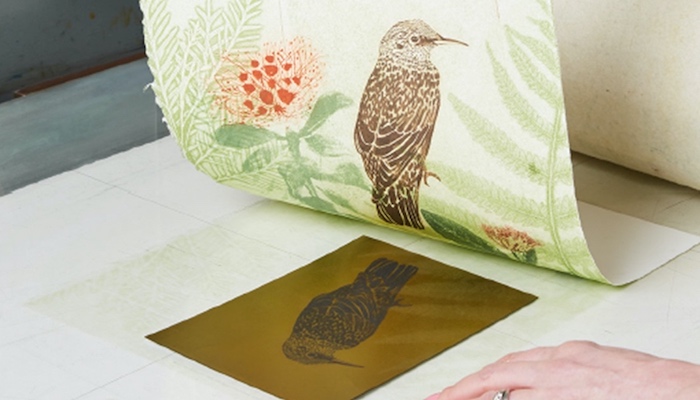
In this episode of the Art Biz Podcast I talk with Trudy Rice about how she has grown her Instagram and email list by cross-promoting other brands.
Trudy uses a platform called Ampjar, but the underlying lesson is to find like-minded people and share each other's art, products, and services. Trudy refers to these as "shout outs" and loves this system because of the good karma it creates.
The post The Art Biz ep. 77: Growing Your Audience with Good Karma with Trudy Rice appeared first on Art Biz Success.
]]>More of anything! Because it makes our efforts feel worthwhile. It seems validating.
But we’re often stopped in our tracks when we begin to realize what we need to do in order to increase our numbers.
We think we have to post more, research hashtags, invest in advertising, create a lead magnet, learn to write better copy, or forget about a restful night’s sleep.
Yeah, you probably do have to do some of those things in order to attract more followers and subscribers, but you might also benefit from being open to doing things a little differently to increase those numbers.
In this episode of the Art Biz Podcast I talk with Trudy Rice about how she has grown her Instagram and email list by cross-promoting other brands.
Trudy uses a platform called Ampjar, but the underlying lesson is to find like-minded people and share each other’s art, products, and services. Trudy refers to these as “shout outs” and loves this system because of the good karma it creates.
Music by Wildermiss
Highlights
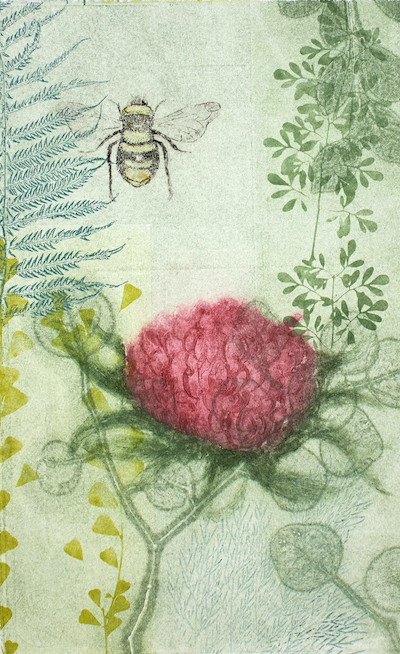
- Trudy Rice details her Australian flora and fauna art, teaching, and other current projects. (2:13)
- Taking original prints and paintings to a homewares line. (4:28)
- Quantifying the growth of a successful art business through a variety of income streams. (6:18)
- The primary systems and marketing channels Trudy uses for her sales. (8:25)
- Details about the Ampjar mailing system and the karmic aspect to shout outs. (11:37)
- The algorithms behind the Ampjar shout-out system. (13:57)
- How to systematically simplify the process of business promotion. (17:39)
- Promoting other artists while boosting yourself. (21:16)
- The variety of brands that Trudy promotes through Ampjar. (22:18)
- How to connect with new and international audiences through shout outs. (23:57)
- Tracking the success that has come with integrating new systems. (26:08)
- The importance of collaborating with other artists who have systems that work. (29:23)
- How to do the work once and benefit from it over and over again. (30:17)
- Trudy shares her project and collaboration plans for 2021. (33:35)
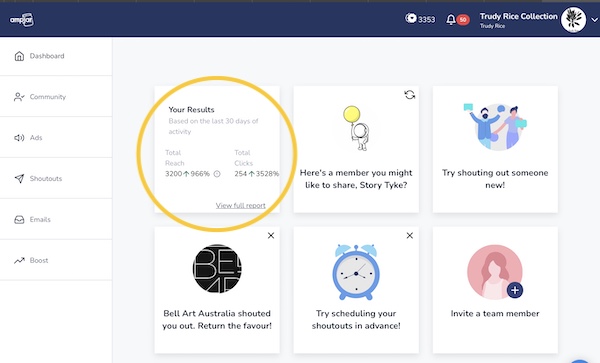
Mentioned
Ampjar karmic advertising community
Shopify e-commerce
Loomly social media content management
ConvertKit e-mail marketing
Related Episodes
Growing Your Art Business on Instagram with Jeanne Rosier Smith
Creating a Monthly Report for Your Art Business (measuring success)
Facebook Live Group Art Shows with Brooke Harker (collaborating)
Quotes
“What really drew me to this system was the karmic aspect of it.” —Trudy Rice
“I’m a community-minded person and I love supporting local brands.” —Trudy Rice
“Not only were you making connections, but you were getting results.” —Alyson Stanfield
“In that eight months I gained 1500 followers on Instagram, which is a lot more than I normally would.” —Trudy Rice
About My Guest
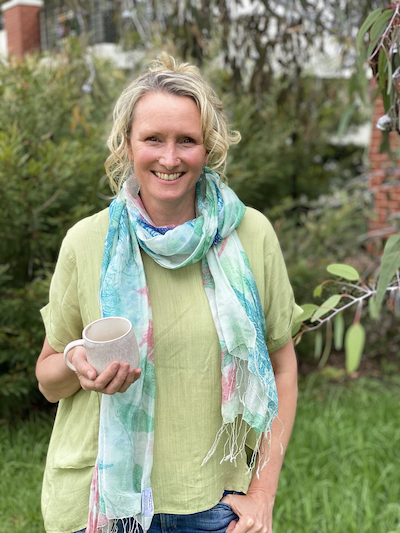
Trudy Rice is an Australian painter and printmaker whose inspiration is taken from the coastal landscape in and around Lorne on Victoria’s picturesque Great Ocean Road. She is passionate about her environment—working on paper using the non-toxic print method of solar plate etching. She also incorporates other printmaking techniques including linocut, collograph, monotype & etching.
Trudy has applied her images from nature to a line of popular homewares and wearable art that add delight to anyone’s table or wardrobe.
Follow Trudy on Instagram: @trudy_rice
Music by Wildermiss
The post The Art Biz ep. 77: Growing Your Audience with Good Karma with Trudy Rice appeared first on Art Biz Success.
]]>Your list starts with everyone you know, but I want you to do a few more things before you add names and addresses to an email marketing platform.
The post How to start your email list appeared first on Art Biz Success.
]]>Start with who you know
Make a list of everyone you know who might want to hear about you and your art:
- Friends
- Family
- Neighbors
- Colleagues at a day job
- Other artists

Don’t discount anyone because you believe they’ll never buy your art. You never know how they can support you until you bring them into your art life.
Save the following information for each person:
- First and last name
- Email address
- City, State/Province, Zip/Postal Code
- Country
- Phone number
Yes, we’re talking about email lists here. But as long as you’re collecting the first two pieces of information, you might as well record the rest.
You are not adding these people to a bulk email list. You are saving their names to invite them at a later date.

You don’t want to run afoul of anti-spam laws.
Get an account with an email marketing platform
Open an email account with a platform like MailChimp or Constant Contact. See this review of options.
You don’t have to anything with it yet. Just get an account. Remember: Baby steps.
You will use this to email your growing list, which you cannot do from a regular email account without triggering the suspicion of your Internet Service Provider.
Join other artists’ lists
Sign up for other artists’ email lists for ideas on what to do and what not to do.
When you sign up, pay close attention to the experience:
- Is the form easy to use?
- Is there a thank-you page that looks like it’s personally from the artist? Or does it appear to be cold and from the email company?
- Did you receive an immediate thank-you?
- What happens next?
- What’s the frequency of the emails?
You can model what you like and improve what you don’t like about the experience.
Map out your communication
These three things can happen in any order:
- Decide on the cadence of your email. I suggest once a month to create a habit.
When you invite people to your list, you want to tell them what they’ll be receiving and at what frequency.
2. Begin gathering ideas for six months of emails. In my Essentials program, I lead you through a process that includes 98 ideas for email, blog posts, and social media, along with an intention for every piece of content.
You can’t use the excuse that you don’t have anything to say when you keep a stash of content ideas handy.
3. Create an email template on the email service you have selected. This will be ready to go when you’re ready to send.

Finally
Ask those whose names you’ve collected if they would like to hear about your art on a regular basis via email. This can be done through personal emails or in conversation.
Plan to send an email within 1 week to anyone who asks to be on your list. This is when they are most interested in hearing from you, so you don’t want to blow the opportunity.
These people have trusted you with their email addresses. You should be full of gratitude in your opening missives to them.
Oh, and finally finally … Don’t make the mistake of waiting until you have more people on your list to begin sending email updates. Your list won’t grow until you start using it.
The post How to start your email list appeared first on Art Biz Success.
]]>As all of my students and clients know, I stress the importance of “doing the numbers” before it’s too late.
Doing your numbers means figuring out where the money is coming in, identifying the leaks, and seeing clearly the best return on your investment of time and resources.
For conducting this process, you are rewarded with clarity like you’ve never had before. What you see might not be the beacon of hope you were looking for, but at least you are armed with knowledge to make sound financial decisions.
When your numbers aren’t where you’d like them to be (a realization we’re all faced with at some point or another), consider options to increase your income quickly.
Focus on how to maximize your return with limited time and resources to invest. This means concentrating on larger sales. It’s not the time to create a new stream of income for a new audience.
The first step is to get extra clear on how much you need to earn and figure out what the path to that number looks like. Specifically: What is your monetary goal and what will it take to reach that goal?
How many students or clients do you need to enroll to equal your goal?
How many artworks do you need to sell in a particular size to equal your goal? And do you have enough inventory?
My first choice when looking for fast cash is to …
The post In a Cash Crunch? Try These Ideas to Bring in the Bucks appeared first on Art Biz Success.
]]>As all of my students and clients know, I stress the importance of “doing the numbers” before it’s too late.
Doing your numbers means figuring out where the money is coming in, identifying the leaks, and seeing clearly the best return on your investment of time and resources.

For conducting this process, you are rewarded with clarity like you’ve never had before.
What you see might not be the beacon of hope you were looking for, but at least you are armed with knowledge to make sound financial decisions.
When your numbers aren’t where you’d like them to be (a realization we’re all faced with at some point or another), consider options to increase your income quickly.
Focus on how to maximize your return with limited time and resources to invest. This means concentrating on larger sales. It’s not the time to create a new stream of income for a new audience.
The first step is to get extra clear on how much you need to earn and figure out what the path to that number looks like. Specifically: What is your monetary goal and what will it take to reach that goal?

How many students or clients do you need to enroll to equal your goal?
How many artworks do you need to sell in a particular size to equal your goal? And do you have enough inventory?
My first choice when looking for fast cash is to …
Focus on Your List
It’s 5-25 times more expensive to land new customers than it is to get sales from the ones you have now, so it makes sense to spend most of your effort on your current buyers, collectors, and students.
Plus, if you’ve been staying in touch with them all along, it’s easier to ask for something.
Begin by following up with anyone who has expressed interest in your art. Go through the names on your list one by one.
Make calls, send personal emails, and suggest items in your inventory that they might like.
If they are students, you have additional options.
Add Classes, Workshops, and Mentorships
If you’re already teaching (remember, this isn’t the time to create a new income stream), you might:
- Schedule an additional class that you weren’t planning on teaching.
- Create a higher-level class for current students who want to continue studying with you – as long as it takes minimal effort.
- Add a private consultation or critique to a class on the books (for an extra fee, of course).
- Open a mentorship program to your best students. Don’t undervalue your time!
- Offer private lessons. Private students should pay premium prices.
Follow up with venues where you might teach.
If you have been teaching for quite some time and have a good-sized list of students that you’re staying in touch with, you might:
- Package lessons into a video class.
- Bundle several classes together and offer a small discount for buying all three at once.
Loyal students will probably purchase anything you can cook up. They might even purchase your art, which brings me to …
Sell More Art
Again, focus on original art that is in the higher price range. Low-priced items will put less money into your account.

To sell more art, you can:
- Tweak your social media posts to lead to sales.
- Organize a pop-up exhibition. This can be in an empty storefront, in your studio, or in someone’s home.
You might even consider sale sales. You know, the kind where people think they’re getting a deal.
Some of these are extreme, but I’ll let you be the judge of what is right or wrong for you:
- Put together a sale of earlier work. Some artists refer to this as an “inventory reduction” sale.
- Offer pre-sales on work that has yet to be produced. These pieces would be discounted because purchasers are buying art sight unseen.
- Have a BOGO sale – buy one, get one free.
- Hold a 1-day only promotion using all of your social media channels and your email list.
- Holiday sale: your birthday, your cat’s birthday, the solstice, Chocolate Day (July 7), International Day of Friendship (July 30).
** Anytime you have a sale of your art, your VIPs (previous buyers, collectors, students, friends) are the first to be notified. They receive exclusive first access to what is available. **
Whatever you decide, making fast cash requires hustle and some sacrifice. I think you’ll be surprised by how quickly you can make up the discrepancy in your financial goal. Then you can spend the rest of the year building on your momentum.
The post In a Cash Crunch? Try These Ideas to Bring in the Bucks appeared first on Art Biz Success.
]]>I share this list with some hesitation. It’s intended as a checklist to work through, not to tackle at once.
Remember, our businesses and careers are works in progress.
Your Name
1. Decide on a single professional artist name and use it consistently for your art business - if you want to be remembered. I don’t care what it is and it doesn’t have to be the same name you sign to your art.
It’s critical that people can easily find you by your name and associate your name with your art.
Networking
2. Meet more people! The more people you know, the more opportunities you will create.
3. Show other people you care about them. Focus on building trust and relationships rather than selling to everyone who crosses your path. Along similar lines ...
4. Keep notes on people on their business cards and add to your database so you can personalize your relationships.
5. Send “It was nice to meet you” cards or emails after connecting with someone (unless it wasn’t nice to meet them and you don’t care if you ever see them again).
Branding & Image
6. Use the same font and colors for all of your marketing material. And please! Stay away from
The post 42 Ways to Improve Marketing Results appeared first on Art Biz Success.
]]>
I share this list with some hesitation. It’s intended as a checklist to work through, not to tackle at once.
Remember, our businesses and careers are works in progress.
Your Name
1. Decide on a single professional artist name and use it consistently for your art business – if you want to be remembered. I don’t care what it is and it doesn’t have to be the same name you sign to your art.
It’s critical that people can easily find you by your name and associate your name with your art.
Networking
2. Meet more people! The more people you know, the more opportunities you will create.
3. Show other people you care about them. Focus on building trust and relationships rather than selling to everyone who crosses your path. Along similar lines …
4. Keep notes on people on their business cards and add to your database so you can personalize your relationships.
5. Send “It was nice to meet you” cards or emails after connecting with someone (unless it wasn’t nice to meet them and you don’t care if you ever see them again).
Branding & Image
6. Use the same font and colors for all of your marketing material. And please! Stay away from Comic Sans and Papyrus fonts.
7. Keep the focus on your art. Pare down the design and strip out the bright colors. All eyes should be on your art.
8. Market to your best prospects. The World is not your target market, so define your audience as narrowly as possible.
9. If you’re confused about your art, you’ll confuse people with your marketing. Make your brand as cohesive as possible, which means you had better know what your art is about.
Your Mailing List
10. Your mailing list has the potential to be your most valuable asset, so use it! Use it regularly. Your list is no good if you’re not using it.
11. Don’t rely on your current list. Keep adding names (re-read #1 above).
12. Send personal correspondence from time to time rather than relying on email blasts to everyone. People respond better when they know you care about them as individuals.
Address people by name in your correspondence and sign your name.
13. Use 1 business email address and phone number. It’s very confusing when you use multiple email addresses.
Bulk Email
14. Use an email delivery system like MailChimp or Vertical Response. Do not send bulk email from your regular email program. Hundreds of messages will look like spam to your Internet Service Provider.

15. Vary your subject lines. All emails look the same when you use the same words every time you send an email.
16. If you have something very important to share, such as an invitation to an event or a sale announcement, don’t bury it in a newsletter with multiple articles. Send a separate email that serves only one purpose: to encourage action.
17. Send email recipients to the specific page on your site that you want them to see rather than the home page. The home page is likely the most boring page on your site.
18. Never apologize for not sending a newsletter. No one noticed. (Sorry.)
Blogging
19. Never apologize for not posting to your blog. No one noticed. (Sorry.)
20. Add at least one image of your art with every blog post, unless, of course, you aren’t interested in people seeing it.
21. Don’t delay posting because you aim for perfection. Imperfect posts are far better than no posts at all. Besides, there’s no such thing as perfection.
It’s a process and a commitment. You didn’t hop out of the womb knowing how to make the art you do now, so why would you expect to write the perfect blog post out of the starting gate?
Website
22. Make sure your name is at the top of every page on your website.
23. Write a compelling story for your About page. Very few people will look at your résumé.
24. Double check to see that all of your images include a complete credit line. This means ©Your Name, Title of Artwork, media, and dimensions.

25. Add your artwork to every page of your site. The Web is more image-based than ever and you, a visual artist, are in a prime position to capitalize on that. Use all of those pages to show off your art.
26. Vary the images on your site. Show your art in process, in situ, and in exhibition installations. Include photos of you in your studio and with collectors.
27. Embrace video and post a trailer for your art on your site. Putting a voice and face to your art can help you sell more work.
Social Media
28. Use an image of your art for your Facebook business page, and then comment on other business pages as your page (not your personal profile). Others will see your art and be encouraged to visit and like your public page.
29. Use a desktop platform like HootSuite, Later (Instagram), or Flume (Instagram) to organize and post-date your social media updates.
30. Respond to everything! Don’t just click on Like.
31. There are legitimate reasons for tagging people, but don’t spam people by simply tagging them in order to get them to see your link. This is lazy, annoying self-promotion.
32. Say nice things about people and encourage others.
33. Be proactive and follow people. Don’t wait for them to follow you!
Plan
34. If you have a big event or exhibition coming up, make a promotional plan for peace of mind. A plan consists of clearly defined tasks with deadlines.
35. Commit to a marketing mix that includes social media, email, and regular mail. This is a powerful cocktail that will cover more ground than relying on a single platform.
36. Plan something big that challenges you. Big projects get noticed and move the dial in your favor. You don’t have to know how you’re going to make it happen, you only have to begin. You’ll never get anywhere without taking risks and moving beyond your comfort zone.
37. Track your results so that you can plan better next time.
Finally
38. Build your confidence by continually moving forward with increasingly challenging projects. We like to buy art from artists who know what they’re doing and where they’re going.
39. Send out only positive energy. Don’t complain, whine, or criticize in public or on social media. People are less likely to buy from you if you exhibit these negative qualities, which are signs of weakness.

40. Accept 100% responsibility for your successes and failures. This will empower you like nothing else. When you blame others, you are relinquishing control.
41. Give people the tools they need so they can help you promote your art. You probably have an army of people willing to help you. Tell them how!
42. Under promise and over deliver in every aspect of your business. People are unhappy when you don’t do what you said, but are delighted when you exceed their expectations.
Your Turn
Remember that you are a work in progress. Improve one aspect of your business at a time and do it well before moving on to your next area of focus.
What’s your first item to improve? Please tell us in a comment below.
The post 42 Ways to Improve Marketing Results appeared first on Art Biz Success.
]]>The post Conquering Newsletter Anxiety appeared first on Art Biz Success.
]]>They imagine a monthly newsletter with regular columns, special features, and a calendar of upcoming events. It starts out good enough, but then something goes wrong for some artists.
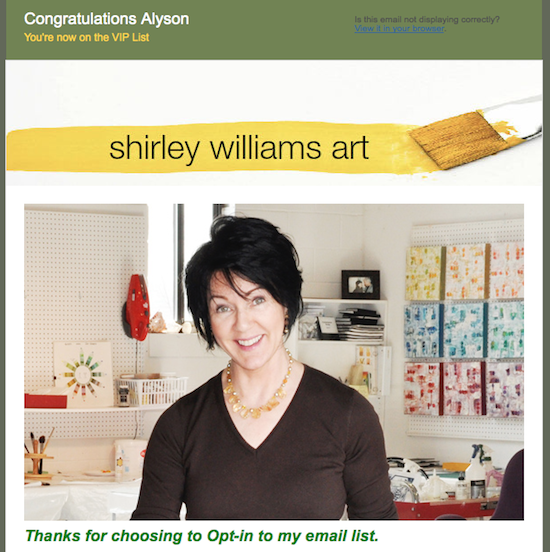
It goes a little like this . . .
One newsletter goes out and contains every possible bit of information the artist can come up with. When it’s time for the next issue, the artist has nothing new to share. She gave all she had in the last issue.
She decides: It’s cool to skip an issue or two. So she waits for something to happen.
Finally! She has news! She starts piecing together a fresh issue. Then she realizes all of the other things that have been going on, which she previously thought were unworthy of the newsletter. Now she wants to cram them all (again) into a single edition.
It’s a vicious cycle of lack and plenty. If you’re affected by this, there might be a way out.
Stop Calling It a Newsletter
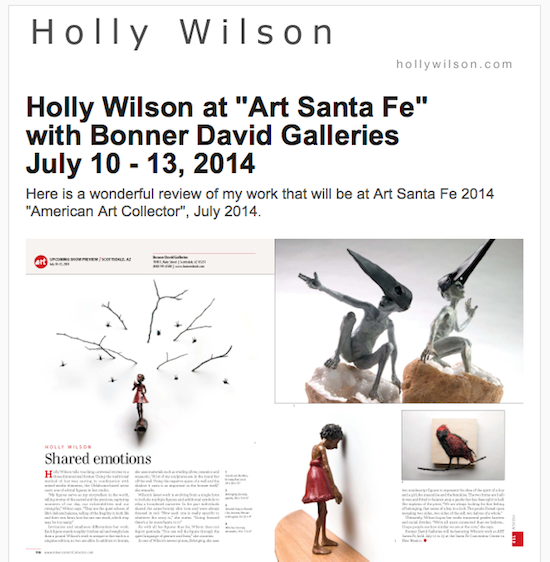
I have begun to recommend to many artists that they stop thinking about their emails as newsletters.
Just the word “newsletter” brings up all kinds of anxieties, including the demands of a deadline and actually having news – something to say. Never mind the pressure of competing with everything else in recipients’ inboxes.
Once you say, “I’m going to send a newsletter,” the burden begins because language matters. Once you name something, your mind fixates on what you believe that thing to be.
Try this: Fixate on the recipients – the people who know and love you. Why are you emailing them? Why should they read it?
Do the people on your list really need an email with three regular columns and an accounting of all your events for the next three months? Or would it be better to send a less substantial email more frequently?
I vote for the latter.
An Alternative
An alternative to sending an email newsletter is to send a simple, regular update.
Include at least one, but perhaps more, images of your art, along with detailed credit lines and the prices if they’re for sale.
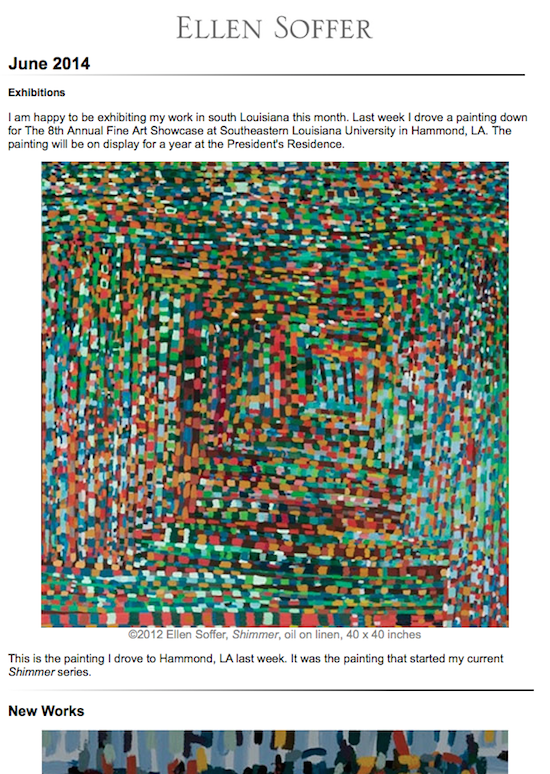
Ellen Soffer does this beautifully. She shares several large images of her paintings with maybe 4 or 5 sentences. The subject line of her emails is the title of one or more of the pieces. Easy!
Ellen calls it a newsletter, which is fine. She found a format that works for her.
Call it a newsletter, call it an update, or call it whatever you like. It’s an email to keep your list warm. It won’t do its job until you write it and send it, so you might as well do it in a way that you enjoy.
If you find yourself anxious about keeping up the newsletter you promised your list, reframe it. Don’t let language get in the way.
The post Conquering Newsletter Anxiety appeared first on Art Biz Success.
]]>The post In the Zone of Discomfort appeared first on Art Biz Success.
]]>They are asked to 1) meet everyone in the room before the end of the event; 2) share workshop exercises with people they don’t know; and 3) change seats so they sit next to someone new.
I do this because dealing with discomfort is necessary for growth as an artist and as a businessperson.

Some of the ways artists stay in their comfort zones:
- Entering the same exhibitions year after year
- Maintaining membership in a group whose members are not growing
- Sticking close to a friend at art openings rather than meeting new people
- Writing a newsletter that looks like every other artists’ newsletter
- Using an artist statement from five years ago
- Promoting their art the same way year after year without seeing results
- Having a website that hasn’t changed in three years
If any of these sound familiar, I challenge you to get uncomfortable with your art, with your marketing, and with your life.
Challenge Yourself
Take the statement that rings true and, if you think it would help with your progress, turn it on its head.
Enter a different exhibition or stop entering juried exhibitions altogether. Attend an art opening with the sole purpose of meeting three new people. Scratch the newsletter you’ve been clinging to and build a new, more interesting one from the ground up.
You don’t want to stay uncomfortable for long, but you do want to stay there long enough to stretch your potential.
In the Zone of Discomfort, you seek new ideas, knowledge, and clarity. You want to test what is possible. You want to innovate.
Ask These Questions
If you’re still not convinced that you’re ready for the challenge, ask yourself a few favorite questions that I use in these situations:
What’s the worst that can happen if I put myself in this uncomfortable situation? If this does happen, can I live with it?
What’s the absolute best thing that can happen if I put myself in this uncomfortable situation?
If the best scenario could happen right now, why would I postpone the results?
The post In the Zone of Discomfort appeared first on Art Biz Success.
]]>The post Implementing Is Worlds Beyond Knowing appeared first on Art Biz Success.
]]>
Alarms should go off whenever they find themselves thinking “Yeah, I already know that.”
These are dangerous words because they are often used in place of action.
“I know that,” when referring to ideas for improving your business, is completely different from “I am doing that.”
Self Check
Did you just hear about it in a class?
Did you read about it in a book?
Are you embracing it as a good idea?
Or are you actually implementing the concept?
The post Implementing Is Worlds Beyond Knowing appeared first on Art Biz Success.
]]>