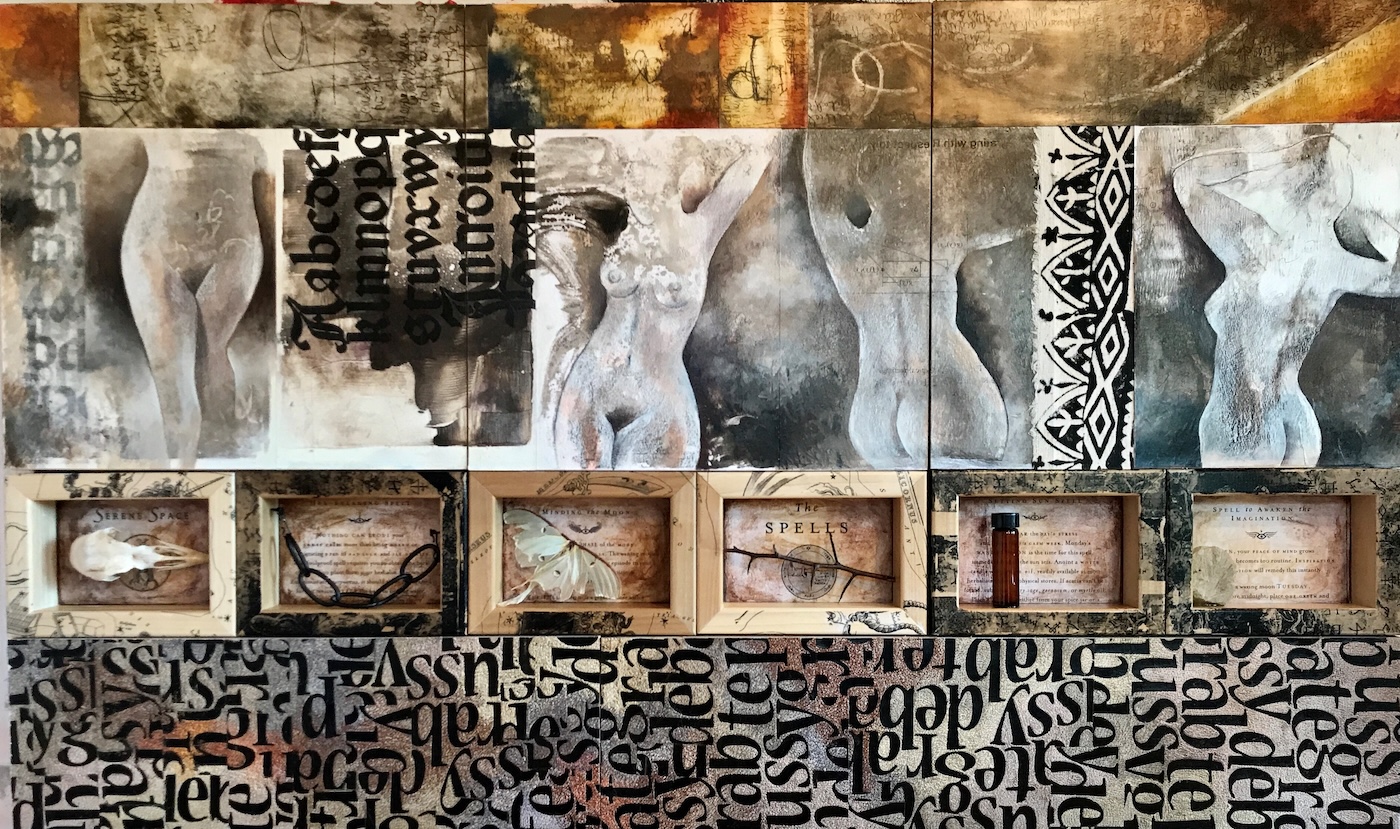
Discover why titling matters, what it can teach you about your work, and how to approach it with intention and care. A thoughtful conversation every artist should hear.
The post The Awesome Responsibility of Titling Your Art with Fran Gardner (229) appeared first on Art Biz Success.
]]>
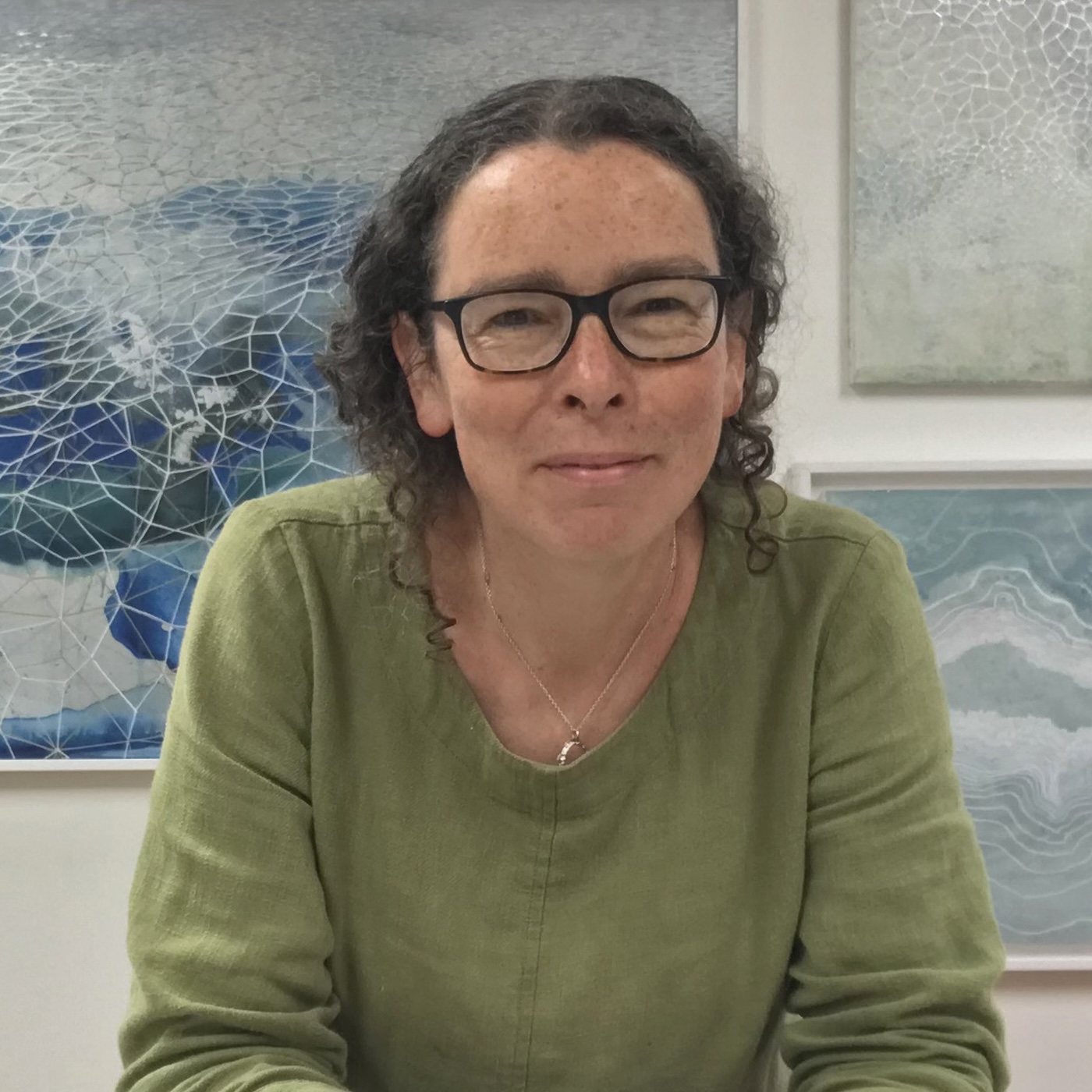
The post The Awesome Responsibility of Titling Your Art with Fran Gardner (229) appeared first on Art Biz Success.
]]>The post How to Write an Art Review appeared first on Art Biz Success.
]]>Today I want to give you tips on how to write about other artists’ exhibits.
Let’s start with the facts.
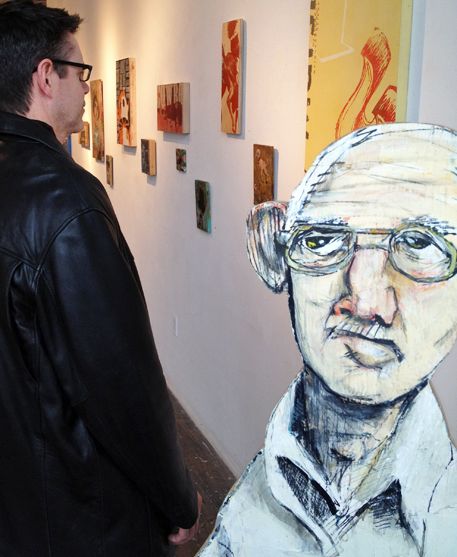
Find the Facts
Gather as much information as possible about the exhibit you’ll see before visiting. Look for answers to the following on websites, in press releases, and on social media.
Who? Who is in the exhibit? Who organized the exhibit? Who is the curator?
What? What is the exhibit about (its curatorial thesis or purpose)? What is included in the exhibit? What is the entrance fee? What do you know about the artists and artwork you’ll be seeing?
Where? Where is the venue, including the street address? Where can you park?
When? When does the exhibit open? When does it close? When is the best time to see it?
Why? Why this exhibit? Why now? Why should your readers care?
How? How can you get a complimentary pass? How can you secure images to use in your article? How can you get in touch with the curator or artists?
Armed with the facts, you can begin planning your visit.
Plan Your Visit
Call or email the venue to make sure they’ll be open and find out when the best time to come would be. If the person answering the phone doesn’t seem to know much and it’s a museum, ask to speak to the education office, curator, or public relations officer.
Some smaller galleries seem to close on a whim. I was recently at a gallery that was partially closed because of video taping. Likewise, you don’t want to look at the work when school tours or sketching sessions are going on in the galleries. You want the space mostly to yourself. You want quiet.
Plan on spending at least an hour in the galleries.
Venues with entrance fees will give legitimate publication journalists a complimentary pass, but you must be established and prove you have a significant following. Contact their press or media office.
Bring a pen, notepad, and voice recorder—depending on how you work best.
I used to travel up to an hour to review an exhibit. It was nice to have the recorder to help me process my ideas on the ride home.
Get the Lay of the Land
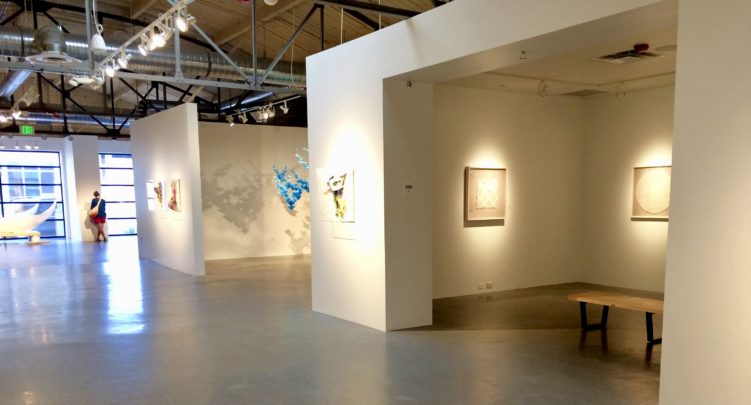
When you first enter the space, make a cursory walk-through to look at the big picture.
How is it installed? Is it chronological? By artist? By subject? By media?
What’s good about the installation? What strikes you as “off”?
Everything is fair game. You might consider:
- Label size
- Font selection
- Explanatory text
- Wall color
- Floor color or pattern (yes! even that)
- Spacing between the art
- Sight lines
- Juxtapositions of individual artworks
How has the curator made sense of the large grouping? Use this information to give your reader a sense of being there.
Select Feature Pieces
What work stands out as worthy of your attention? Select 3 or 4 pieces (depending on the space you have) and spend most of your time with them. Sit your butt down in front of each one for long periods of time. Ask for a stool or chair if you need one.
Write down every detail so you can describe it for your reader.
Don’t run through an exhibit with your camera and go home to write. Your digital images can neither replace the experience you have with the art itself nor can it replicate the relationship of the works to one another.
Why do you like them? What makes them strong? How do they relate to one another and the exhibit as a whole?
I write almost exclusively about work that I like because (1) I’d rather spend more time with work that I like and (2) I enjoy the challenge of persuading readers to my line of thinking. Also, in all honesty, I don’t want to hurt anyone’s feelings. I don’t write to be critical, but to point out strengths.
Take Photos
Get permission to take photos of groupings of art to help you remember the installation.
For illustrating your article, sculpture or other three-dimensional objects, like benches, add a lot to an installation image. If there is no sculpture, single artworks might be the best choice to use with your article. Use your artist eye to frame an image that will attract more eyeballs.
Ask the venue if they have press images they prefer be used in your feature. Take photos of any labels for artwork you want to properly credit.
Ask the venue for preferred credit lines to go along with the images. Make sure all names are spelled correctly. Double and triple check the facts for accuracy.
Select 1 Thing to Criticize
If you like everything, your readers will get suspicious. More importantly, you need to use these opportunities to hone your eye. To be more discerning. But you don\’t have to be as critical as you might think.
I have been known to harp about lighting, display cases, installation, traffic flow, label text, and label styling. I’ve also knocked the way a show was organized (e.g. the juror was anonymous).
You might find fault with an artist’s technique, matting (boy, don’t get me started on poor matting!), framing, artistic choices and clichés, or craftsmanship. It makes more sense to criticize installation and curatorial choices in a group show and an artist’s individual choices in a solo exhibit.
Pull Your Article Together
Go home and put your thoughts together while they\’re still fresh. You’ll forget your brilliant ideas if you wait until tomorrow. Write What Anne Lamott calls the shitty first draft immediately.
Sit on your draft for 24 hours and then look at it with new eyes. Revise it in 2 or 3 sessions until your deadline approaches. If you’re working without a deadline, make one up.
Edit your review for spelling, grammar, redundancy, and anything that might put the reader to sleep. Be open to suggested changes from an editor. The only way to become a better writer is to get this kind of feedback.
This post was first published on May 2, 2012 and has been expanded and updated with original comments intact.
The post How to Write an Art Review appeared first on Art Biz Success.
]]>The illustrations that often punctuate artists' journals are a bonus that can't be found in the journals of those less visual.
But don't keep a journal to satisfy my whims. Keep one for yourself. Write things down in order to remember and reflect. And keep writing because it contributes to your art marketing.
The post Imperfect journaling for artists with Cynthia Morris (51) appeared first on Art Biz Success.
]]>Peeking at artists’ journals is my definition of heaven. I love to see how ideas develop and change—how creative thought processes evolve.
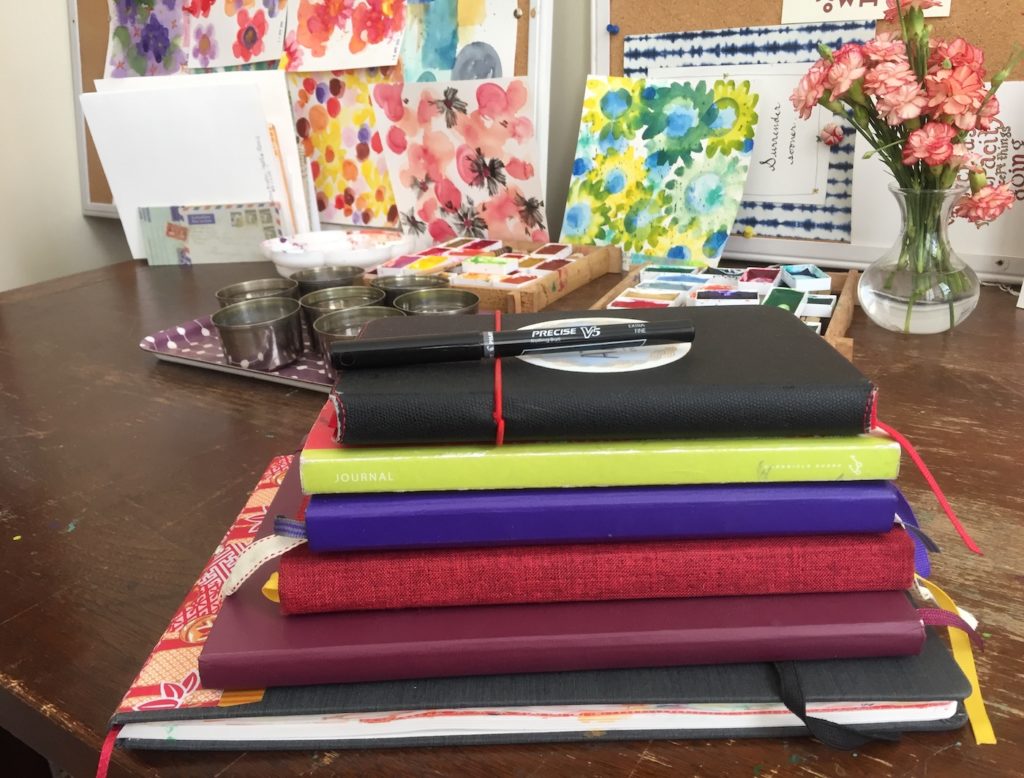
The illustrations that often punctuate artists’ journals are a bonus that can’t be found in the journals of those less visual.
But don’t keep a journal to satisfy my whims. Keep one for yourself. Write things down in order to remember and reflect. And keep writing because it contributes to your art marketing. It builds your confidence so that you have no problem introducing yourself as an artist.
I mentioned journaling last week as a vital part of writing your artist statement. In this latest episode of the podcast, I talk with author/coach/artist Cynthia Morris about journaling. It was recorded over Facebook Live.
Cynthia and I give you a framework to help you commit to a journaling practice and discuss how we use journals for our businesses.
We discuss the types of journals we think are best for this process, why it’s important to write by hand before moving to the computer, a structure for your journaling process, and how to use prompts to get your ideas down.
Remember that we recorded this as a video conversation with one another. Some things might not translate. For example, we did show and tell about our journals. That’s why I’m sharing the video here as well.
Here it is … my conversation with Cynthia Morris about an imperfect journaling practice for artists.
Music by Wildermiss.
Highlights
4:45 How I met Cynthia 15 years ago.
6:15 Why it’s not a good idea to write important documents under pressure.
8:00 Writing is about having a relationship with yourself and making sense of your world.
8:51 Brainstorm 50 ideas instead of 10.
9:39 How I rebooted my journaling practice.
11:15 “The answers are in your ink.”
11:50 Why we call it, and why it must be, an imperfect practice.
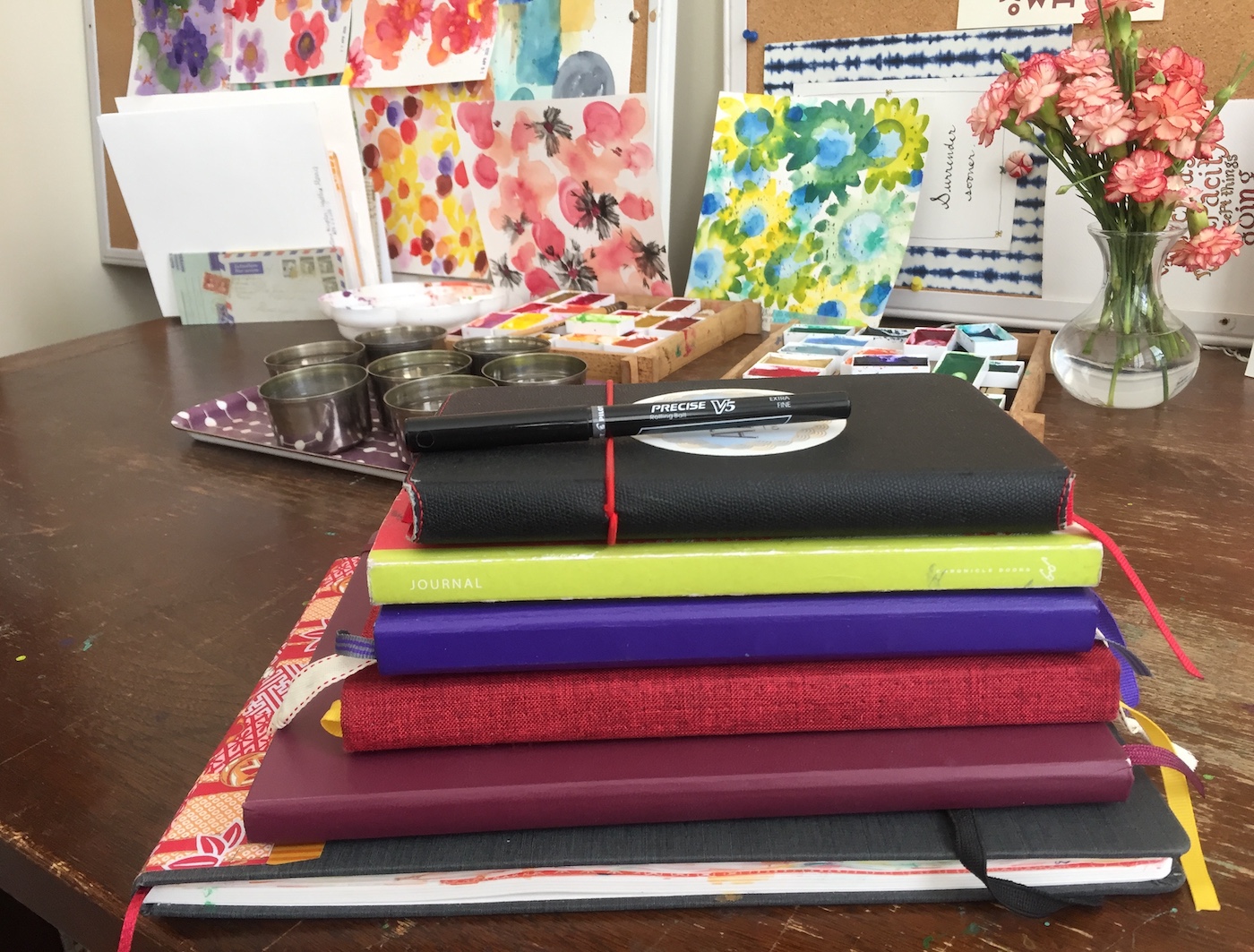
14:02 The specific journals we prefer and why.
17:09 Your journal has to fit into your life.
17:40 The notebook from artist Mary Martin that I use for a very special purpose.
18:00 How I use a notebook with magnetic pages.
19:31 The various notebooks Cynthia keeps at all times.
20:35 Why we refer to precious or leather-covered journals as dust collectors.
23:17 The difference between writing by hand and typing on the computer.
25:45 Using “free writing” and writing prompts to collect words.
29:08 Get daily prompts and write for 3 months in Cynthia’s Devoted Writer course.
30:00 How my Magnetic You program complements Cynthia’s Devoted Writer course.
34:09 A writing prompt for you to start with.
37:10 I dreamed I had a Chihuahua.
38:35 You have our permission to be imperfectly messy with your practice.
Mentioned
The Artist’s Way by Julia Cameron
Writing Down the Bones by Natalie Goldberg
Journals mentioned and that we like:
- Moleskine: Classic Notebook that Cynthia uses for business and the Cahier Journal
- Leuchtturm1917 Medium A5 Dotted Hardcover Notebook
- Sea Flowers Eco-Journal by Jill Bliss
- Go-To Notebook with Mohawk Paper, Mulberry Wine Dotted
- Rekonect Magnetic Notebook
About Cynthia Morris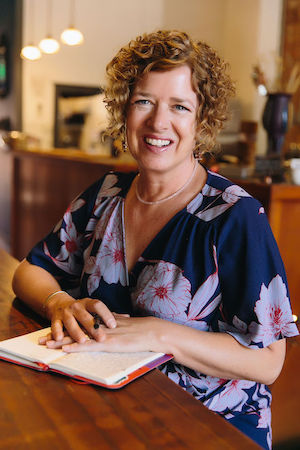
Cynthia Morris helps writers, artists and entrepreneurs make their big dreams a powerful reality. Cynthia is a certified coach, teacher, author and artist. In 1999, she founded Original Impulse, a boutique coaching company that empowers creative people to focus, follow through and finish projects that matter.
The author of The Busy Woman’s Guide to Writing a World-Changing Book, Cynthia has published seven e-books on writing and creative travel as well as the Paris historical novel, Chasing Sylvia Beach. She is a watercolor artist and visual journal keeper who uses art as a way to express joy and consistently access inspiration.
Music by Wildermiss
The post Imperfect journaling for artists with Cynthia Morris (51) appeared first on Art Biz Success.
]]>The post Guidelines for Your Artist Statement (50) appeared first on Art Biz Success.
]]>In this episode I want to talk about a document you can revisit (or perhaps face for the first time) that gives you power (control) over how your art is perceived.
Yes, I’m talking about your artist statement.
[ A thorough treatment of this topic is in episode 221: Comprehensive guide for writing an effective artist statement ]
Don’t be scared! This is important. And if you don’t want to listen, you can read every word at YourArtistStatement.com.
This pandemic has caused so many people to be introspective. If you’re one of them, you might want to put this time to good use and work on your statement, regardless of whether you’re updating it, rewriting it, or facing it for the first time.
There’s no way around it if you want to show your art at a high level. When you want to become part of the critical discourse—to have others consider your work for venues, grants, residencies, and articles—you can’t neglect writing your artist statement.
Listen Now
Music by Wildermiss.
Highlights
- My definition of an artist statement (3:00)
- Why you need a statement (3:40)
- Collecting words that contribute to your artist statement (6:40)
- Journaling prompts for your statement (8:00)
- Guidelines for artist statements and what tense to use (11:30)
- The ultimate test for a successful artist statement (15:00)
- How to write your first draft (16:55)
- What to look for (and delete) in the editing process (17:50)
- How and where to use your statement (22:10)
- What to do when instructions don’t match what you’ve heard here (24:44)
Mentioned
- Anne Lamott’s shitty first draft
- Artist statement makeovers (2 videos in this post)
- A good example of an artist statement by Linda Hugues (in this post)
Music by Wildermiss.
The post Guidelines for Your Artist Statement (50) appeared first on Art Biz Success.
]]>Cathy wrote pages and pages about a new body of work. Then she got an idea from another lesson to leverage all of that writing she had done. She put it to work and turned her written stories into audio for an exhibition.
The post Turning journaling into audio for your art show with Cathy Read (43) appeared first on Art Biz Success.
]]>In the spring of 2018, Cathy Read took my Magnetic You course. This class isn’t for the faint of heart because it involves a lot of writing. And, if you’re like most of my clients, you really would prefer to get by without more writing.
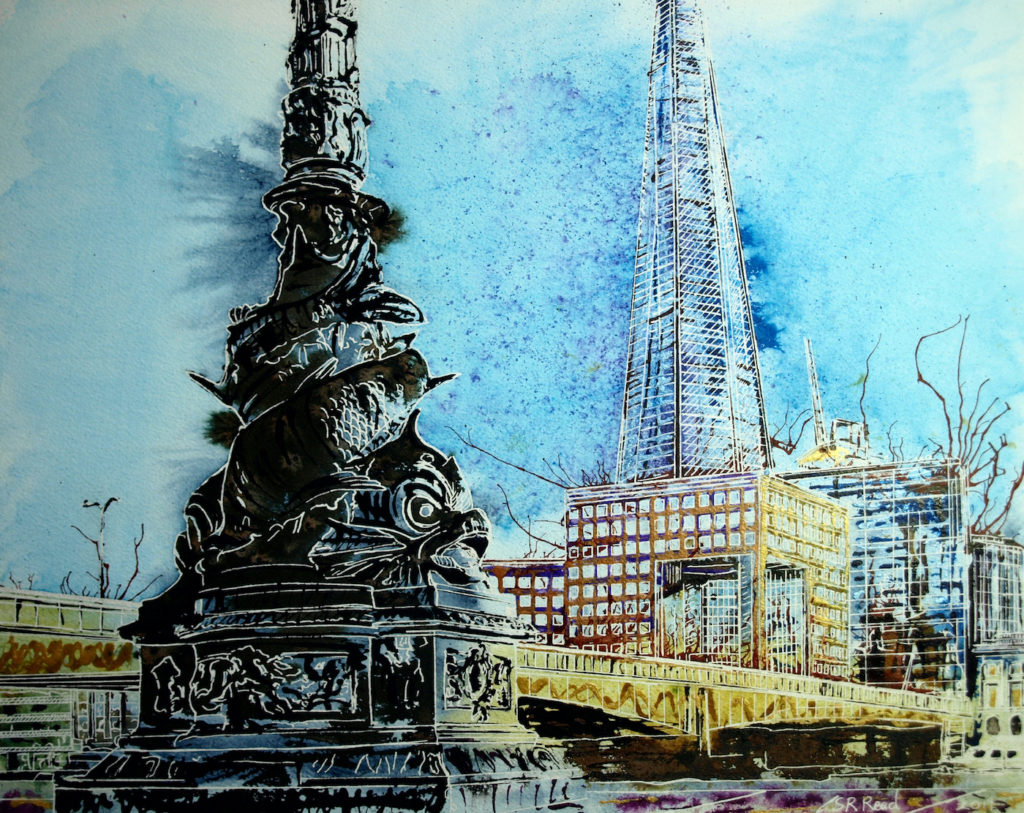
We work on your artist statement, bio, about page, stories about your art, and your branding. All of your hard work leads to a cohesive presentation that makes you more attractive to buyers, curators, and collectors.
One of the most important lessons in Magnetic You involves meditating on your art. You read that right. Meditating on your art. I insist that art speaks when you give it the time and space to tell you its story. Then you have to capture that story in a journaling process.
Cathy wrote pages and pages about a new body of work. Then she got an idea from another lesson to leverage all of that writing she had done.
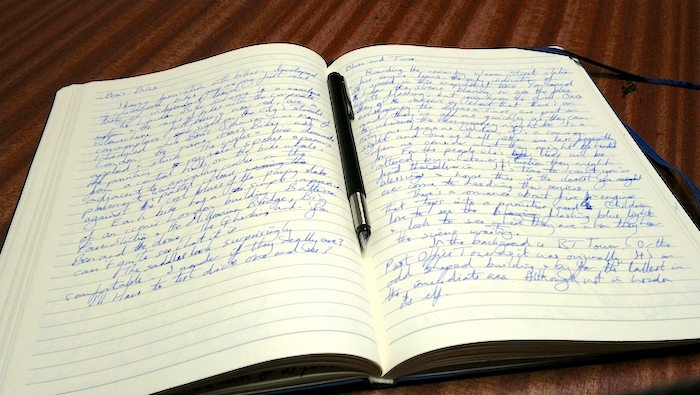
The writing didn’t just stay in a notebook or in a file somewhere in the dark depths of her computer. Nooooo. She put it to work and turned her written stories into audio for an exhibition.
The leap Cathy took from written word to audio involves a different way of thinking. It’s much like how museums consider programming their shows. They don’t simply put up the art along with nearby labels. They have docents who lead tours, scholars who give presentations, activities to expand on a theme, and audio for telling stories.
Why shouldn’t artists do the same when they have their own solo shows?
I asked Cathy all about the process and experience in this episode of the podcast.
Music by Wildermiss.
Highlights
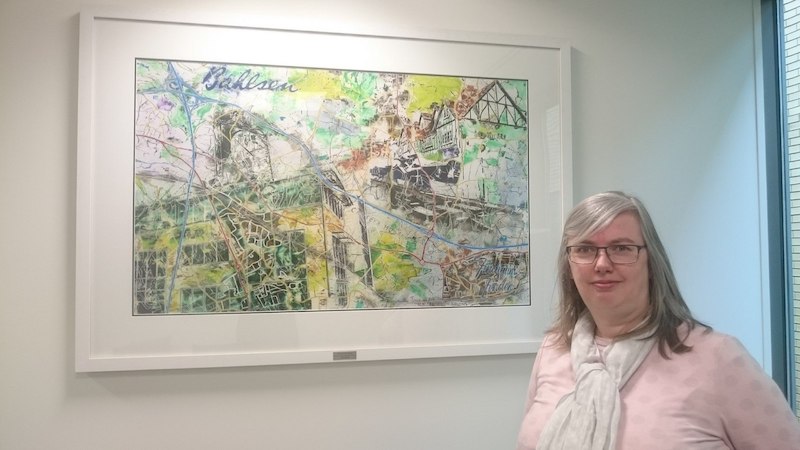
- Cathy’s career path starting with caricatures and developing into architectural painting with abstract elements. (2:40)
- How Cathy developed the interest in architecture which informs her work. (4:22)
- Her experience with the meditation exercises she learned in the Magnetic You class. (7:10)
- The decision Cathy made to dictate her meditations. (9:20)
- The detailed process she underwent of writing then speaking the words that helped her clarify her message about the work and why she feels it makes her descriptions more interesting. (11:55)
- How Cathy got the idea to include the audio in her solo exhibition using lessons from Magnetic You on how to engage your audience. (14:35)
- The process of recording the audio and how she perfected it. (15:40)
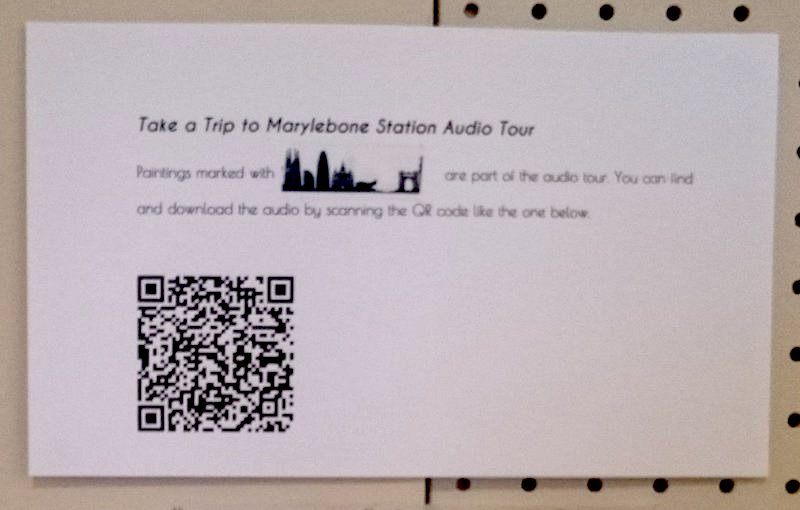
Label explaining how to use the QR codes within Cathy’s exhibition. - How she made the audio available at her exhibition using a QR code, and other ways she leveraged the recordings on her blog. (19:00)
- Visitor experience with the audio recordings and hiccups they encountered. (23:20)
- Why Cathy thinks its valuable for viewers to hear her voice. (24:50)
- What she learned and what she will do differently next time. (26:25)
- My suggestion for Cathy to encourage more engagement with the audio from visitors. (28:30)
- How Cathy plans to continue her meditation process for upcoming shows. (30:40)
- The full list of what she’s working on now. (32:00)
Mentioned
How to make a QR Code
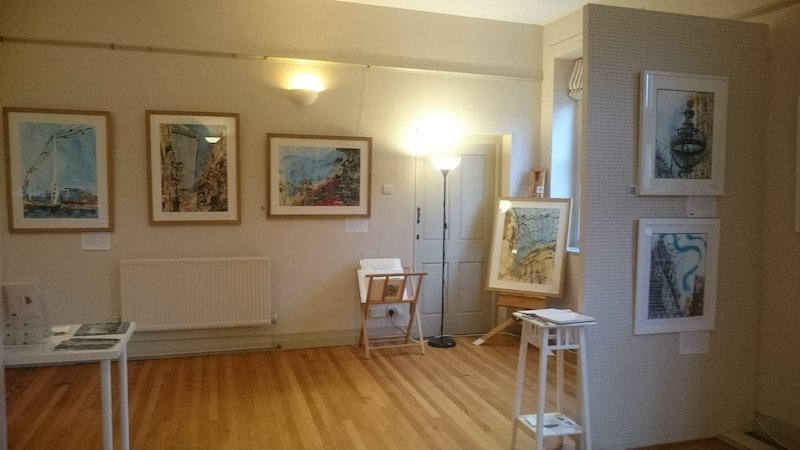
The Stables in The Courtyard at Claydon Estate, exhibition venue
Google Keep
About Cathy Read
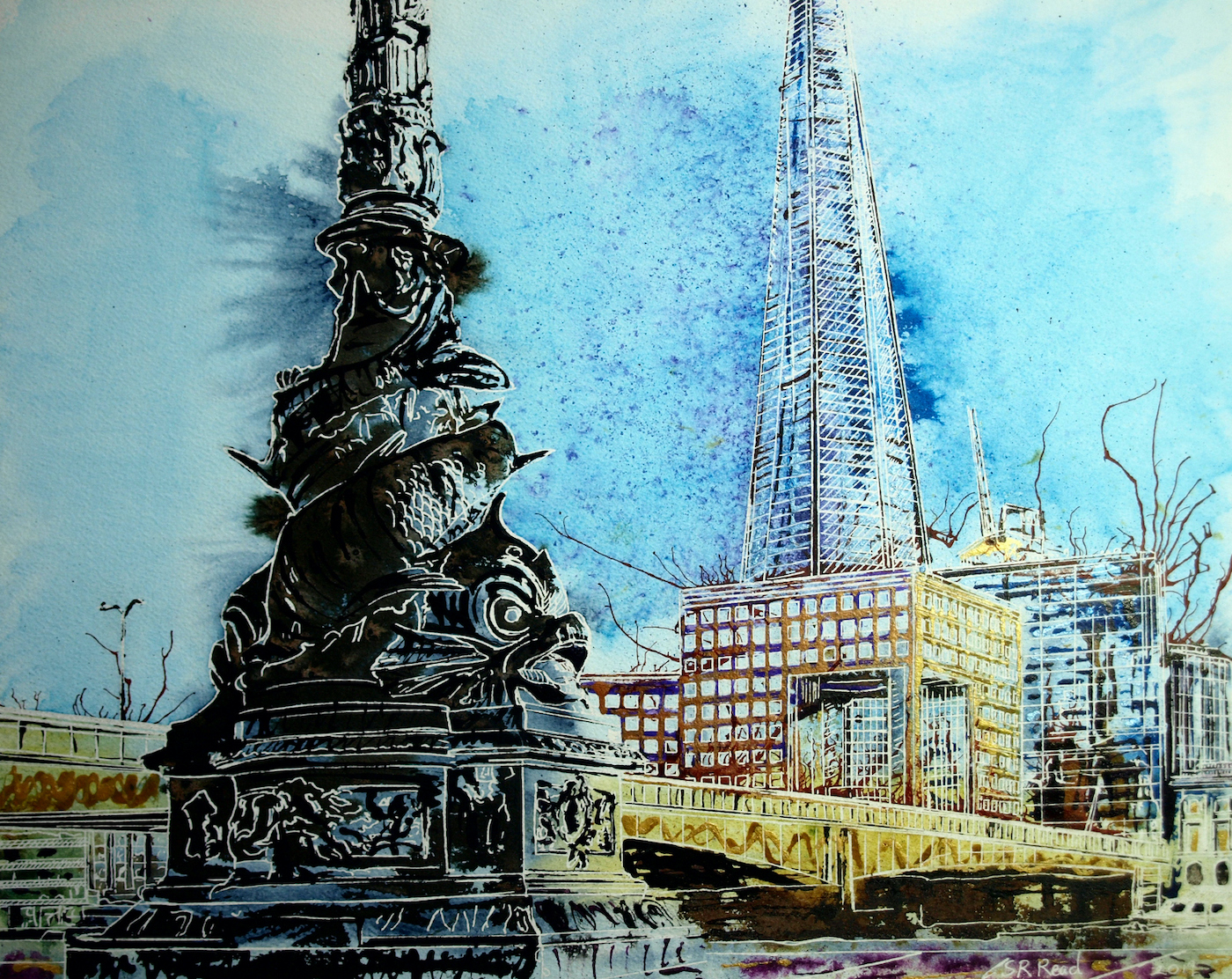
Cathy Read re-imagines iconic architecture using explosive, colorful drops and trails of paint, held together with a structure of white lines. Inspired by looming and dramatic architecture, she draws on influences from various nearby cities.
She lives near Buckingham, England, and is a member of the Society of Women Artists, receiving their Barbara Tate Memorial Award in 2015. Cathy has also shown with the Royal Watercolour Society and the Royal Institute of Painters in Watercolour in London.
Cathy appeared as a contestant on Sky Arts Landscape Artist of the Year in 2016, returning as a wildcard in 2017. The same year, she was shortlisted for Artist and Illustrators Artist of the Year and received the Wild and Tame award.
Her work can be found in collections in the Canada, Africa, New Zealand, and the U.K., including the Ashmolean Museum in Oxford.
Follow Cathy on Instagram @CathyReadArt.
Music by Wildermiss.
The post Turning journaling into audio for your art show with Cathy Read (43) appeared first on Art Biz Success.
]]>You can’t go wrong unless you have a bunch of type-os, use poor grammar, or don't align your tenses.
Here are some guidelines for which tenses to use and when when you're writing your artist statement and bio.
Your Artist Bio
Your bio is about you and your artistic accomplishments. It is not your life story.
It is written in the third person (otherwise, it would be an autobiography). It helps to think of it as your résumé in paragraph form.
Write it in reverse chronological order, acknowledging that your most important accomplishments are those that are most recent. You can open a bio with a short paragraph summarizing your current work. This can be taken from your statement and reworked for the bio format.
Your Artist Statement
In contrast to your bio, which is about your accomplishments, your statement is about your work—the current direction of your work, not the history of how you got to this point. It’s your opportunity to define a body of work before others respond to the work and define it for you.
Your statement—because it is a statement—is written in first person. It is not the definitive statement about your work forever and ever because your work changes. You must allow your statement to get better and to grow along with your art.
My litmus test for a good statement is
The post Is Your Artist Statement Written in First or Third Person? appeared first on Art Biz Success.
]]>There is no overseer of the perfect artist statement and bio that is going to come get you for not adhering to rules that never existed. Breathe a sigh of relief.
You can’t go wrong unless you have a bunch of typos, use poor grammar, or don’t align your tenses.
[The Successful Artist’s Guide to Writing Your Artist Statement]
Here are some guidelines for which tenses to use when you’re writing your artist statement and bio.
Your Artist Bio
Your bio is about you and your artistic accomplishments. It is not your life story.
It is written in the third person (otherwise, it would be an autobiography). It helps to think of it as your résumé in paragraph form.
Write it in reverse chronological order, acknowledging that your most important accomplishments are those that are most recent. You can open a bio with a short paragraph summarizing your current work. This can be taken from your statement and reworked for the bio format.
Your Artist Statement
In contrast to your bio, which is about your accomplishments, your statement is about your work—the current direction of your work, not the history of how you got to this point. It’s your opportunity to define a body of work before others respond to the work and define it for you.
Your statement—because it is a statement—is written in first person. It is not the definitive statement about your work forever and ever because your work changes. You must allow your statement to get better and to grow along with your art.
My litmus test for a good statement is that it makes me want to quit reading and look at the artist’s work again. Otherwise, it’s just a bunch of words.
Exception for Websites
I believe, however, that there is an exception to the “bio in the 3rd person” rule. And that’s when the information is on your website.
It’s perfectly okay to combine your statement with your bio on an About the Artist page and write everything in 3rd person. If you separate them, don’t call your statement a statement because a statement should be in 1st person. Statements come from an individual’s lips, pens, or fingertips.
It’s also perfectly okay to do the same and write everything in 1st person. In fact I kind of prefer that About pages for artists are written in 1st person because, let’s face it, everyone knows you wrote it anyway. It’s weird to talk about yourself in 3rd person. I’m kind of a stickler (or try to learn and get better) about correct grammar.
I prefer that a bio in 1st person is called About Me. As I said, though, no one is going to lock you up for breaking my guidelines. Praise the lord!
This article was first published on October 9, 2007. It has been updated with original comments left intact.
The post Is Your Artist Statement Written in First or Third Person? appeared first on Art Biz Success.
]]>I'm at the San Francisco Museum of Modern Art to see the Matisse/Diebenkorn exhibition. I arrive early with Rob, my trooper of a husband. He’s agreed to be my companion through the permanent collection galleries before our afternoon ticket time.
What I witness restores my faith in humanity.
Here’s how it goes down.
Is It Art?
As a former museum educator, I know that it’s wise to avoid school tours in the galleries. If I had thought about that, I might have visited later in the day. But then I wouldn’t have been fortunate enough to have had this experience.
There is at least one group in each of the galleries. Most students have assignments and a docent.
One docent teaches native Spanish speakers how to say Marcel Duchamp.
Mahr-sel’ Du’-shahn
They giggle.
She stands in front of Duchamp’s Fountain and asks: Is it art? They are pretty certain it isn’t. It’s a urinal, for Pete’s sake.
I don't stick around to hear more of their reasoning. I already feel like I'm an intruder.
I’m less interested in the art history lecture than in the way these kids are fully engaged with the art. They are hanging on every word she says.
My husband finds me and asks what I’m up to. “This docent is awesome,” I say.
Then I catch a glimpse of another heartwarming scene.
The post Life Is Beautiful and I Have Proof appeared first on Art Biz Success.
]]>I’m at the San Francisco Museum of Modern Art to see the Matisse/Diebenkorn exhibition. I arrive early with Rob, my trooper of a husband. He’s agreed to be my companion through the permanent collection galleries before our afternoon ticket time.
What I witness restores my faith in humanity.
Here’s how it goes down.

Is It Art?
As a former museum educator, I know that it’s wise to avoid school tours in the galleries. If I had thought about that, I might have visited later in the day. But then I wouldn’t have been fortunate enough to have had this experience.
There is at least one group in each of the galleries. Most students have assignments and a docent.
One docent teaches native Spanish speakers how to say Marcel Duchamp.
Mahr-sel’ Du’-shahn
They giggle.
She stands in front of Duchamp’s Fountain and asks: Is it art? They are pretty certain it isn’t. It’s a urinal, for Pete’s sake.
I don’t stick around to hear more of their reasoning. I already feel like I’m an intruder.
I’m less interested in the art history lecture than in the way these kids are fully engaged with the art. They are hanging on every word she says.
My husband finds me and asks what I’m up to. “This docent is awesome,” I say.
Then I catch a glimpse of another heartwarming scene.
Big Floaty Shapes
A man with glasses is sitting on a bench – flanked by two other gentlemen. They’re worshipping at the altar that is Mark Rothko’s No. 14 from 1960.
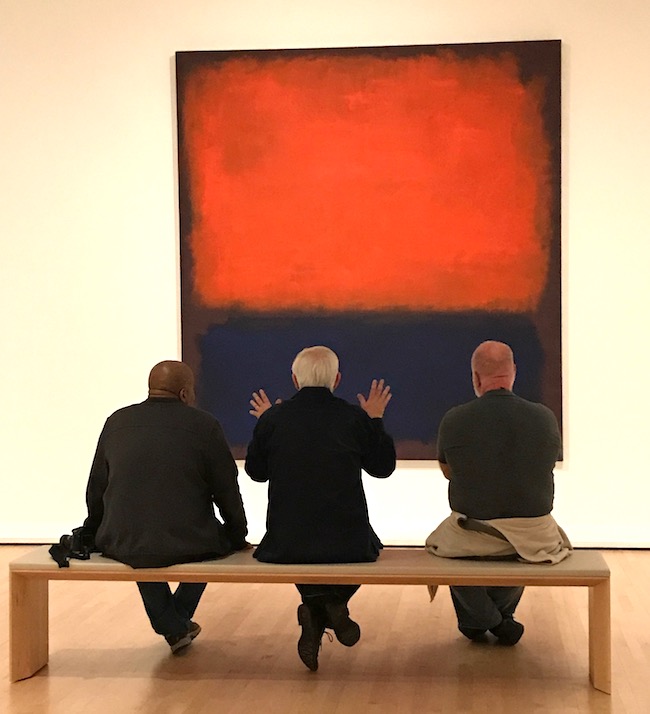
At first they seem like buddies hanging out on their lunch break. But then I notice that the man in the middle is doing all of the talking and pointing. The other two are nodding. Their heads follow his every direction.
The man in the center, the docent, brings a Joan Mitchell into the conversation with Rothko. Compare. Contrast.
His audience eventually moves on, but he’s quickly in the spotlight again with an even larger group.
He’s a human magnet.
I’m hanging in the wings – amazed by his knowledge and desire to share what he knows. He is turning these visitors into raving fans. I’m immediately a fan of him.
My husband circles back around to find me once again absorbing the scene. “Man, this guy is really good!”
I still feel like a voyeur, but I can’t stop listening.

Dirt and Mirrors
We’re on to sculpture and the docent who had the kids at Duchamp now stands them in front of Robert Smithson’s Nonsite (Essen Soil and Mirrors). It consists of mirrors and (as the title states) soil.
Once again, high school kids, who are usually some of the biggest skeptics, are completely present and curious.
They’re having a serious conversation about dirt and mirrors! They understand there is something more to it and decide that it’s worth investigating.
They might not have a solid grasp of English, but they grasp the language of art.
This is when I lose it.
Losing It
Tears begin to well up in my eyes. I can’t contain them.
I am overcome with emotion and look for a place to sit down because I’m compelled to capture this experience before it leaves me. I scribble …
“This is where all is right in the world.”
“Engaged in humanity.”
“Best of humanity.”
I continue crying. I am so freakin’ moved. Life is beautiful.

My husband wanders in (again) and is concerned. “What’s wrong?” He wonders. I can’t talk about it. Not just yet.
It’s hard to explain what’s happening to the mathematician-physicist I married.
I am overcome not by art, though that has happened on other occasions.
In this moment, I am overcome with love. Love of all that is right with the world.
Art has the power to bring people together, discover, and discuss their common humanity.
All I can think is Damn! I’m so lucky to get this! And blessed to witness others whose lives might be shaped – for the better – in that moment.
Postscript

Before we left for our quick trip, my husband had an interesting conversation with his hair stylist.
After she heard he was going to see an art exhibit in San Francisco, she shook her head and said with a scowl, “Art! I just don’t get it.”
I hope one day she is fortunate enough to happen upon a docent as knowledgeable as the ones we encountered. She doesn’t have to get it. But I hope that she is open to new experiences and has a growth mindset.
Because if you happen upon the right people with the right words and a keen amount of patience, you might be taken on a journey you’ll never forget.
One final note: the Matisse/Diebenkorn show was also well worth the trip.
Your Turn
Please leave a comment to tell me the art experiences you’ve had that reaffirm that life is, indeed, beautiful.
The post Life Is Beautiful and I Have Proof appeared first on Art Biz Success.
]]>You make a heroic effort to create interesting content for social media.
You work tirelessly to craft a decent artist talk that will engage an audience.
You curse at the person who told you that it was easy to use iMovie as you grit your teeth through the process of producing your first video.
You meet your deadlines for newsletters and blog posts because, ahem, somebody said you should. (Okay, maybe you didn’t meet the deadlines, but they did go out. You get points for that.)
You Are a Word Collector
You didn’t know it, but if you’re doing even a few of the things I mentioned above, you are a word collector.
Don’t worry! Being a word collector doesn’t entail heavy responsibilities. Nor is it likely that your word collection will make it to the auction block one day.
But that doesn’t mean your collection isn’t valuable. It is! I wonder if you know just how valuable.
If you’re like a lot of artists, you have all of these words that are probably being used only one time.
That’s a shame.
There is so much more you can do with your collection of words.
The post Multiply Your Content by Repeating Yourself appeared first on Art Biz Success.
]]>You make a heroic effort to create interesting content for social media.
You work tirelessly to craft a decent artist talk that will engage an audience.
You curse at the person who told you that it was easy to use iMovie as you grit your teeth through the process of producing your first video.
You meet your deadlines for newsletters and blog posts because, ahem, somebody said you should. (Okay, maybe you didn’t meet the deadlines, but they did go out. You get points for that.)
You Are a Word Collector
You didn’t know it, but if you’re doing even a few of the things I mentioned above, you are a word collector.
Don’t worry! Being a word collector doesn’t entail heavy responsibilities. Nor is it likely that your word collection will make it to the auction block one day.
But that doesn’t mean your collection isn’t valuable. It is! I wonder if you know just how valuable.
If you’re like a lot of artists, you have all of these words that are probably being used only one time.
That’s a shame.
There is so much more you can do with your collection of words.
Leverage What You Put So Much Effort Into
Your artist statement and bio are the backbones of your marketing. They are the primary stories that you use to connect people to your art.
Sometimes they’re excruciating to write. And to get right.
But … man! When you have good stories, they will work hard for you.
You will use your statement and bio not only on your website, but also in grant applications, exhibition proposals, and brochures.

You will be rewarded for your efforts when it comes time to develop:
- A video about your art
- An artist talk for your exhibition
It’s hard to make a decent video or deliver a coherent artist talk without first having those stories in your back pocket.
Speaking of stories, why would you publish some of your stories only on Facebook? Save the social media posts that have stories about your art or your life as an artist. Reuse them on:
- Labels next to the art
- Your website – beside the individual artworks
And, hey, you know that blog post you busted a gut over? Isolate juicy sentences from blog posts and quote yourself:
- As stand-alone social media updates (rather than just linking to the blog post)
- In text next to your art – on your website or on exhibition labels
- Within your artist talk
- In tweets
- In a teaser in your newsletter, with a link to the entire post
Get the idea? Whenever you create new content, slice and dice it to see how many additional ways you can leverage what you wrote.
But What If …
I’m going to stop you right there because I know what you’re thinking. You’re thinking that people will be annoyed seeing the same thing over and over.
Phooey! Don’t spend a single minute worrying about this.

First of all, each time you reuse the language, it will be slightly different because you’ll find new ways to say it or expand on it.
Second, you reinforce your point when people read the same text in multiple places. Don’t assume they remember what they previously came across.
Finally, if they ever complain about your repetitiveness (highly unlikely), all you can do is feel sorry for them. They have entirely too much time on their hands if they’re seeing every post of yours!
Your Turn
How do you repeat yourself? How do you leverage the content you’ve created?
The post Multiply Your Content by Repeating Yourself appeared first on Art Biz Success.
]]>My calendar says "Writing Time." Every Friday at this time is blocked out to write. I like going into my weekend knowing that I have written something that will contribute to next week's newsletter and blog post.
I wish I could say it's as easy as marking off to write, and it will happen.
It doesn't always work that way for me. Actually, it rarely works that way for me.
Today I don’t feel like writing. I don’t feel like doing much of anything.
Everything seems to distract me. Do you know this feeling?
The post Seeking Inspiration While Topic Hopping appeared first on Art Biz Success.
]]>My calendar says “Writing Time.” Every Friday at this time is blocked out to write. I like going into my weekend knowing that I have written something that will contribute to next week’s newsletter and blog post.
I wish I could say it’s as easy as marking off time on your schedule to write, and it will happen.
It doesn’t always work that way for me. Actually, it rarely works that way for me.
Today I don’t feel like writing. I don’t feel like doing much of anything.
Everything seems to distract me. Do you know this feeling?
For some reason I keep writing because I have so many deadlines: this newsletter, content for a workshop, the upcoming Creative Content Camp, and the next lesson for the Art Career Success System.
I sift through the notes I’ve created in Evernote.
I have an editorial calendar, but I’m not inspired by the topic I’ve chosen for this week. Surely there’s something that’s more interesting.
Nope. Not this week.
What is this about?
Nothing catches my eye. Absolutely nothing.
I go through old blog posts. Sidetracked! But I find gold – not just in my articles but also in the comments. My readers share loads of valuable comments.
I decide that the blog posts are interesting and that I should work a little on my new book. (Oops! I probably wasn’t supposed to say that. Now the cat’s out of the bag.)
This is fun! I’m capturing all kinds of ideas as I stroll down memory lane in the comments of my blog.
I keep plugging along.
Hopping from topic to topic to topic.
I recall the post I wrote about doing the work even when you don’t feel like it because that’s what professionals do. They don’t wait for inspiration to strike. They do the work because that’s just what they do. [Tweet “Professionals don’t wait for inspiration to strike. They do the work.”]
So I think, Hey! This is an article in itself. The struggle to write a weekly article.

And I start a new note in Evernote with the temporary title, “How This Article Happened.” I know that won’t be the title, but at least it has a placeholder that I can find.
I don’t attach a date to it because I don’t know when I will publish it.
I type type type in order to capture what has transpired to this point. I don’t want to lose my thoughts.
Don’t you hate it when you are struck by a really good idea and then forget what it was?
Through this process – on this Friday alone – I have:
- Created a new article
- Added content to an upcoming module for my students
- Updated the outline for my new book (Yikes! There I go again!)
Now I’m ready to tackle that article idea from my editorial calendar that didn’t seem so interesting a couple of hours ago. This is the post that was the result.
Two Mondays Later
Apparently I missed (again) my Friday writing-for-the-blog schedule, and I’m writing on a Monday. It’s closer to my deadline than I’m comfortable with, and it’s now or never.
I dive headfirst into two topics and crank out about 1,000 words on each of them.
I am uninspired to finish either for this week’s article, as if I needed more proof that satisfaction with one’s work is hard won.
I return to Evernote to add more to this article that I started 10 days ago.
Then, out of nowhere, Boom!

I remember a personal experience that could be turned into a valuable piece of content. I am inspired and, almost effortlessly, this article is birthed.
Today I’ve worked on at least 5 articles.
One Month Later and The Big Lesson
Here I am – finally ready to share this. Here’s what I want you to get out of it: Content, at least for me, doesn’t come quickly and easily. I have to let it simmer.
MOST people have to let it simmer, especially if they want it to be worthy.
Creating content for your blog, newsletter, and social media is a process, and artists who think strategically will honor this process instead of having a let’s-just-get-this-over-with attitude.
Your Turn
Is writing difficult for you? Do you get distracted?
What are your biggest struggles around creating content (writing or otherwise) for your newsletter, blog, or social media?
The post Seeking Inspiration While Topic Hopping appeared first on Art Biz Success.
]]>There’s no shortcutting this one. You need at least one artist statement for each body of work you create.
Writing your statement is a process. Like any other type of writing or artmaking, you can’t expect to nail it in a single sitting.
And, like all good things that take time, it will be time well spent. The process helps you gain clarity about your art.
If you can’t define your art in a statement, you will likely face difficulty marketing your work. Where else will you get language for wall labels, brochure and website text, informal presentations, and conversations?
Answering these three questions will help you write a better artist statement.
1. What, in particular, do you want people to see in your work? Is it . . .
- Your labor?
- A special material?
- An emotion?
- Color? Line? Texture?
What is important to you?
Discuss how you handle this aspect of your work. The words you choose for your statement should be clues that lead viewers to these discoveries.
Declaring “I love color” is weak language. Who doesn’t love color? Show us exactly how you respond to color and use it to transfer meaning from your head and heart to the viewer.
2. What is a distinguishing characteristic of your art?
The post Write a Better Artist Statement with These 3 Questions appeared first on Art Biz Success.
]]>There’s no shortcutting this one. You need at least one artist statement for each body of work you create.
Writing your statement is a process. Like any other type of writing or artmaking, you can’t expect to nail it in a single sitting.
And, like all good things that take time, it will be time well spent. The process helps you gain clarity about your art.

If you can’t define your art in a statement, you will find it difficult to market your work. Where else will you get language for wall labels, brochure and website text, informal presentations, and conversations?
3 Questions for a Better Artist Statement
Answer these questions to improve your artist statement.
1. What, in particular, do you want people to see in your work? Is it . . .
- Your labor?
- A special material?
- An emotion?
- Color? Line? Texture?
What is important to you?
Discuss how you handle this aspect of your work. The words you choose for your statement should be clues that lead viewers to these discoveries.
Declaring “I love color” is weak language. Who doesn’t love color? Show us exactly how you respond to color and use it to transfer meaning from your head and heart to the viewer.
2. What is a distinguishing characteristic of your art?
A distinguishing characteristic might be one of the items in the list under #1 above or something else.
What makes your art different from artists working along the same lines? Emphasize this quality when you speak and write. Help us to see what makes you an original.
Part of your job is to educate others how to look at your work. Most people haven’t had a visual education. They need to be shown what to look for.
3. What do other people find delightful or surprising about your art?
If it captures one person’s attention, it will probably be fascinating to others as well. Listen to what people say about your art. Their discoveries might shock or confound you, but trying to understand where they’re coming from is part of the communication process.
You will learn a lot by listening to these insights, and I think you’ll be surprised that they pick up aspects of your work that you hadn’t consciously considered.
Ready to dive in deep to find the right language for your artist statement?
Check out our Magnetic You independent study. You can start making better connections with a statement you’re proud of right now!
The post Write a Better Artist Statement with These 3 Questions appeared first on Art Biz Success.
]]>