The post Valuable Business Lessons From Infusioncon appeared first on Art Biz Success.
]]>In no particular order, here are some things I learned that I thought might be useful to you.

From Jay Baer, author of The Now Revolution and the forthcoming Youtility . . .
- When marketing onine, we’re no longer competing against just others in our same market. We’re competing against everyone – business and personal – all in the same space. No one can be that amazing, so we should focus on being useful.
- Search engines are less useful than they used to be. We now use Yelp, Angie, Siri, and Facebook.
- In 2010, people needed 5.3 sources of information before making a buying decision. In 2011, they needed 10.4 pieces of information. (source: Google’s Zero Moment of Truth)
From Preston Stapley of Infusionsoft team . . . Customers leave because they are indifferent. They are indifferent because:
- They haven’t heard from you.
- You haven’t provided additional customer service.
- You haven’t provided value recently. (The emphasis on recency was a theme throughout several of the sessions.)
From Ryan Deiss, CEO of the Idea Incubator . . .
- People expect images in email to be clickable. They will always try to click on an image or graphic.
- 20% of Web traffic is from phones and tablets. Are your sites optimized for mobile?
- The subject line is to get people to open the email. The email is to get people to click through. The sales page is for the sale. Don’t confuse these.
How To Get The Most From A Workshop Or Convention
I came home with lots of notes full of actionable steps, which can be overwhelming. So I first reviewed all of those notes.
I highlighted the things I wanted to take action on and highlighted others that I think are fodder for posts.
I am now prioritizing the actions, but I made a point of taking immediate action on a single thing – and it was a BIG thing. This is important because it proves my commitment to implementing what I’ve learned and, therefore, increases the value of my investment of time and money.
What do you think about any of this?
The post Valuable Business Lessons From Infusioncon appeared first on Art Biz Success.
]]>The post Are You Nuts? appeared first on Art Biz Success.
]]>Insanity is doing the same thing over and over again and expecting different results.
It first appeared in 1981 text from Narcotics Anonymous and has been misattributed at various times to Albert Einstein, Benjamin Franklin, and Mark Twain.
If the quote is true, are you nuts?

Have you been promoting your art the same way for years and expecting improved results?
Persistence And Consistency
I’m a big fan of persistence and consistency – in doing the same thing over and over again – in marketing. You must commit to certain repeated marketing tasks before you can judge their effectiveness.
At the same time, I believe in tweaking aspects of your marketing as you go along.
You should learn something with each new artwork, email, newsletter, or blog post, and you need to use that knowledge to get better results in the future.
Expect Improved Results
Let’s assume that you seek the following results, regardless of where you are in your art business:
- More sales
- More inquiries
- Additional subscribers
- More quality connections
- Better venues
- Improved work
Constant Tweaking
To see improved results like those above, try any of the following with your marketing.
- Reduce the amount of text
- Break up the paragraphs into 1 or 2 sentences only
- Simplify the options
- Change the colors
- Resize the format
- Increase the font size
- Add more bullet points
- Add more white space
- Put your name at the top
- Put your name at the bottom
- Test a different image
- Enlarge the images
- Decrease the size of your logo
- Adjust the length of the article or message
- Use a photo of yourself
- Remove the photo of yourself
- Be more personal
- Be less personal
- Send it email
- Send it snail mail
- Use the phone
- Deliver it in person
Don’t implement these changes all at once. The only way to understand what works is to modify one thing at a time.
Since you’re here, I know you’re not nuts. You’re willing to experiment to get better results. You can do this!
What has worked for you? When did you change part of your marketing and see an improved outcome?
The post Are You Nuts? appeared first on Art Biz Success.
]]>The post Email Marketing for Artists: A Compilation appeared first on Art Biz Success.
]]>This post is for you if you use email for marketing your art.

This is really good, basic advice that you should never take for granted: Slow Down and Get Your Email Blast Right.
Always focus your message. You’ll get much better results when you know what you want to accomplish with your email.
Don’t forget to provide a call to action. You usually don’t get what you don’t ask for.
Email blasts differ from newsletters in their purpose. You will also adjust the rhythm of your email blasts according to what you have to share with your list.
Why last-minute email works.
If you want to get people to your site, you have to encourage them to click through.
Avoid these email mistakes.
The post Email Marketing for Artists: A Compilation appeared first on Art Biz Success.
]]>The post Coordinating Your Marketing Efforts appeared first on Art Biz Success.
]]>Website, blog, newsletter, email, Instagram, Facebook, Twitter, LinkedIn, YouTube, TikTok, Pinterest. The list just keeps exploding.
How do you keep up with it all?
The answer is: You can’t!
Don’t even try.
The trick is to admit defeat. To let go of the platforms that aren’t serving you or that just feel like no fun.
Here’s a rundown of 3 basic platforms you should be using to promote your art and how they work with one another. Facebook is optional, but recommended. The other two are mandatory.
Blog or Website
Your artist website is your home base, your brand, your everything. You can’t neglect your site!
Use might use your site to brand yourself as an expert. You might be an expert on your subject matter, an expert on your media, or an expert on local artists. In those instances, you probably need a blog.
Or you might just be an expert on you.
It’s critical that you do this on your site and not on a social media site owned by a big company. It’s the only way you can control your message and ensure that it endures.
Tips for coordinating your site with other marketing platforms:
- Use your site to collect email addresses through a sign-up form.
- Make sure your social media links are easy to find.
- Install “Share” buttons to blog posts so that visitors can share your content quickly on social media sites.
- Create Pinterest boards for your top blog posts and thematic groupings of your art.
Some people will connect with you through your blog or social media, but you can’t count on that. You can’t control those algorithms.
Email, whether in the form of short reminders or newsletters, is vital for keeping your name in front of people. Send email messages to announce exhibitions and classes, send invitations, and broadcast reminders.
Tips for coordinating your email with other marketing platforms:
- Revise content from your blog or social media updates for email newsletters.
- Use email to drive people to your website or blog, but don’t send them to your home page. Home pages are boring! Send them to the page with your hot-out-of-the-studio art or your most-commented-on blog post.
- Provide links to your social profiles in your email newsletters and encourage people to follow you.
Facebook or Instagram
Remember that most people will see your updates as they appear in news feeds—not from your timeline or profile page. It’s rare that people (unless they’re spending way too much time on the computer) who saw an update of yours at 8 a.m. would see another one at 4 p.m.
Tips for coordinating your social profiles with other marketing platforms:
- Make sure the link to your website or blog appears in your profiles. People should be able to quickly find the link and visit your site.
- See that your Facebook business page shows up as your employer on your personal profile. (IOW, that your business page is your employer.)
- Consider making custom posts in the native apps rather than cross-posting the same message across diverse platforms.
- Every now and then, post an invitation to subscribe to your email newsletter.
That’s it! website/blog, email, and social media, although this is by no means a comprehensive list of how you can coordinate these marketing tools.
I know what you’re asking now: Where’s Twitter? Why not Pinterest? What about YouTube?
We could go on and on. If you like these additional platforms, use them! They’re all good. They can all be worthwhile if used consistently and with respect for their unique qualities.
But . . . Coordinate your marketing efforts. Your various profiles, sites, and platforms do not stand by themselves. You must use them in harmony in order to be effective with your message.
How are you coordinating your marketing?
The post Coordinating Your Marketing Efforts appeared first on Art Biz Success.
]]>The post Promoting Events 6 Months Out appeared first on Art Biz Success.
]]>
6 Months Out
It’s never too early to start promoting an event! People need to see a message at least 7 times in order to act on it, and that message should occur over time and across multiple platforms. Start now!
- Develop an incentives package, such as deep discounts and bonuses, for early registrations.
- Create your website sales page. Ensure that online ordering is working.
- Make an announcement about the event in your organization’s newsletter.
- Add the workshop as an event on Facebook and post it to your Facebook timeline.
- Start contacting potential partners that can help promote your event to their lists.
- Create a postcard and/or inexpensive flyer. Identify key locations and happenings for placement of handouts or flyers.
3-6 Months Out
This is when you might be tempted to slack off. You think you’ve already done a bunch of marketing and that you should allow your message to percolate with recipients. Don’t do this! Ramp up your marketing efforts even more!
- Mention the event 2x a month in blog posts (ask me for a guest post or interview!).
- Post it weekly on your Facebook page – varying the time of day you post.
- Tweet it several times a week during high-traffic times.
- Cite the workshop in each issue of your newsletter.
- Send at least 5 personal emails each week to encourage other organizations to spread the word about your event. Follow up as necessary.
- Make phone calls to key alliances that can attract attendees.
- Follow up all online registrations with confirmation welcome letters. Always remember that these people are your guests and should be treated as such.
1-2 Months Out – Early registration ends
There should be a big push to sell seats right before early registration ends. This is when you will receive the majority of your sign-ups.
- Continue all of the promotions you’ve been doing for the last several months. Don’t let up!
- Send a press release and reminders to all alliances to announce the end of early registration. Don’t forget to include the key arts bloggers in your area.
- Schedule a series of 2-3 emails to your list with the early registration deadline reminder. These emails should be specific to the workshop and include no other offerings or announcements.
1 Week to 1 Month Out
- If you haven’t sold out, expand your efforts to fill the seats. You want it to be a success, don’t you?
- Send at least two more emails to your list.
5 Days Out
Relax. You’ve done the best you can, and you have a good crowd coming! Kick up your heels and relax – but only for about an hour. Then you can start tending to workshop details for your guests.
Any details you would add to this list?
The post Promoting Events 6 Months Out appeared first on Art Biz Success.
]]>The post Never Fear Sending the Email Blast appeared first on Art Biz Success.
]]>One missive is never adequate to ensure people show up or respond.

You’re missing out on a big opportunity if you fear the email blast.
How a Blast Differs from a Newsletter
An email newsletter is sent on a schedule. It’s delivered, for instance, weekly, bi-weekly, or monthly.
A newsletter is fairly substantial. It might have, as my Art Biz Insider has, a main article, a personal note, and announcements about upcoming events. In other words, it has sections of news that readers can skim to find something of interest.
In contrast, an email blast focuses on encouraging a single action. In it, you might invite readers to:
- Attend an event
- Sign up for a class
- Donate to a crowdfunded project
Each of these bullet points is asking for one thing from the reader: either they will attend/sign up/donate or they won’t. They don’t have to decide between this article or that article or this request or that request. They must make only one decision.
That’s the beauty of the blast → One request, one action.
If your results are anything like mine, you’ll get much more traction from an email with a single message than a newsletter with options.
Of course, one message often won’t do. Consider a series of emails focused on the desired action.
Email Blast Rhythm
You may have sent a postcard or mentioned your event in your newsletter or on your blog, but you still need to call attention to it.
Let’s say you have an exhibit opening. You could send the following four messages.
1. A “Save the Date” announcement – 4 to 6 weeks out
2. An official invitation to the opening – 2 weeks out
3. A reminder to attend – the day before the exhibit opening
4. A reminder to see the show before it closes – final week of exhibit
You can see how these could quickly become annoying. If you had a lot of events and they overlapped or butted up against one another, it is possible to send too many emails.
Don’t do this! Space out your email blast series so that they’re helpful to your list members rather than annoying. I suggest that running the series above two or three times a year isn’t too often.
Another way to avoid the irritation factor is to use this series only for geographically appropriate messages. If you’ve done a good job segmenting your list, don’t email an invitation to someone in Vermont to come to your opening in Arizona tomorrow.
Or, if your stomach needs to warm up to the thought of sending several emails, start with #3 and track the results you receive from sending only the last-minute reminder.
What do you think? Do you fear the email blast?
The post Never Fear Sending the Email Blast appeared first on Art Biz Success.
]]>The post Benefits of Last-Minute Marketing appeared first on Art Biz Success.
]]>I’ve found that last-minute marketing (the day of or the day prior to a deadline) is worth every ounce of effort. When I don’t bother with the extra push, my enrollment is smaller, my sales are lower, and fewer people benefit from what I have to offer.

I’ve learned:
- Most people sign up or purchase at the last minute, but they’ve usually seen my offer multiple times by that point. This means . . .
- My last-minute email reminders create more action (i.e. more sales) than all of my other efforts combined.
- People will unsubscribe from my list because of those last-minute reminders. I grew to be okay with that as soon as I understood they aren’t my ideal customers.
- Others will be grateful for the eleventh-hour reminders. They are worth reaching out to one last time. They are my ideal customers and will benefit from what I have to offer.
Last-minute marketing doesn’t mean waiting until the day before to first tell people about a sale, product, or event. In order for last-minute marketing to work its magic, you have to have put all of the right pieces into place.
Before any last-minute marketing, you should have completed at least half of the following promotional efforts:
- Mailed postcards
- Emailed an original message with all of the product or event info to your list
- Sent personal emails to those who can help you spread the word
- Posted the event on your website, blog, Google+, and Facebook
- Written and sent at least one press release
- Tweeted about it multiple times
- Mentioned it in your newsletter
Some people are afraid that more promotions will result in “bothering people.” As I said above, people will unsubscribe. Keep in mind that they’re not your ideal customer.
Remember these last-minute marketing lessons whenever you think that one last message might be too much. Your final missive might pay off, but only if you’ve laid the groundwork over time.
Has last-minute marketing paid off for you?
The post Benefits of Last-Minute Marketing appeared first on Art Biz Success.
]]>The post Drive More Traffic to Your Site appeared first on Art Biz Success.
]]>Use more enticing language in your newsletter, email blast, Facebook update, or tweet to encourage blog visits and more meaningful connections.
Below are examples of how I might announce selected real-life blog posts.

If your blog post solves a problem, emphasize that you have a solution >>>
How to add your Facebook page to your personal profile:
http://www.makebigart.com/2011/01/work-for-yourself (Lisa Call)
Your missive will also be successful if you pique the curiosity of the recipients >>>
Get a sneak peak of what I’ll be wearing to the Art of the State:
http://hammermarks.wordpress.com/2011/06/06/in-process-new-agate-piece-to-match-my-dress (Wendy Edsall-Kerwin)
Must see: 3400-year-old paint box from an artist who lived during the reign of Amenhotep ll:
http://www.margretshortblog.com/an_artist_and_her_work_ma/2010/12/index.html
(Margret Short)
Ever wonder what a booth looks like at an art licensing trade show? See me in front of giant banners of my art:
http://debracortese.com/blog/?p=2394 (Debra Cortese)
Proof that pink and brown look great together:
http://thecolorist.blogspot.com/2011/06/fauvist-forest.html (Casey Klahn)
They sent me a necklace in the mail and here’s how I updated it:
http://clay-space.com/2011/05/results-of-the-do-over-challenge (Charlie)
5 Women from history that inspire me to be a better artist:
http://cathyreadart.com/2011/05/5-inspiring-women-the-artist-the-doctor-the-civil-liberties-campaigner-the-teacher-and-her-pupil (Cathy Read)
Spend a few extra minutes on your next email or tweet to drive more traffic to your website or blog.
The post Drive More Traffic to Your Site appeared first on Art Biz Success.
]]>The post 10 Dumb Bulk Email Blunders appeared first on Art Biz Success.
]]>You probably send a lot of email. I’m asking you this week to reexamine what you’re sending people. I want you to improve your messages and make sure you’re not sending the same ole, lame ole email messages that everyone else is sending.
Slow down. Think before you send.
Think of your email as another art form. You’re reaching out and trying to build connections with every email. Create an engaging composition as you would with your art.
Don’t waste the one chance you have to get the message right. More importantly, don’t junk up other inboxes with ill-advised email.
Oh-Too-Common Email Blunders
- Not saying anything. You’re just sending an email because you think it’s time and you don’t work on your message long enough. Don’t waste your readers’ time.
- Saying too much. If you haven’t sent an email update in awhile, it’s tempting to try to catch up with all that’s been going on. Don’t do that to your poor readers. That’s what blogs and Facebook pages are for. Get to the point in your email.
- Apologizing for not staying in touch. Really? Do you think we missed another email in our inboxes? Don’t apologize, just get to the point. In the future, when you promise to send a monthly missive, keep that promise unless you have extenuating circumstances (always understandable and forgiven).
- Putting your entire list in the TO or the CC line. Every time you do this, you share email addresses with everyone on your list and risk pissing people off (sorry, there’s no nicer way to say it). Use the Bcc line!
- Using a dull or trite subject line. Your subject line encourages people to open an email – or not. Vary your subject line and compel us to open what’s inside.
- Bunching up all of your text. Your message should be scannable. Use 1-2 short sentences per paragraph, add subheadings, and bold important points. (See how I’ve done it in this post?)
- Sending images that are too large and take a long time to download.
- Putting all of your message in an attachment. Rule: Attachments are bonuses. They support the message, but they don’t replace it. ALL images are attachments. Even though they look great on your screen, they might show up as a big red X and an attachment in someone else’s inbox.If you want people to open the attachment, you have to give them reason to do so. Put all of the details in the message itself.
- Not using precise locations. Remember that email messages go out to the world – not just your local audience. Don’t forget to add the name of the town, the city, and perhaps the country. Saying “It’s near the mall” doesn’t mean anything to your readers if they don’t know your town and aren’t anywhere near you.
- Sending your bulk email message to anyone who didn’t request it. If you’re sending your email to people who didn’t opt in to your list you risk violating the CAN SPAM laws. More importantly, you risk alienating potential fans. Nobody appreciates receiving bulk email that they didn’t subscribe to.
- There must be more. Maybe you know of a #11. Please share it with us in a comment.
Correct any of the above blunders you might be making and you’re on your way to mastering email marketing for your art.
The post 10 Dumb Bulk Email Blunders appeared first on Art Biz Success.
]]>The post What's at the top of your email message? appeared first on Art Biz Success.
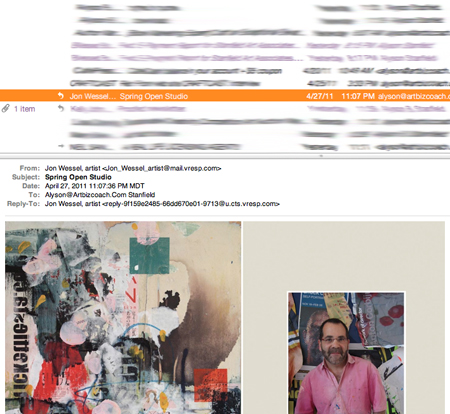
]]>I had this epiphany when I saw this invitation from Jon Wessel in my inbox.
My inbox is a split screen: messages on top and preview on bottom. I don’t open all of my email messages. I’m sure you can understand that most of them aren’t worth opening.
But with this invitation, Jon gave me reason to open his email all of the way. It’s simple, really.
Jon placed his art at the top of the message. The art is what I see – along with a nice photo of him. So if I’m interested in his art, I’m going to open it to read more.
What do you think?
The post What's at the top of your email message? appeared first on Art Biz Success.
]]>