invitations Archives - Art Biz Success https://dy-online.com/tag/invitations/ Trusted Art Business Coaching and Consulting Sun, 19 Apr 2026 18:49:19 +0000 en-US hourly 1 https://wordpress.org/?v=7.1.4 https://dy-online.com/wp-content/uploads/2022/02/favicon-2-150x150.png invitations Archives - Art Biz Success https://dy-online.com/tag/invitations/ 32 32 How to write an art show invitation: announcing, commanding, or inviting? https://dy-online.com/are-you-inviting/ https://dy-online.com/are-you-inviting/#comments Sun, 19 Apr 2026 18:49:14 +0000 http://artbizsuccess.com/?p=16743 An art show invitation has two jobs: give people everything they need to know about the event, and use a tone that makes them actually want to come.

Here's how to decide between announcing, commanding, and inviting, what to include when space is tight versus when it isn't, and the common mistakes artists make on their announcements and invitations.

The post How to write an art show invitation: announcing, commanding, or inviting? appeared first on Art Biz Success.

]]>
A good art show invitation does two things. It communicates the full who, what, where, when, why, and how of the event, and it does so in a tone that makes people actually want to come. 

Here’s how to get both right.

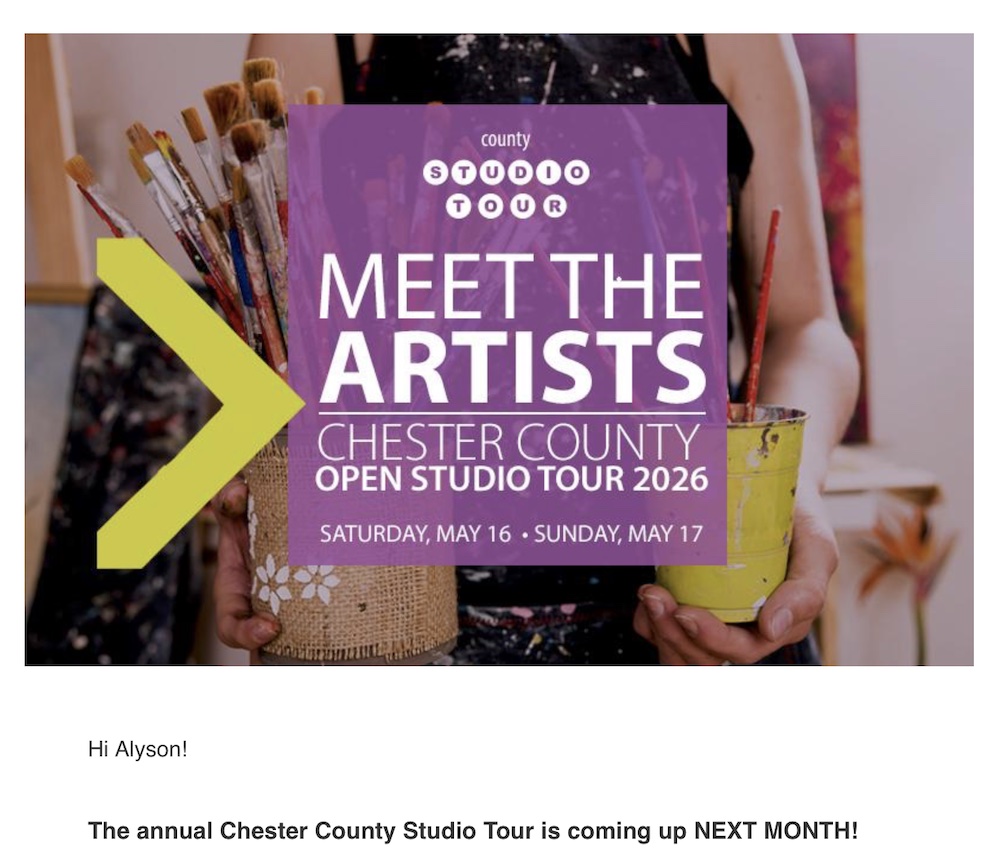
Save the date announcement from Chester County, Pennsylvania Studio Tour.
A save-the-date announcement from Chester County, PA studio tour.

Announcing, commanding, and inviting: what's the difference?

Whether you’re opening a show at a gallery, hosting an open studio, unveiling new work at a pop-up, or inviting collectors over for a private preview, your wording sets the tone for how people will respond. 

Announcing

An announcement is a presentation of the facts.

I’m having an exhibition. Here’s the opening date and time. Here’s how you can see the work.

Announcements work earlier in your marketing, especially paired with a “Save the Date.” They’re useful for press releases, social media captions, and anywhere you need to convey information efficiently.

Commanding

A commandment sounds like this:

Come to…, Drop by…, Mark your calendar…, Sign up…, or Don’t miss….

Calling this a commandment sounds harsh, but’s not usually perceived that way.

We’ve been trained by years of marketing to read commands as invitations and understand the spirit behind them. They get the job done on postcards and posters where space is tight.

They can also go ugly fast in the wrong hands. Too pushy, too salesy, too many exclamation points.

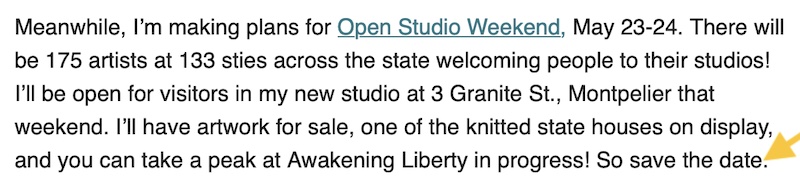
Email text from an artist requesting people to save the date for visiting her studio.
Open studio save-the-date announcement from Eve Jacobs-Carnahan.

Inviting

An invitation is a request for someone’s attendance. It’s warmer, more personal, and closer to how you’d actually talk to a friend.

I hope you can come.
It would be lovely to see you at…
Please drop by if you can.
I’d love for you to be there.
You’re invited.

When I write invitations, I picture the person at the other end. Real names, real faces. I’m talking to them as individuals, not as a list.

“Come to my show” asks someone to show up. “I hope you can come” tells them they’ll be welcomed when they do.

When should you announce, command, or invite?

The closer you get to the event, and the warmer your relationship with the recipient, the more your message should lean toward invitation.

  • Save-the-date postcards, emails, and early buzz: announcement or light commandment.
  • Printed show invitations where space is tight: mostly announcement with clear details, but find room for a warm phrase (“You are invited…” or “I hope you’ll come”).
  • Email to your list: invite. You have the room, and email feels personal. Just remember that they are receiving as individuals, not as a collective. None of this “You’re all invited.”
  • Individual messages to collectors, VIPs, close contacts: invite, and make it specific to them.
  • Social media: mix. Announce early, invite closer in.


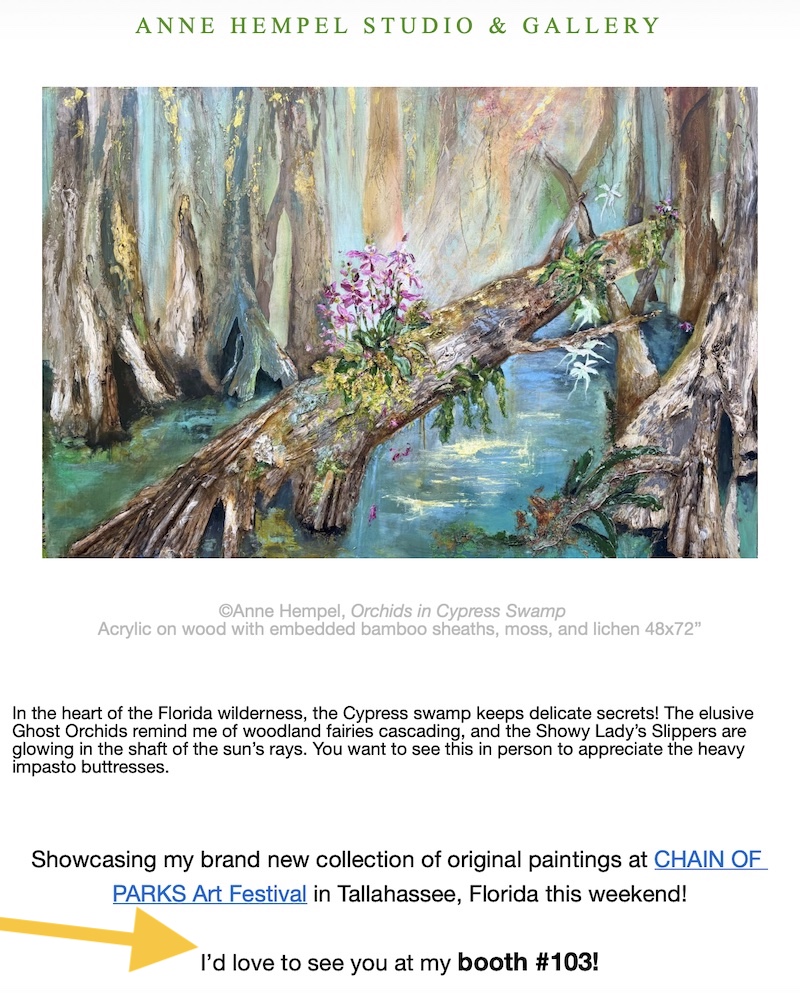
Email invitation for Chain of Parks art festival in Tallahassee, FL from Anne Hempel.
Email invitation from Anne Hempel.

What should an art show invitation include?

Every version (announcement, commandment, or invitation) should consider these questions. Of course, not every invitation can include all of this information. A postcard has room for the essentials. An email or a personal letter has room for all of it (or at least a link to more detailed information on your website).

Questions in bold must be answered.

As for the rest, use your best judgment for various platforms and purposes.

Who

  • Who are you? Full name.
  • Who is the host?
  • Who are the other participating artists, if any?
  • Who is it benefiting, if it’s a charity event?

What

  • What is this? (Opening reception, open studio, artist talk, sale, preview.)
  • What will we see?
  • What will we do?
  • What should we bring, if anything?
  • What’s the phone number to call or text if someone can’t find the place?

Where

  • Where is it? City AND state. If the invitation might travel internationally, include the country.
  • Where do we park?
  • Where can I see more of your art or find more information in advance?

When

  • Date and start time.
  • End time.
  • Exhibition open and close dates, if it’s not a one-night event.

Why

  • Why should I come?
  • Why are you doing this show?

How

  • How do we get there? Any tricky directions, elevator issues, or accessibility notes?
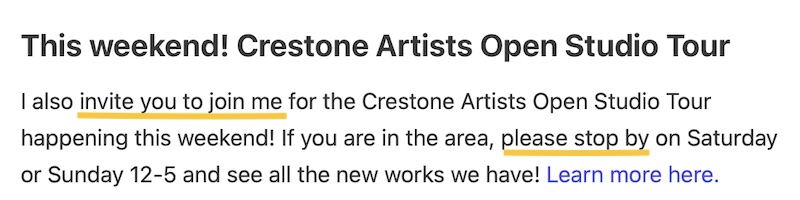
Open studio invitation for Crestone Artists Open Studios.
Open studio inviation sent by Kim Roberts.

Common mistakes artists make with show invitations

  • Forgetting the state. You know you’re in your town. The internet does not. (This is especially true if you aren’t segmenting your list and careful to send it only to local people.)
  • Assuming people know they’re invited. You learn this the hard way. You hand someone a detailed postcard and they ask, “Is this a business card?” Not everyone recognizes an art show invitation when they see one. Say “You are invited” explicitly, especially for anyone outside your core art community.
  • Assuming people know what an open studio is. Many don’t. Spell it out: “My studio will be open so you can take a peek behind the scenes. Come see new work, have a glass of wine, and say hello.”
  • Leaving out the dress code when the event is new to recipients. If it’s casual at your studio, say that. People hesitate when they don’t know what they’re walking into.
  • Designing a postcard without following postal service specs. USPS (and most international postal services) apply a barcode to the bottom portion of the address side during sorting. Any text or artwork in that zone gets covered. Use a mail-approved postcard template for your country so your event details don’t disappear under a sticker.
  • Not naming the host venue. If the event is hosted somewhere other than where people expect you to be, make that crystal clear.
  • Sending an email invitation with no images or cramming too many images onto a postcard. If people can’t see the work, they have no reason to come see the work. On the other hand, single images on postcards are bigger and more impactful than including a bunch of smaller images.
  • Treating every recipient the same. A stranger on your mailing list and your top collector should not receive identical copy. The collector gets a personal note. The stranger gets the warmest version of the public invitation.

One last thing

An invitation’s job is to bring specific people into your world so they can experience your work in person. Write as if you’re writing to one person at a time, and your invitations will do their job.

The post How to write an art show invitation: announcing, commanding, or inviting? appeared first on Art Biz Success.

]]>
https://dy-online.com/are-you-inviting/feed/ 7
Is Your Message Annoying or Informative? https://dy-online.com/annoying-vs-informative/ https://dy-online.com/annoying-vs-informative/#comments Thu, 21 Apr 2011 11:00:00 +0000 http://artbizsuccess.com/?p=9596 One of the excuses in my book - excuses that keep artists from promoting their art effectively - is "I don't want to bother people." You know what it feels like to be bothered and you don't want to do that to anyone else. But don't err to the other extreme.

The post Is Your Message Annoying or Informative? appeared first on Art Biz Success.

]]>
One of the excuses in my book – excuses that keep artists from promoting their art effectively – is “I don’t want to bother people.” You know what it feels like to be bothered and you don’t want to do that to anyone else.
But don’t err to the other extreme. People need to see multiple marketing messages (in a variety of locations) before they act. You need to cover all of your bases. No single person will see the same message across all of the platforms you use.

So, where do we draw the line when promoting our events? (By events, I mean exhibits, sales, openings, open studios, trunk shows, gallery talks, classes, and workshops.)
I propose the following breakdown.

Annoying – Horsefly Buzzing Around Your Head

  • Multiple email “reminders” for the same event
  • Corrections to those email reminders because you left something out of the first one
  • 49 tweets in a row promoting your art
  • 15 Facebook updates that tell us how excited you are about something coming up
  • Promoting your event on someone else’s Facebook page

Informative – Covering All of Your Bases

  • Announcement in your newsletter or email
  • Postcard sent in the mail
  • Feature on your blog sidebar or website events page
  • Sprinkling of mentions in blog posts that relate to the event
  • Blog post devoted solely to the event
  • Special email announcement focused on the event only (no other news included)
  • Email reminder the day of or the day before the event
  • Facebook event
  • A few tweets a day that are varied (varied message, varied time of post)

What have I missed?

The post Is Your Message Annoying or Informative? appeared first on Art Biz Success.

]]>
https://dy-online.com/annoying-vs-informative/feed/ 5