mindset Archives - Art Biz Success https://dy-online.com/tag/mindset/ Trusted Art Business Coaching and Consulting Fri, 12 Jun 2026 01:54:27 +0000 en-US hourly 1 https://wordpress.org/?v=7.1.4 https://dy-online.com/wp-content/uploads/2022/02/favicon-2-150x150.png mindset Archives - Art Biz Success https://dy-online.com/tag/mindset/ 32 32 Risk, rejection, and resilience with Christine Aaron (114) https://dy-online.com/rejection-aaron-podcast/ https://dy-online.com/rejection-aaron-podcast/#comments Fri, 16 Jan 2026 14:46:06 +0000 https://dy-online.com/rejection-aaron-podcast/ You’re going to make mistakes. You will absolutely make the “wrong” decisions from time to time. And you’re going to be rejected from shows and opportunities.

You'll become more and more resilient every time you take a risk that doesn’t work out as you had intended. You’ll bounce back. And you’ll be stronger for it in the long run. Promise. Listen to how this plays out for Christine Aaron.

The post Risk, rejection, and resilience with Christine Aaron (114) appeared first on Art Biz Success.

]]>

(New share of an episode from 2022 that is very much related what we’re doing in Essentials this season.)

We like a sure thing. The desire to eliminate risk has birthed many a promise in marketing messages. Because we keep looking for magic bullets. We continue to hope that the 1 thing that will solve all of our problems about [fill in the blank] is out there.

Still, uncertainty persists, and it’s a thorn in our side. Because, again, we would much prefer a sure thing.

I want to make what I know will sell, I’ve heard from risk-intolerant artists throughout the years.

Making art for the marketplace turns my stomach. It’s the antithesis of what art, at its core is about. This is one of the few times when I’ll should on you: You should only make art that comes from your soul. Art that must be birthed. Anything less is less than art.

Memory project art installation artist Christine Aaron strips of printed paper hanging from ceiling | on Art Biz Success

Great Art Requires Risk

What is art—great art—if not a risk at the time it was made?

History books are sorely lacking in stories of people who played it safe. What boring stories those are! History is made by people who took big risks.

In order to embrace risk, we have to practice. We step into it, try it on, and, almost always, discover that it isn’t as bad as the soundtrack we were playing in our heads.

Here’s another one I hear: I want to make sure it’s the right thing to do.

Think about those words the next time you hear them come out of your mouth. When, in the history of the Universe, has anyone ever been 100% sure that their next move was the right move for their long-term happiness and success?

You want a sure thing? Go back to engineering school. There’s plenty of work for you in that field.

Mistakes and Failures Are Part of the Bargain

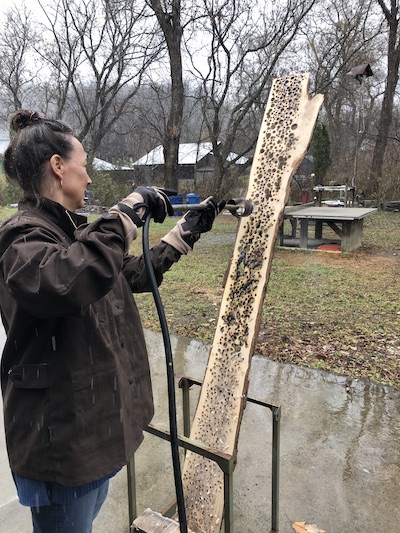
artist Christine Aaron standing burning holes into wood slice | on Art Biz Success
Christine’s artist residency at the Vermont Studio Center in November 2019. She is burning the holes she drilled for a series of tree slice sculptures.

Yes, you’re going to make mistakes. You will absolutely make the “wrong” decisions from time to time. And you’re going to be rejected from shows and opportunities. Count on them. Prepare for them. You’ll survive.

You may be a bit black and blue. But you’ll use courage muscles you never had before.

You’ll become more and more resilient every time you take a risk that doesn’t work out as you had intended. You’ll bounce back. And you’ll be stronger for it in the long run. Promise.

My guest to discuss these things on The Art Biz is Christine Aaron. 

You’ll hear how she embraces risk and has come to understand the role of rejection in her art career. She also shares the tools she relies on to get back in the studio and do it all over again. Resilience.

Highlights

  • The unusual motivation behind Christine’s first watercolor class selection. (2:08)
  • Taking risks and challenging yourself in a rewarding art career. (5:31)
  • Refining your art by sharing it with and soliciting critique from others. (12:45)
  • Identifying your safe zone and moving beyond it. (21:45)
  • Taking on the work that pushes you out of your comfort zone. (25:12)
  • Name the risks to work your way through the potential rejection. (32:57)
  • What rejection really means about the work that you’re doing. (39:46)
  • Honing your resilience skills amid rejection. (40:35)
  • Stop comparing yourself to other artists and remember how far you’ve come. (45:45)
  • Reflecting on your work, your processes, and your improvement. (47:06)
  • The risks that Christine is going to take in 2022. (48:00)
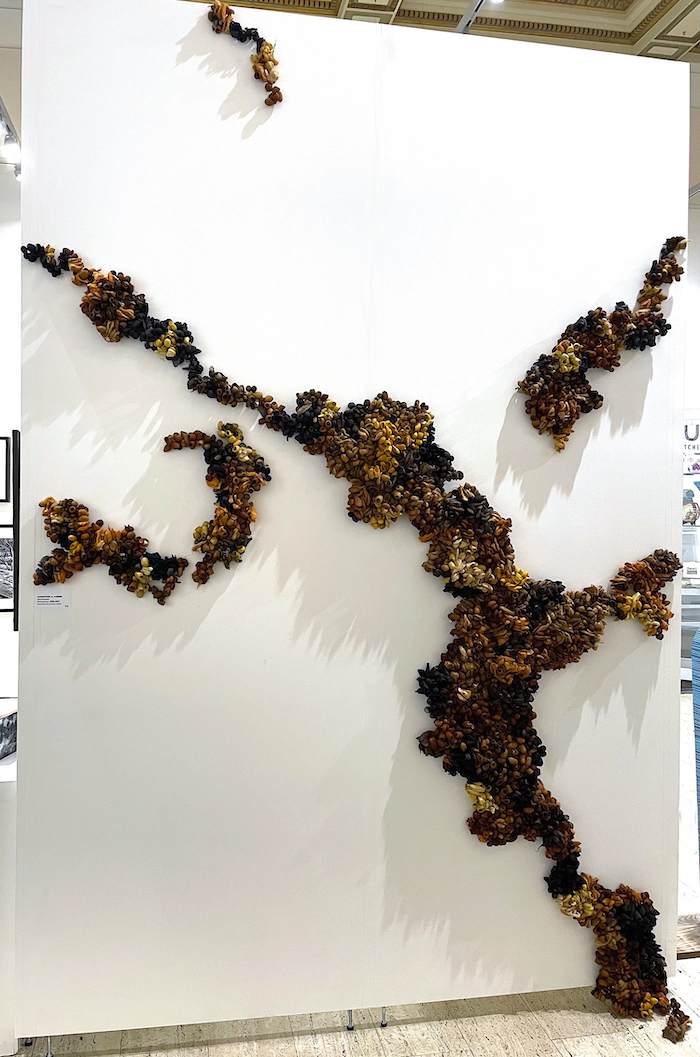
large white panel with brown silk organic tree like shapes climbing it | on Art Biz Success
©Christine Aaron, Emergence (2020-present). Hand-dyed Erie and Bombyx silk cocoons and thread, 10 foot x 8 foot x 5 inches.

Christine Aaron Quotes

  • “There’s not one of us that hasn’t experienced disappointment and loss in life.”
  •  “I make work ultimately because I want it to resonate with someone else.  And the only way to do that is to get it out there.”
  •  “Think beyond what you can imagine now and know that you’ll have the ability to get the resources you need to do it.”
  • “Every artist I know gets way, way more rejections than they get acceptances. But nobody is talking about that.”

About My Guest

Christine Aaron is a conceptual and material focused artist. Her work is exhibited nationally and internationally. Aaron received an artist’s grant from ArtsWestchester—New York State Council on The Arts, a Surface Design Association grant, and a residency and grant from Vermont Studio Center. She presents talks at The International Encaustic Conference in Provincetown, MA, received awards in printmaking and mixed media, and had a solo exhibit of The Memory Project at California Museum of Art Thousand Oaks.

Aaron holds a BS in education from Cornell University and a Masters in Social Work from Hunter College. She lives and maintains a studio in New Rochelle, NY.

Follow Christine on Instagram: @christineaaronart

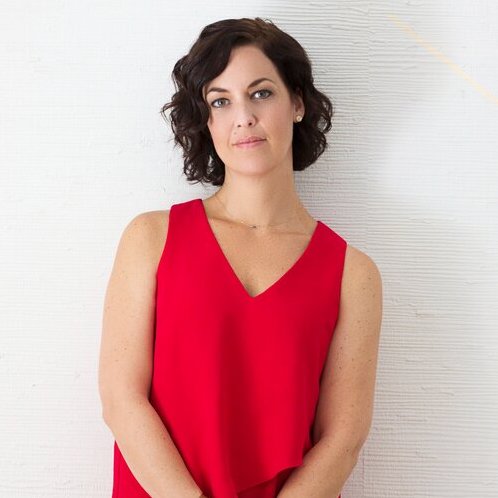
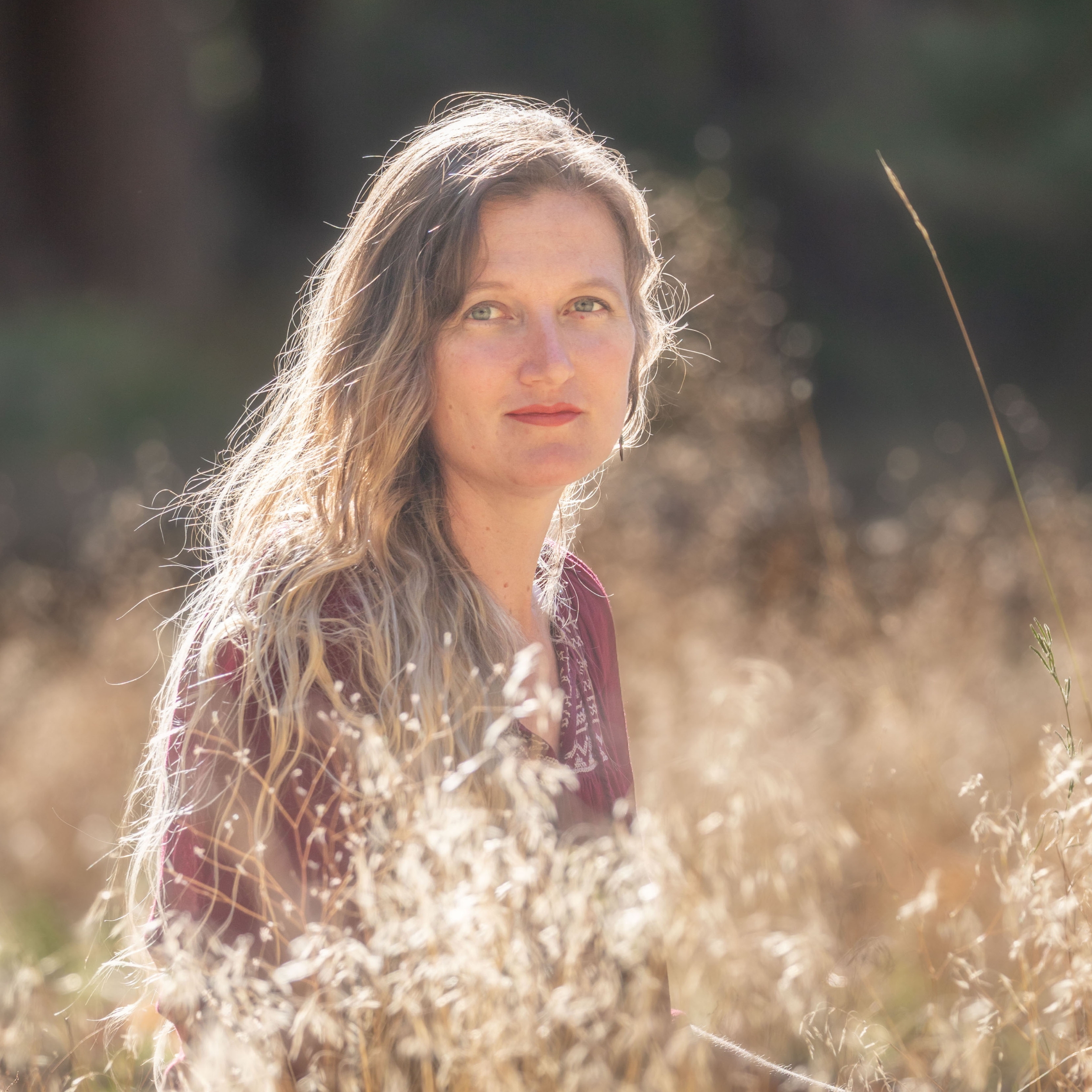
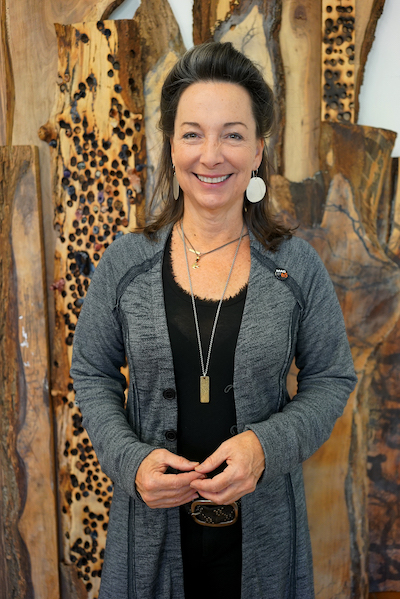
artist Christine Aaron | on Art Biz Success

The post Risk, rejection, and resilience with Christine Aaron (114) appeared first on Art Biz Success.

]]>
https://dy-online.com/rejection-aaron-podcast/feed/ 7
It’s not your job to worry about adding to the noise (233) https://dy-online.com/noise/ https://dy-online.com/noise/#comments Thu, 24 Jul 2025 11:19:00 +0000 https://dy-online.com/?p=54409 Tired of overthinking every post and wondering if you’re just adding to the noise? You’re not alone. And you’re not the noise.

This episode calls out the perfectionism hiding behind “quality over quantity” and reminds you what your real job is: to show up, share the work, and let the right people catch on. No false hype, no algorithm games, just honest strategy and a clear path forward for thoughtful artists.

The post It’s not your job to worry about adding to the noise (233) appeared first on Art Biz Success.

]]>
You know, every time I sit down to record an episode of The Art Biz, I feel this pressure bubble up in my chest.

Like… this better be worth my time. And in order for it to be worth my time, it had better be worth your time.

You are busy. You’re juggling a lot in and out of the studio.

The last thing I want to do is publish something that feels like filler. Like background noise. Like another reel with lo-fi music and a cryptic caption—while you’re over there wondering if any of this is actually connecting to anyone.

No thank you.

Paige Weber oil painting
©Paige Weber, Between the Woods (triptych). Oil on canvas, 48 x 72 inches.

I want every episode to feel like a deep breath. Or a permission slip. Or a really good side-hug with solid advice baked in. Something that sticks with you later when you’re brushing your teeth and thinking about how to show up for your work.

I love it when artists tell me they hear my voice as they’re working.

And that brings me to today’s topic—one I’ve heard come up again and again from artists in our community. It’s a fear of contributing to the noise.

That little voice that says, “Don’t post it. Everyone’s already saying that.”

“Don’t post it. I already said it before.”

“Don’t post it. There is so much out there that is better than this.”

Or: “If it’s not perfect, don’t bother.”

Don't post it.

Everyone's already saying that.

Don't post it.

I already said it before.

I hear this all the time from artists, makers, creative entrepreneurs—especially the thoughtful ones. The ones who genuinely care about the impact of their work.

So today, we’re going to talk about it.

This is for you if you want to share authentically but don’t want to sell out, sound fake, or feed the algorithm monster.

You’re not here to add to the noise.

You’re here to resonate. To be a beacon.

Let’s get into it.

Listen

Where the Fear Comes From

Here’s the truth: the people who worry about “contributing to the noise” are almost never the ones actually making it. Right?

If you are that self-aware, you definitely aren’t contributing to the noise.

Noise comes from shouting, chasing trends, and empty posts designed to manipulate or impress.

But if you’re someone who pauses before you hit publish … If you’re trying to be thoughtful, or honest, or useful … If you feel like your content should have a soul …

You definitely are not the noise.

When you speak from alignment, you become the signal amid the noise.

And the fear you feel before you share? That’s a signal too.
Not a stop sign—just a message from your nervous system saying, “This matters. This is real. Pay attention.”

That you care. That you want your work to land. That you’re trying to be intentional, not performative.

But sometimes we use “I don’t want to add to the noise” as a very elegant-sounding excuse not to show up at all.

Trust me, I’ve done it.

When you speak from alignment, 
you become the signal among the noise.

Quality vs. Quantity

Let’s talk about this whole “quality over quantity” thing.

It sounds noble. Like you’re taking the high road when you say you embrace quality over quantity.

But if you scratch at it just a little, it starts to fall apart.

Because you can’t create quality in a vacuum. You don’t find your voice by thinking about it for two years.

You find it by using it. In your studio and when you take the work out of the studio and share it with others—in real life or online.

That doesn’t mean you post every day just for the sake of consistency. It means you show up for the process. You improve quality over time—through practice, through repetition, through doing the work again and again. Just like you do in the studio.

Some of my best posts? I wrote or recorded them in five minutes.

Some of the ones I labored over? Crickets.

That’s how this works.

If your standard for quality is “perfectly polished and universally beloved,” you’ll never share anything. How could you live up to that?

But if your standard is “true, useful, and aligned”? That’s a game you can actually play—and win.

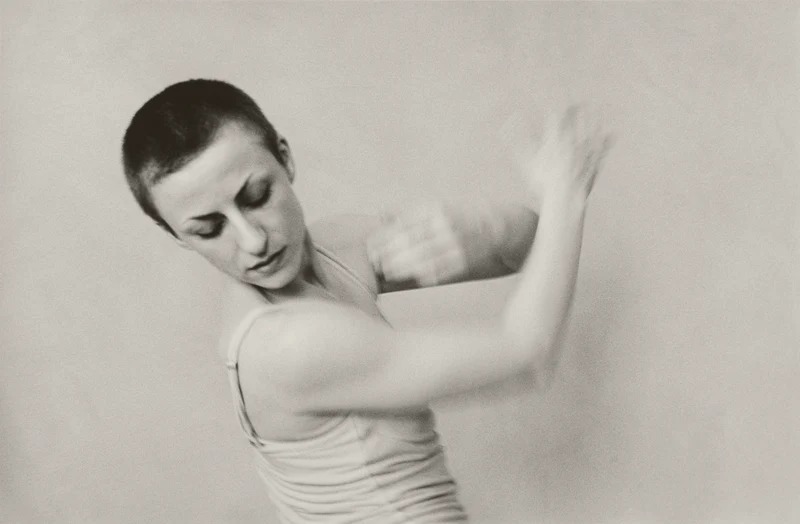
Kate Baker photograph
©Kate j Baker, Adagio (Lo Poesia della Danza series). Silver gelatin photograph, 12 x 16 inch print.

The Perfection Trap

And look—I think we need to name something here before moving on.

A lot of the time, when we say “quality over quantity,”’ we’re not actually talking about strategy. We’re talking about perfectionism.

It just sounds better when we wrap it in honorable language.

But really? It’s too often used as a delay tactic. A form of self-protection. Because what we’re scared of is not being good enough. Or being judged. Or being ignored.

And I get it—showing up is vulnerable. Especially when your work is personal.

Perfectionism loves to masquerade as professionalism.

It says, Wait. Hold back. Make it better first.
And if you listen to that voice every time? You stay invisible.

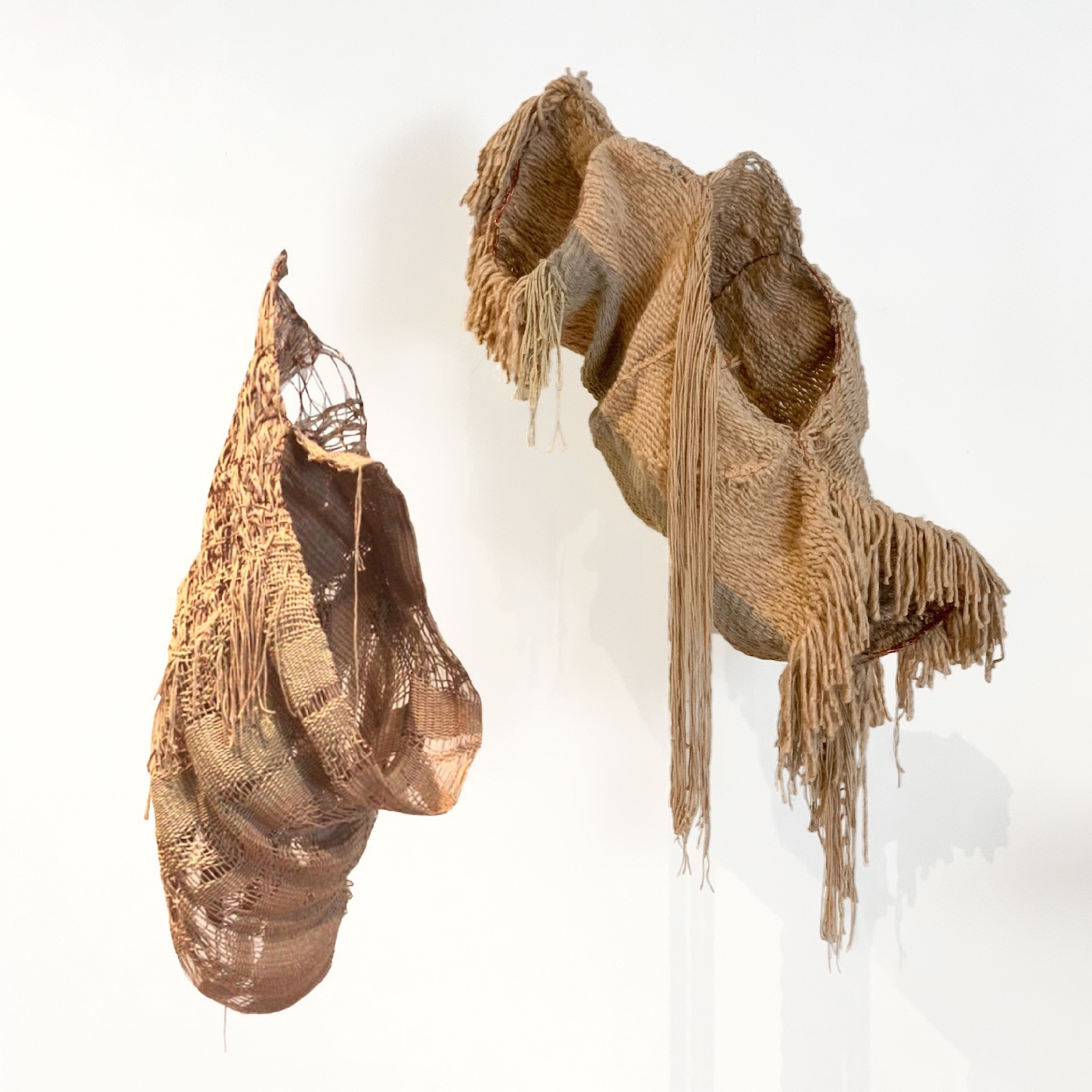
Cynthia Malmud textile hanging
©Cynthia Malamud, Cocoons: Shelter & Nest. Organic cotton and copper, 80 x 60 centimeters (Shelter) and 80 x 20 centimeters (Nest).

What is Quality Content, Really?

Let’s break that down. What makes something quality?

To me, it’s not production value or polish. Quality means:

  • Honest.
  • Helpful.
  • Inspiring.
  • Resonant.
  • Enlightening.

Sometimes it’s messy. Sometimes it’s short. Sometimes it’s something you almost didn’t post because it felt too small.

But here’s the magic part: the stuff that feels obvious or boring to you? That’s often the exact thing someone else needs to hear.

The encouragement you give a friend in your DMs? That’s content.

The process you walk yourself through in your journal? That’s content.

The way you describe your work to someone at a dinner party? You got it. Content.

You don’t need to invent brilliance. You just need to pay attention to what you’re already doing—and amplify it with intention.

Because sometimes we’re the ones who need to hear our own message the most.

Trusting That Your Work Will Reach the Right People

You can’t control who sees your work.

You can tweak your captions, research hashtags, post at the perfect time … and it still might flop. Or it might reach one person—and they might remember it forever.

So instead of obsessing over how to “reach more people,” what if you asked:
“What do I need to say today—even if it only helps one person?”

And what if that one person… was you?

Because sometimes we’re the ones who need to hear our own message the most. And in saying it out loud, we make space for others to connect to it, too.

Your content doesn’t have to go viral. It just has to go out.

You don’t need everyone to hear you. You just need the right people.
And they can’t find you if you’re hiding behind a fear of not contributing to the noise.

A Few Gentle Shifts

If you’ve been stuck in “quality over quantity” mode or just find yourself not wanting to contribute to the noise, try these shifts.

  • Shift from performance to presence.
    You don’t need to impress anyone. Just be here. For yourself, for the work, and for others.
  • Shift from broadcasting to connecting.
    Stop thinking of your posts or emails as megaphones and start thinking of them as conversation starters.
  • Shift from perfection to permission.
    What would you share if you didn’t need it to be amazing—just real?

What have you been afraid to share?
What have you started but not finished?

Silence can feel safe, but it’s not where your people will find you and your art.

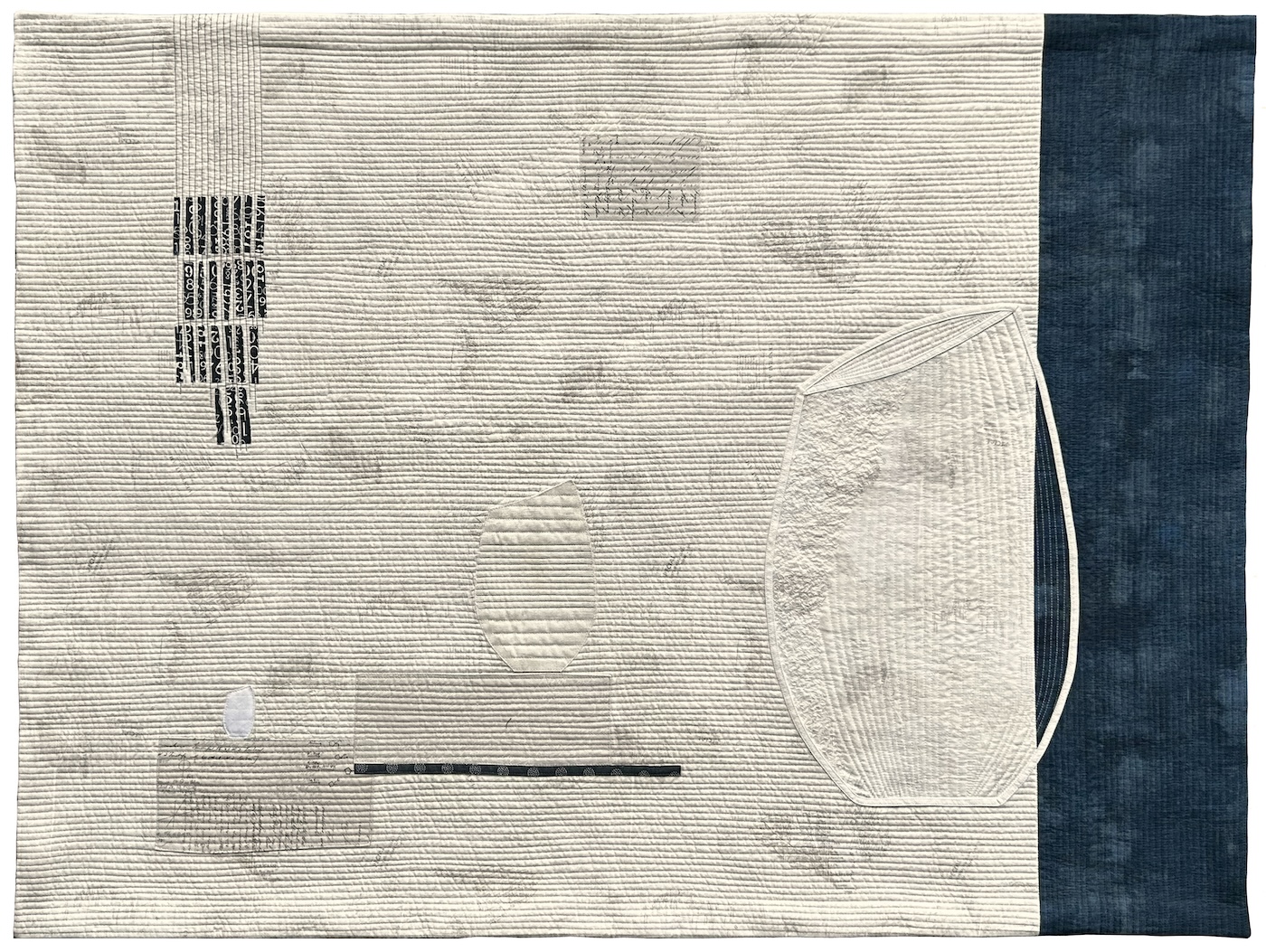
Debbie Grifka textile
©Debbie Grifka, Old Friends. Textile, 36 x 48 inches.

You Don't Get to Choose Who Gets It

You don’t have to post more or send more emails just to keep up with it all.

You don’t have to bow to the algorithms or pretend that every message needs to be hyped. (Please … Stop the false hype!)

But you do have to show up—with honesty, with trust, and with enough consistency to be reliable.

Because you’re not here to contribute to the noise. You’re not here to make the perfect piece of content.

You’re here for the people who are actually listening. The ones who are waiting—consciously or not—to be moved, grounded, sparked, or seen by what you do.

And here’s an eye-opener: You don’t get to choose who those people are. I know you know this intellectually, but let it sink in.

It’s not up to you to decide whether or not your message has value.
It’s only up to you to honor it.

It’s not up to you to decide whether or not your message has value.

Hit publish. Say the thing. You never know who needs to see or hear it.

The post It’s not your job to worry about adding to the noise (233) appeared first on Art Biz Success.

]]>

https://dy-online.com/noise/feed/ 2
Enoughness, Astrology, and the Artist’s Path with Bonnie Gillespie (215) https://dy-online.com/enoughness-gillespie/ Thu, 06 Feb 2025 12:14:00 +0000 https://dy-online.com/?p=52799 The older I get, and the more artists I have the privilege of working with, the clearer it becomes that what works for one artist won’t necessarily work for another. Personal preferences, life circumstances, and individual personalities all shape an artist’s journey.

In this episode of The Art Biz, astrologer and coach Bonnie Gillespie shares how artists can work with their natural wiring instead of against it.

The post Enoughness, Astrology, and the Artist’s Path with Bonnie Gillespie (215) appeared first on Art Biz Success.

]]>
Are you ever curious about how we are wired? Why we make certain choices, how we show up in the world, and what drives us to keep creating even when things feel uncertain?

The older I get, the more curious I am about these things—especially when it comes to helping my artist clients. I see more and more that what works for one artist isn’t necessarily going to work for another. Personal preferences, life circumstances, and individual personalities all play a role in shaping an artist’s journey.

That’s why I seek answers—and often find clues in surprising places.

Bonnie Gillespie Cricket Feet Showcase
Bonnie Gillespie with the award-winning cast of the Cricket Feet Showcase (produced by Bonnie Gillespie).

In this episode of The Art Biz, I talk with Bonnie Gillespie, an astrologer and coach who helps creative people—artists, performers, and entrepreneurs—lean into their gifts and overcome self-doubt.

I’ve enjoyed Bonnie’s astrological readings and wanted to share them with you as we kick off the new year. Perhaps you’ll find something to consider—not in a predictive, “your fate is written in the stars” kind of way, but as a tool for better understanding yourself—your strengths, your patterns, and the rhythms that influence your work.

Although Bonnie looks at my natal chart as an example, this episode is really about you. We discuss:

  • How astrology can help you understand your creative flow and business decisions.
  • The role of “enoughness” in an artist’s life and why it’s essential to separate self-worth from external validation.
  • Simple ways to use astrology to stay motivated, inspired, and aligned with your artistic path.

I encourage you to listen with an open mind—there might be a takeaway that helps you move forward with more confidence and clarity.

Listen

If something resonated with you, please drop a comment below or share your biggest insight with me on Instagram.

Don’t miss new articles, podcasts, programs, and some of my favorite discoveries.

Sign up for my weekly newsletter.

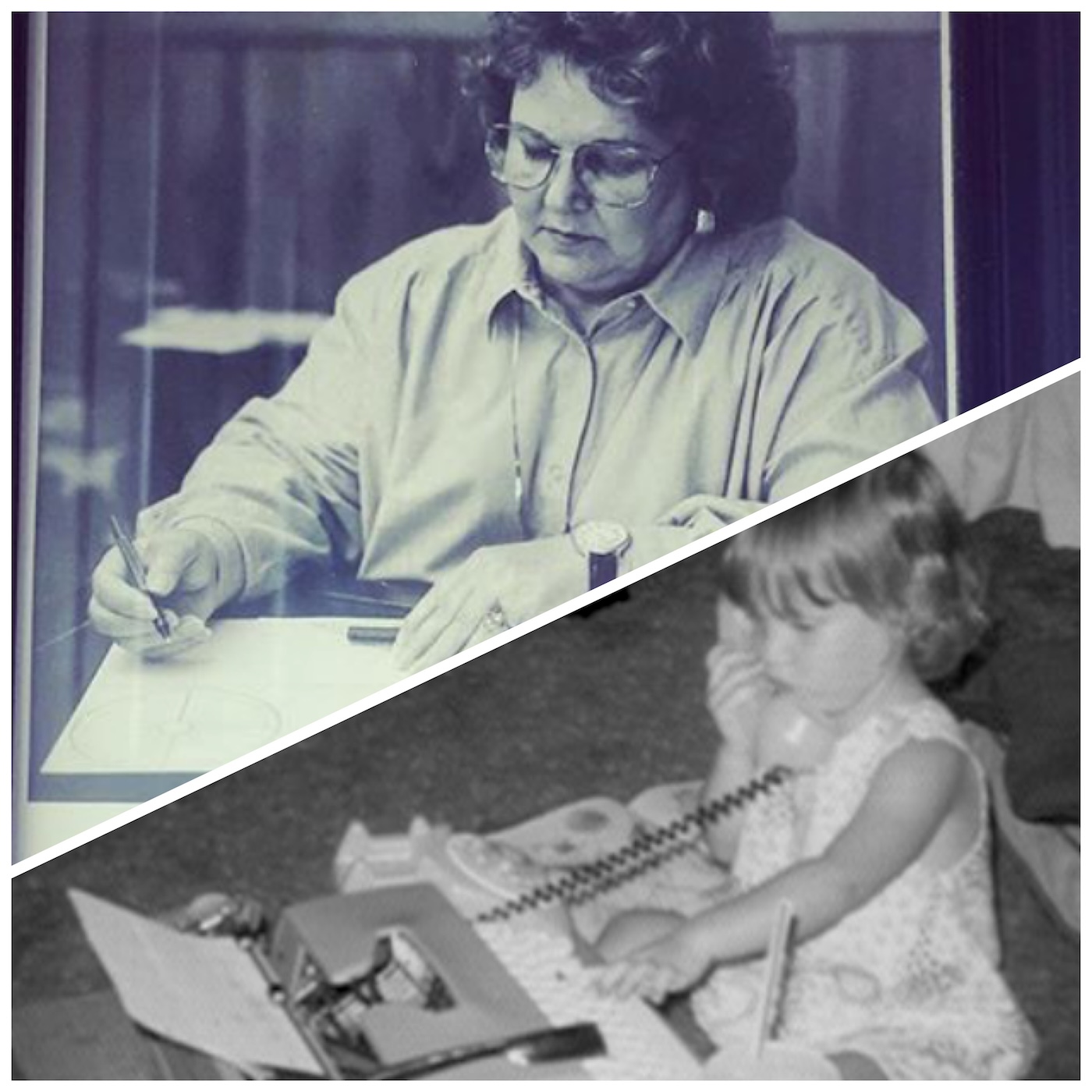
Bonnie Gillespie with mother Charlsie
Like mother, like daughter: Charlsie Gillespie, astrologer, and toddler Bonnie Gillespie, future astrologer.

Bonnie Gillespie Quotes

“Enoughness is less about ‘I’m good. I’ve got this,’ and more about ‘Whatever happens, I know I’m enough.’”

“You cannot let your enoughness rise and fall off what other people say because you can’t control what other people say. You can control what you say to yourself.”

“Venus is the planet of love, money, and enoughness. It’s the exchange of values for valuables. Venus says, ‘I receive because I am, not because I do or perform or please.’”

“Your work as an artist is to heal people who don’t have the ability to turn strong emotions into art. Your art helps people understand what they’re going through.”

“Sometimes, we need to spiral. Sometimes, at the bottom of that pit of despair is the next creative genius thing that we have to make.”

“When you understand how you are wired, you stop fighting against yourself. Your chart isn’t a set of rules—it’s a tool for self-awareness and working with your natural rhythms.”

“The stuff you are doing today is what will show up in your bank account five years from now. It’s the result of the work and relationships you’re building now.”

Consider how you are wired.

What motivates you? What keeps you inspired?

How can you honor your natural rhythms rather than fighting against them?

Bonnie Gillespie is living her dreams by helping others figure out how to live theirs. As a weekly columnist, she began demystifying the casting process for actors in 1999. Her most popular book is Self-Management for Actors, the curriculum upon which much of her teaching is based.

As a producer and Emmy-honored casting director, Bonnie specializes in indie darlings. Whether casting, coaching, or putting the woo in Hollywood with some Chart Harmony, she is passionate about leaving this world better than she found it.

Bonnie lives by the beach on unceded ancestral Tongva land with her partner, Keith Johnson, the luckiest man in the world.

Follow Bonnie on Instagram: @chartharmony

Bonnie Gillespie

Don’t miss new articles, podcasts, programs, and some of my favorite discoveries.

Sign up for my weekly newsletter.

The post Enoughness, Astrology, and the Artist’s Path with Bonnie Gillespie (215) appeared first on Art Biz Success.

]]>

You’ll Regret What You Don’t Take Action on Today (214) https://dy-online.com/take-action-today/ https://dy-online.com/take-action-today/#comments Thu, 30 Jan 2025 12:49:00 +0000 https://dy-online.com/?p=52713 This episode of The Art Biz and full post focus on the power of commitment and taking action toward your goals. Explore how to align your schedule with your values, overcome hesitation, and stop waiting for the "perfect time."

With practical strategies like inquiry-based reflection and small, intentional steps, you’ll discover how to move forward confidently. Whether it’s honing your craft, building connections, or pursuing opportunities, this episode inspires you to begin today.

The post You’ll Regret What You Don’t Take Action on Today (214) appeared first on Art Biz Success.

]]>
I started thinking about this post and podcast as an episode about TIME.

There’s never seems to be enough of it. Not today, not this week, not this season, and not even in a lifetime.

Watch or Listen

Time management? Forget about it.

We can’t manage time because the clocks keep ticking and the earth keeps going around the sun. Nothing we can do about that.

We can only manage ourselves: how we respond to what’s going on around us, what we consume, and the actions we take or (for our purposes) don’t take.

And, yet, many of us go through our days acting like we have all the time in the world to waste on things that don’t matter.

While I began thinking more about time, I eventually ended up at the importance of commitment. Stick with me and I’ll do my best to connect the dots.

Living Intentionally

When I reflected on how I was spending my time, I realized there were habits I needed to change to live more intentionally. One of those habits was cutting the cord on cable television last fall before the election. (Yes, I realize we were late to the party!)

There’s nothing wrong with unwinding in front of the television at the end of the evening. Thirty minutes of The Big Bang Theory wasn’t going to kill me, but 30 minutes could easily expand into two hours.

I don’t believe in maximizing productivity just for the sake of being productive, but I do believe in living intentionally rather than mindlessly. And I believe in examining my actions to see how they contribute to, or detract from, my well being.

Mindless television, after a certain amount of time, wasn’t making us happier. Something that costs that much money should contribute to our joy. Am I right?

I’m sorry we waited so long to kick the evening TV habit. We can never get back those hours.

Daniele Jones acrylic painting
© Daniele Jones, Kiki. Acrylic on canvas, 14 x 11 inches.

You'll Regret What You Don't Start Now

Looking back on the past and pointing to regrets isn’t, for the most part, helpful for a meaningful life. But we’re human. We have complex, uncontrollable thoughts that can be set off by any situation. We’re going to have regrets, so we might as well call them what they are.

And if you’re reading this, you’ve probably lived long enough to know that regret comes more from inaction than from the wrong action or from failure.

Students and clients often confess to me, “I wish I would have signed up for your program earlier. I thought I wasn’t ready.”

This makes me both happy and sad. I’m happy because they find value in the work we do together. They are making progress, building momentum, and enthusiastic about what lies ahead.

But I’m also sad when I think of the results they could haven been reaping all along if they had been following the lessons I teach in Essentials for Artist Success.

Leap Before You're Certain

You’ve probably heard the quote “Leap and the net will appear.” Imagine if we collectively started leaping with abandon, trusting that nets would magically materialize beneath us. While I appreciate the conviction of this sentiment, I’d tweak it slightly: “Research, plan, do the hard work, and leap before you are certain you’re ready.”

As the saying goes, the only certainties in life are death and taxes. If you wait for perfect clarity or assurance that your direction is the “right” one, you’ll miss the boat. Certainty doesn’t exist.

The good news is, if you follow my advice to research, plan and work hard before leaping, you already have a metaphorical net in place—one that you’ve been weaving and strengthening through your preparations.

This net represents the confidence you’ve built through preparation and hard work. It’s your safety net—not for avoiding risk, but for knowing you’ve done the groundwork to land on your feet. You can trust it to hold you when you take that leap.

That said, a word of caution: avoid falling into the trap of over-preparing. Some people spend their entire lives stuck in preparation mode, endlessly perfecting, researching, and tweaking. Or, perhaps more accurately, wasting their lives.

At some point, preparation must give way to commitment and action. The truth is, progress doesn’t come from planning alone. It comes when you commit to a path and start moving forward.

Lisa Wagner watercolor painting
©Lisa Wagner, Red, Right Returning. Watercolor on paper, 15 x 22 inches.

Hesitation Creeps In

What about you? Where might you be hesitating?

If you want to see your art in a museum one day …

  • Are you a member of that museum?
  • Are you visiting museums regularly and staying engaged with their programming?
  • Have you introduced yourself to the curator or attended their talks?
  • Most importantly, are you honing your craft to meet museum standards?

If you’ve always wanted to publish a book …

  • Are you writing consistently, even just a little every day?
  • Have you taken writing classes to improve your skills?
  • Are you learning about the publishing industry and what it takes to succeed?
  • Are you practicing by crafting compelling social media posts that tell stories and connect with readers?

If you’d love to attend an artist residency …

  • Are you researching the types of residencies and where you might fit?
  • Are you tracking opportunities and deadlines in a systemized way?
  • Are you reaching out to artists who have participated in residencies to learn from their experiences? (This is a topic that often comes up in our Art Biz Connection community and it’s inspiring to see members finding the answers and guidance they need.)

While you keep waiting for the right time, other artists are moving forward. Galleries and museums are curating shows. Collectors are adding to their collections. And they’re doing it without you.

Will you hesitate further? Or will you commit to taking action?

I’m not here to tell you what to commit to. That’s a deeply personal decision. But I will say this: You’ll regret not committing to something meaningful—something that inspires and motivates you. Something you can look back on with pride, knowing it was worth the effort.

What is that something for you?

It doesn’t have to be big. Sometimes the smallest action can set everything into motion.

Playlist: Something Meaningful

Sharon Curran Errickson oil painting
©Sharon Curran Errickson, Blush Crush. Oil and cold wax on panel, 12 x 12 x .25 inches.

The Myth of "The Right Time"

This leads me to another common hesitation I hear from students and clients: “This is not the right time for me.”

Here’s what I know: There is never a perfect time to expand your business.

You will never wake up one morning and say, “Hey, let’s do this thing NOW!” And you’re quite unlikely to hear a message from the goddesses that encourages you to take action. More likely, you will listen to the anxiety, fear, and apprehension that keeps you small and safe.

If you’ve been saying you want to grow your art business but aren’t taking actions toward that goal, you aren’t in alignment with the vision you want for your life. There is no time like the present to begin.

Now I get that there are moments in your life that are packed with other commitments. That’s what my planning workshops are all about—getting real about the ramifications of what you’ve already said Yes to and how that affects anything else you want to take on.

But I also know this: There will never be a “good time” to have an exhibit, approach a gallery, write a grant proposal, or give your first artist talk.

You have to make room for your priorities. We tend to put off things that make us uncomfortable, and I challenge you, the next time you’re tempted to turn down an opportunity, to ask yourself: Is this truly bad timing, or is there an underlying fear of what might happen if I take bold steps?

Because fear should never drive your decisions. Let your choices stem from a place of authentic curiosity and enthusiasm.

The Artist's Empowered Success Cycle

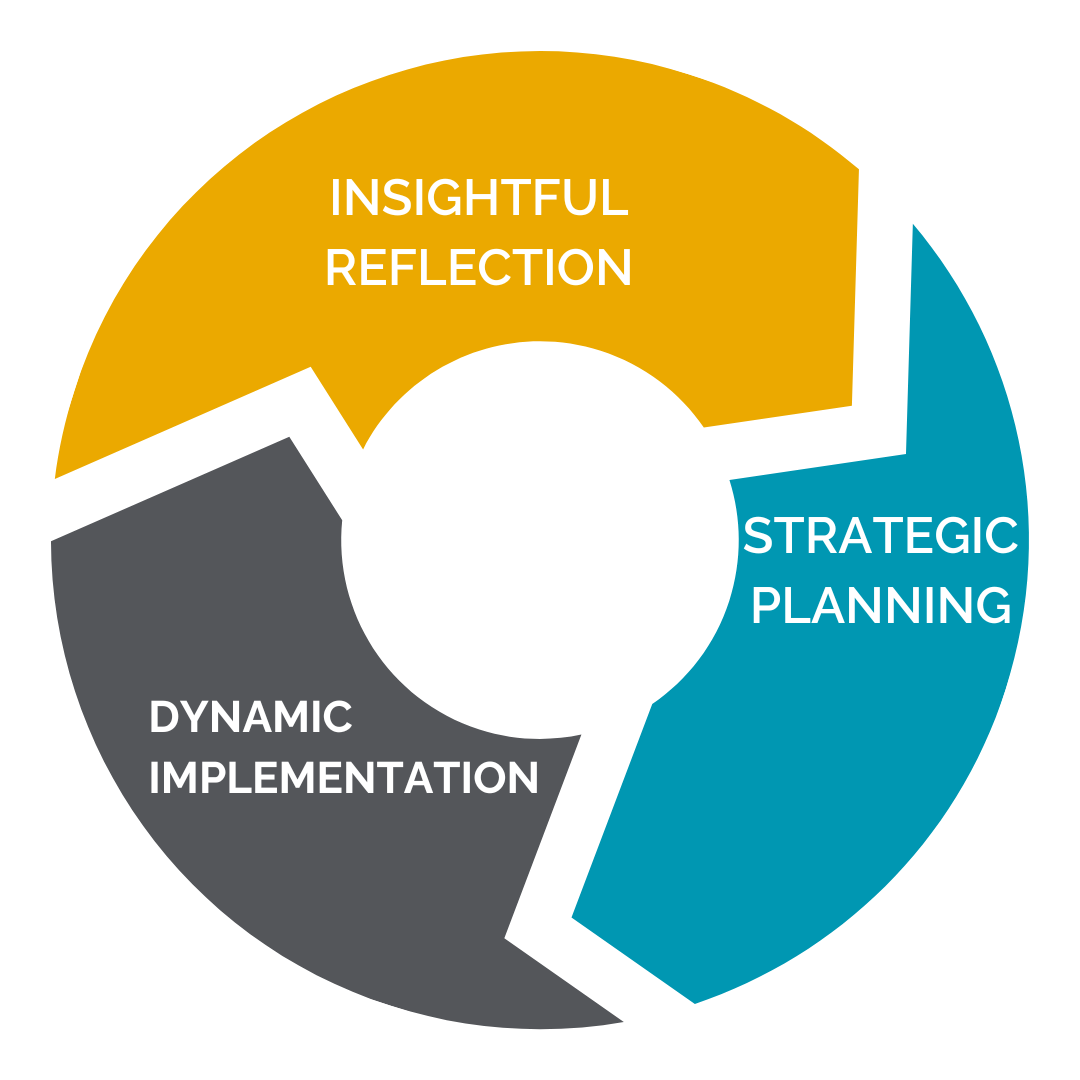
Stage 2 of what I call the Artist’s Empowered Success Cycle is Strategic Planning—a phase where you map out the upcoming months with clear goals, focused strategies, and actionable steps. This ensures alignment with your vision, time, energy, and other commitments.

Empowered Success Cycle

Strategic Planning is the bridge between stage 1, Insightful Reflection, and stage 3, Dynamic Implementation.

The stages are interdependent, forming a cycle that builds momentum and sustains progress. Without one, the others falter.

Yet, even the best-laid plans are, as I have been saying, made without certainty. You can’t predict with absolute confidence that every move will be right. You can’t control what happens in the world, how others will respond, or whether Mercury goes retrograde. You can only control your actions and your responses.

One of the tools we use throughout the Success Cycle is introduced in stage 2 and is called Inquiry for Progress.

Inquiry for Progress

One of the most valuable tools in this Success Cycle, introduced in Stage 2, is what I call Inquiry for Progress. When you feel stuck, unmotivated, or unsure of your next move, I encourage you to sit with questions rather than chase immediate answers.

Questions allow space for reflection, help you assess your level of commitment, and guide your decision-making.

Here are some examples of questions in this tool:

Why is this important to me?
What if I agree to this? What if I let it pass?
What’s the worst that could happen? What’s the best? Which scenario is easier to live with?
What obstacles will I need to overcome?

In today’s world, answers are everywhere—easy to find with a quick web search or conversation with the AI tool of your choice.

Sitting with these questions might feel uncomfortable at first, but that discomfort is where clarity and conviction are born. It’s in those moments of reflection that you uncover your deepest commitments.

Donna Dufault photograph
©Donna Dufault, Nothing is Perfect. Photograph.

Commitment

You can plan all you want, but until you’re fully committed to the plan—until you intend to implement it and give it your best shot—it’s not gonna happen. The Universe knows when you aren’t all in.

When you say you want something but don’t take action, when you pursue something for the wrong reasons, or when you think it’s something you should do, those are all forms of self-sabotage. I believe this is the primary reason plans fail: the commitment was never there.

As Scottish explorer William Hutchinson Murray wrote: 

Until one is committed, there is hesitancy, the chance to draw back, always ineffectiveness. Concerning all acts of initiative and creation, there is one elementary truth the ignorance of which kills countless ideas and splendid plans: that the moment one definitely commits oneself, then providence moves too.

All sorts of things occur to help one that would never otherwise have occurred. A whole stream of events issues from the decision, raising in one’s favour all manner of unforeseen incidents, meetings and material assistance which no man could have dreamed would have come his way …

Whatever you can do or dream you can, begin it. Boldness has genius, power and magic in it. Begin it now.

[ That last couplet has been attributed to John Anster. See the full story of this quote’s attribution. ]

You’ll never have a guarantee that your plan is the right one—because no such guarantee is possible.

But there is a clear way to know you’re on the wrong path: when you lack motivation to implement your plan. That lack of motivation signals a lack of commitment.

The right plan is something you feel deeply committed to. It gives you purpose, something to work toward—a reason to get out of bed in the morning.

Clark Sheppard acrylic painting
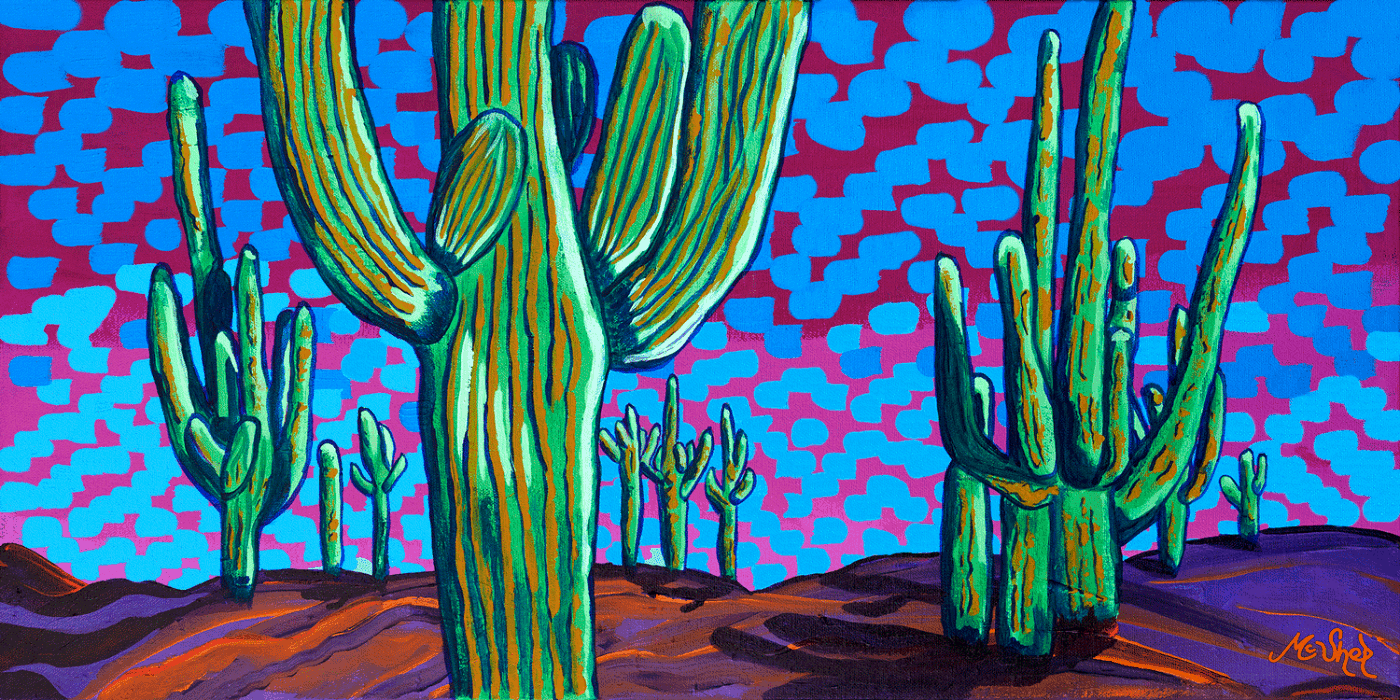
©Clark Sheppard, Iconic Saguaro. Acrylic on canvas, 24 x 48 inches.

Start Today

Hey, I know it’s easy to feel overwhelmed or unsure about your next steps. But you don’t have to figure everything out at once. Small, intentional actions can lead to profound change.

You have enough time to do what truly matters, as long as you’ve identified your values and priorities and let them guide your schedule.

To wrap this up, I encourage you to examine your level of commitment.

  • First, look at your task list and calendar. Does what you see reflect your commitment to yourself, your art, the life you want to live, and the person you want to be?
  • What might need to change to better align with that commitment?
  • Who or what are you allowing to interfere with your goals?
  • Where do you need to enforce boundaries that will protect your vision?

And finally, ask yourself: What one action can I take today—not tomorrow, not next week, but today—to remind me of my commitment to myself?

Remember, it doesn’t have to be a big step. It can be as simple as exploring a topic in your journal, writing an email you’ve been postponing, or spending 30 minutes with your sketchbook.

There is no reason to put off what could bring you positive results. What could bring you joy.

Whatever it is, let today be the day you take that step. The day you honor your commitment to yourself. Begin it now.

The post You’ll Regret What You Don’t Take Action on Today (214) appeared first on Art Biz Success.

]]>
https://dy-online.com/take-action-today/feed/ 2
Dealing with rejection with Megan Wimberley (197) https://dy-online.com/wimberley-rejection/ Thu, 25 Jul 2024 12:15:00 +0000 https://dy-online.com/?p=50379 Rejection is a part of every artist’s journey, essential for growth and success. Megan Wimberley, artist and founder of Cowgirl Artists of America, offers a framework to help artists move past rejection. She emphasizes the importance of mindfulness and professionalism in managing setbacks.

By embracing rejection, artists can push their boundaries, take more risks, and ultimately protect and elevate their reputations.

The post Dealing with rejection with Megan Wimberley (197) appeared first on Art Biz Success.

]]>
In order for the art ecosystem to work, many rejections must be handed out. You have, no doubt, discovered this and been the recipient of one or two.

This means to have a successful art business and career, you must learn to deal with rejection.

More to the point, in order to be successful in life, you have to learn to deal with rejection, regardless of your vocation.

Megan Wimberly painting
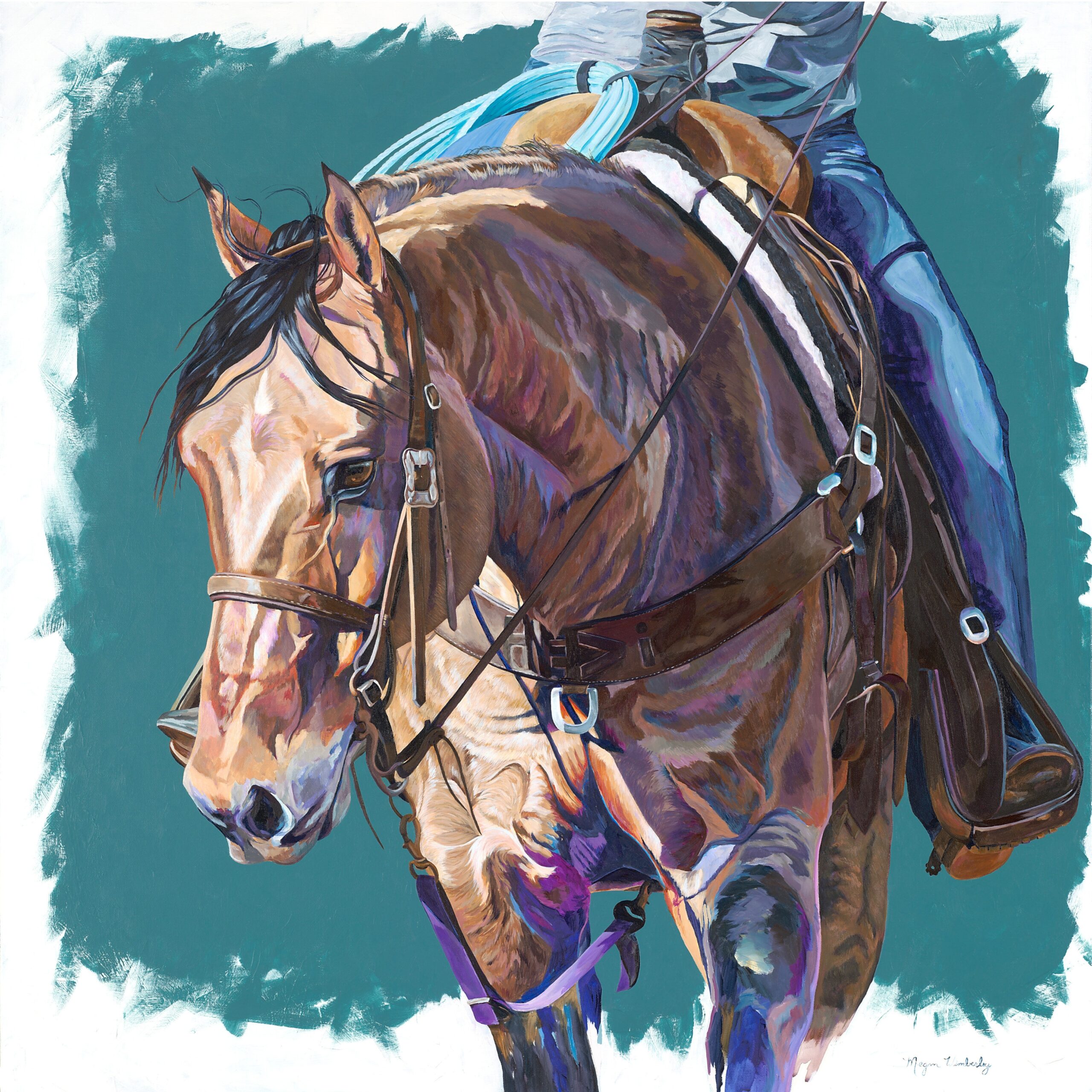
©2023 Megan Wimberley, At Ease. Acrylic on Canvas, 36 x 36 x 1.5 inches.

The good news about rejection is that you are not alone. Every artist who wants to attain a higher level of accomplishment must deal with rejection. If you aren’t counting your rejections, you aren’t taking risks or stretching your goals.

The bad news is … well … You’ve been rejected. And that feels awful. But you can’t let it stop you.

Help is here!

My guest for this episode of The Art Biz is Megan Wimberley, who wants to help you move past rejection. As both an artist and a founder of the Cowgirl Artists of America organization, she has experienced both sides of the process.

We discuss Megan’s framework for dealing with rejection, including the importance of emotional intelligence, mindfulness, and learning from the rejection—all in the service of elevating your professionalism and protecting your reputation.

Highlights with Audio Timestamps

01:48 The birth of Cowgirl Artists of America (CGA)

03:01 Balancing her art and organization admin

03:29 Exhibition programs and the jury process

06:42 We all experience rejection

08:57 Emotional intelligence and mindfulness

14:47 Every juror has a perspective and they will vary wildly from one another

16:24 Common mistakes in art applications

20:27 Space considerations are one reason you might be rejected

22:23 Handling rejection with professionalism

25:16 More about emotional intelligence and mindfulness

26:44 What are your rejections trying to tell you?

29:24 Rethinking that disgruntled email you may want to send

31:54 The importance of professional communication

36:53 Therapy and support systems for artists

38:44 Upcoming CGA exhibition and events

Megan Wimberly
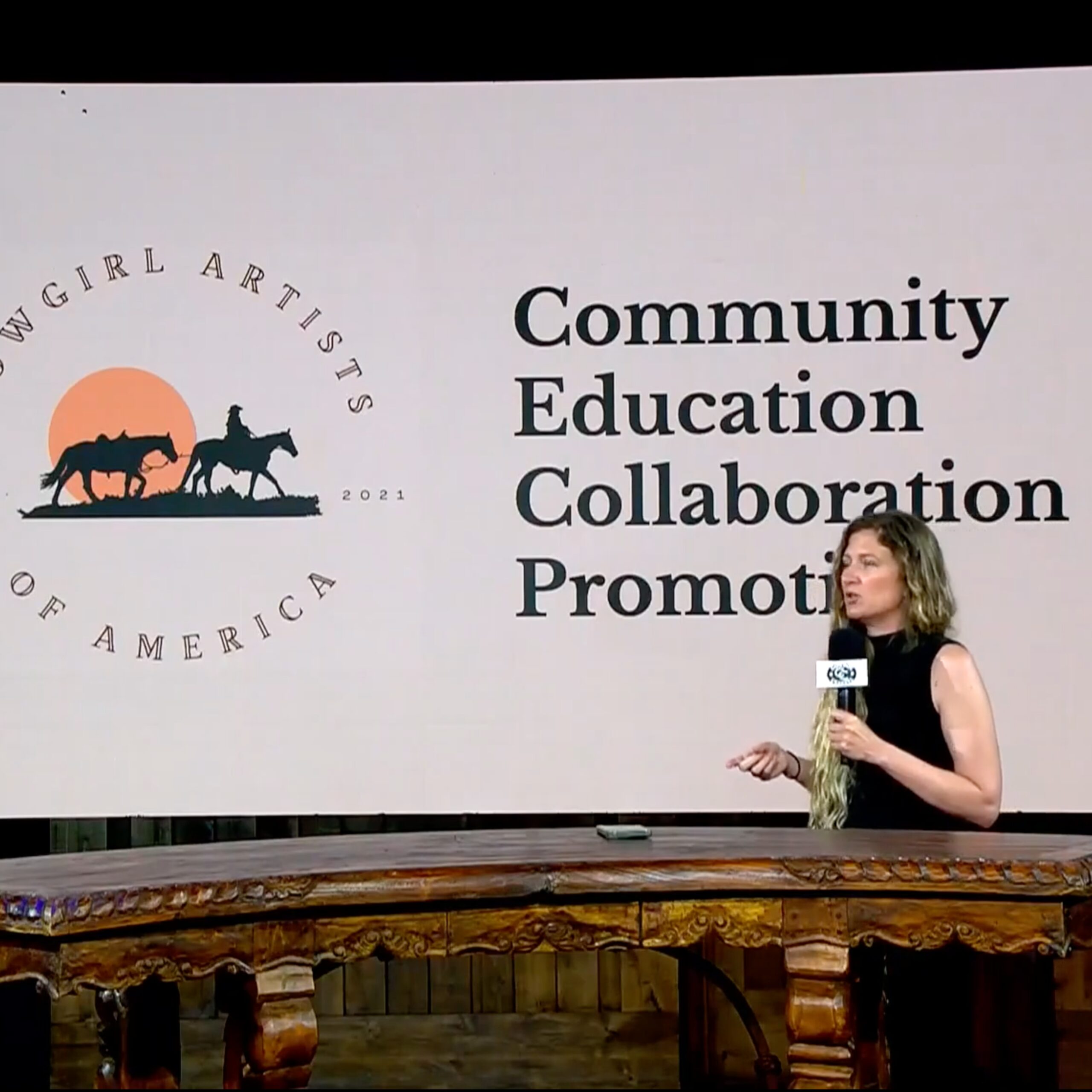
Megan speaking at the Essence Exchange on the Cowboy Channel in 2023

Improve Your Presentation

Spend time learning about how to get better rather than dwelling on rejection. 

Start with my comprehensive art-marketing program for building a lasting foundation for a successful art business … Essentials for Artist Success.

Then gain some insight by listening to these professionals discuss on The Art Biz what they look for in artists.

artist Collin Parson red plaid shirt smile in front of brick wall| on Art Biz Success

COLLIN PARSON
nonprofit gallery curator

MELISSA MESSINA
independent curator

Jeremy Tessmer, gallery director at Sullivan Goss

JEREMY TESSMER
commercial gallerist

Quotes

“We should all be in therapy.” —Megan Wimberley

“Sometimes when I’m dealing with something challenging and feeling big emotions, I imagine that I’m holding this little emotion in my hand and I say, ‘What are you trying to tell me? Because our emotions are trying to tell us something.’ ” —Megan Wimberley

“Because when we name the emotion, it’s this weird little thing in our brain. It takes a little bit of that sting and that power away.” —Megan Wimberley

“What you are communicating when you submit a poor application is I am not trustworthy.” —Megan Wimberley

“Tearing other people down is never going to lift you up.” —Alyson Stanfield

Photo Credit: Brittany Colt

From the moment Megan Wimberley could cling to a saddle horn, legs barely long enough to sit a horse, she was in love. Her fascination with the wild and domestic animals of the American West has dominated much of her life. She explores our connection with these animals, drawing on her experiences with horses, dogs, and cattle.

As founder of Cowgirl Artists of America, she champions female artists in the Western genre. Despite battling Rheumatoid Arthritis, Wimberley continues to create and inspire. Her work has been featured in Mountain Oyster Show and Cowgirl Up! among others.

Follow Megan on Instagram: @megan.wimberley

Follow CGA on Instagram: @cowgirlartistsofamerica

The post Dealing with rejection with Megan Wimberley (197) appeared first on Art Biz Success.

]]>

Beyond comparison and jealousy with Jason Kotecki (191) https://dy-online.com/kotecki-comparison/ https://dy-online.com/kotecki-comparison/#comments Thu, 30 May 2024 11:42:00 +0000 https://dy-online.com/?p=49596 More than 10 years ago in a crowded conference in Philadelphia, artist-writer-speaker Jason Kotecki had an epiphany. He realized that he had a talent stack that could set himself apart from other speakers.

In this conversation, Jason encourages you to find the additional gifts that will differentiate you from other artists and allow you to move beyond comparanoia and jealousy. We also discuss his income streams and collaborating with his wife, Kim.

The post Beyond comparison and jealousy with Jason Kotecki (191) appeared first on Art Biz Success.

]]>
What “game” are you playing in your art business and in life?

Artist-writer-speaker Jason Kotecki makes the point that you have a unique game plan to follow—one that can’t be compared to another artist or online personality.

Jason Kotecki oil painting
©2017 Jason Kotecki, Life's A Wave, Oil on canvas, 24x30 inches

Say goodbye to comparanoia. Adios to jealousy.

Comparing yourself to others is taking you off course and leading you down a path that was never intended for you.

More than 10 years ago, Jason—surrounded by hundreds of people at a conference in a Philadelphia ballroom—had an epiphany when he figured out his game plan of merging his artistic and speaking talents. He quit trying to be someone else and started using all of his gifts to set himself apart.

In this episode of The Art Biz, Jason and I discuss:

  • Practical steps you can take to curb our tendency to compare ourselves to others, which can often lead to jealousy.
  • The benefits of having a “talent stack” to differentiate yourself.
  • The breakdown of Jason’s income streams.
  • Collaborating in business with his wife, Kim.

Listen

Highlights

01:39 Embracing your unique ‘must be nice’

07:33 Merging art and speaking

16:28 The sketchbook comes first in Jason’s creative process

21:29 Navigating comparison and jealousy

24:04 Playing your own “game” in art and life and why it’s important

27:03 Embracing your unique artistic voice

30:12 Moving beyond comparison

37:03 Building diverse income streams as an artist

38:38 The power of partnership in art and business

40:30 Jason’s marketing strategies

42:28 Jason’s upcoming events and creating experiences

Jason Kotecki
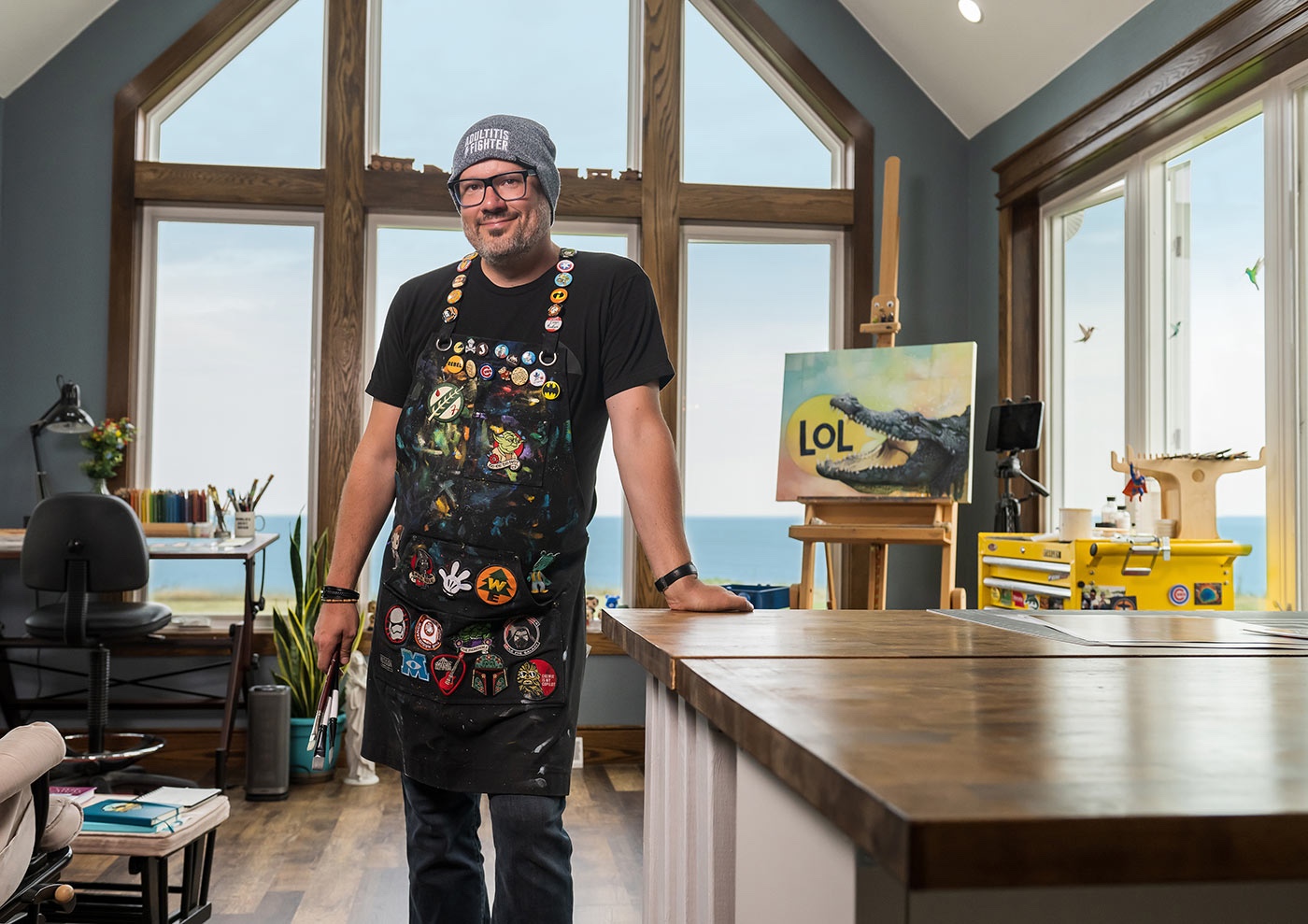
Jason in his Lake Michigan studio.

Mentioned

Jason Kotecki

Jason Kotecki Quotes

“I started to really think bigger about how I could incorporate my different talents.”

“It doesn’t do us any good to whine or complain or put ourselves down because of, or wish for someone else’s ‘must be nice.’ Our job is to figure out what ours are.”

“Comparison can be really good in a healthy way when we’re looking at where we want to improve—what we can learn from them.”

“Really drill down on what you are about. Why are you doing this? And when you have that certainty, it’s a little bit easier when you’re making this comparison.”

“The more we see ourselves like someone, the more likely we are to compare ourselves.”

“When we’re playing the comparison game, we don’t see the hard road they took to get there. The sleepless nights, the effort they put in.”

About My Guest

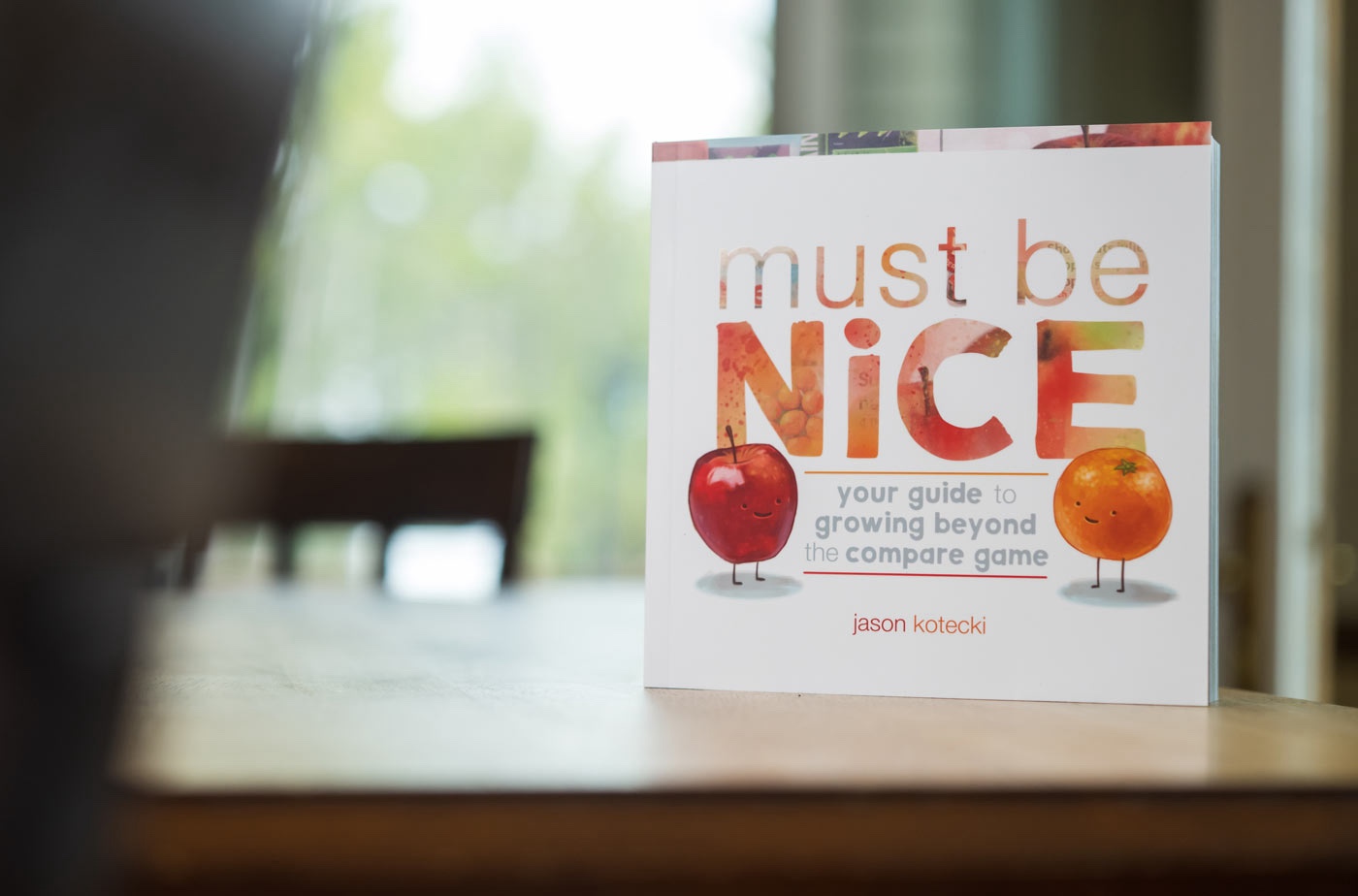
Jason Kotecki is an artist, author and professional speaker. Jason and his wife Kim have made it their mission in life to help people and organizations break free from Adultitis to build better lives, businesses, and teams. His colorful and whimsical art has been licensed and collected all over the world. He is the author of seven books, including Must Be Nice: Your Guide to Growing Beyond the Compare Game. An avid eater of sugar-laden cereal, Jason enjoys Star Wars, soft t-shirts, and brand new tubes of paint. He and Kim homeschool their three weird kids and live in Sheboygan, Wisconsin where they eat way too many cheese curds.

Follow him on Instagram @escapedadulthood

Jason Kotecki

The post Beyond comparison and jealousy with Jason Kotecki (191) appeared first on Art Biz Success.

]]>

https://dy-online.com/kotecki-comparison/feed/ 4
The career journey of growth-minded artists (186) https://dy-online.com/growth-minded-artists/ https://dy-online.com/growth-minded-artists/#comments Thu, 25 Apr 2024 11:45:00 +0000 http://artbizsuccess.com/?p=17373 I want to talk about something that gets in the way of how you think your art business possibilities: The ladder of success.

I want to help you reframe your daily decisions, actions, and results (or lack thereof)—to embrace the volatility of an artist life. To understand that there will be highs and lows, and that just comes along with the territory. To do this, let's consider a circle rather than a ladder.

The post The career journey of growth-minded artists (186) appeared first on Art Biz Success.

]]>
I want to help you reframe your daily decisions, actions, and results (or lack thereof)—to embrace the volatility of an artist life. To understand that there will be highs and lows, and that just comes along with the territory.

Why The Ladder of Success is Problematic

One of the most-used business metaphors is the ladder of success. When you picture a ladder of success, it’s assumed that you start at the bottom and work your way to the top in a predictable, progressive fashion.

You’re always going up head first—getting closer to the ultimate success goal at the top with each step.

What is left out of this visual are the detours, backslides, and missteps that occur on the way to the top.

It would be wonderful if you were always assured that your next step would be the right one to move you up the ladder. The irony is that while waiting for that assurance, you are delaying success.

Even a circuitous path with mistakes and failures will get you to the top faster than waiting for the right circumstances. As we like to say in our Art Biz Success classes and community, one step at a time and every step counts.

Every. Step.

Counts.

Listen

Mistakes and failures are your teachers, and you need them. They are red blinking lights that say, “This isn’t working for me. Go back and try again.” Or, more likely, “Do something differently.”

If you’re not failing at some points, you aren’t growing or progressing. You’ve got to become okay with making the wrong moves from time to time.

And yet … You never picture yourself on a ladder of success going backward, butt first, down the ladder—or falling off of it completely. That doesn’t conform to the narrative, but that’s exactly what happens.

You know this, but it has to be said … There is no such thing as a straight path to the top.

On the way to the top, you’re getting plenty of exercise running in circles. Perhaps falling behind—or what feels like falling behind because you’re so darn anxious for good things to happen. In reality, you’re picking up skills, learning life lessons, and becoming more agile.

If it’s too easy, you’re either doing something wrong or haven’t set the bar high enough.

So that’s my first beef with the ladder of success metaphor: It’s not a 1-way, nonstop trip to the top.

What Happens At The Top

There is another reason that the ladder of success is problematic.

Continue picturing the ladder. There you are at the bottom with your goal at the top.

What happens when you get to the top? Is it all over? Are you done with everything?

I have never heard of a single artist who thinks they’ve attained the highest level possible in their career.

I think that’s why I have a problem with the word “success”, even though I lead an artist coaching business and community under the Art Biz Success umbrella. Check out episode 165, How to Feel Like a Successful Artist, where I talked about why it’s so important to define success for yourself.

Regardless of the definition of success you settle on, growth-minded artists keep moving the target for success. They’re never quite satisfied with the status quo.

You will keep going for as long as you breathe.

You’re creative, after all. You want to learn more, improve your art, and flourish from accepting new challenges.

You want your art to be seen by more people, to be acquired by ever-prestigious collectors and institutions, and to leave a legacy.

Artists don’t reach the top and retire. They keep going!

So, if it’s not a ladder, what does your growth as an artist and artist businessperson look like?

You (The Sphere) in the Art Biz Circle

How about a circle? This is a concept I first introduced in 2014 and have recently refined.

Rather than climbing up a ladder, I envision you, the artist, in the middle of a circle.

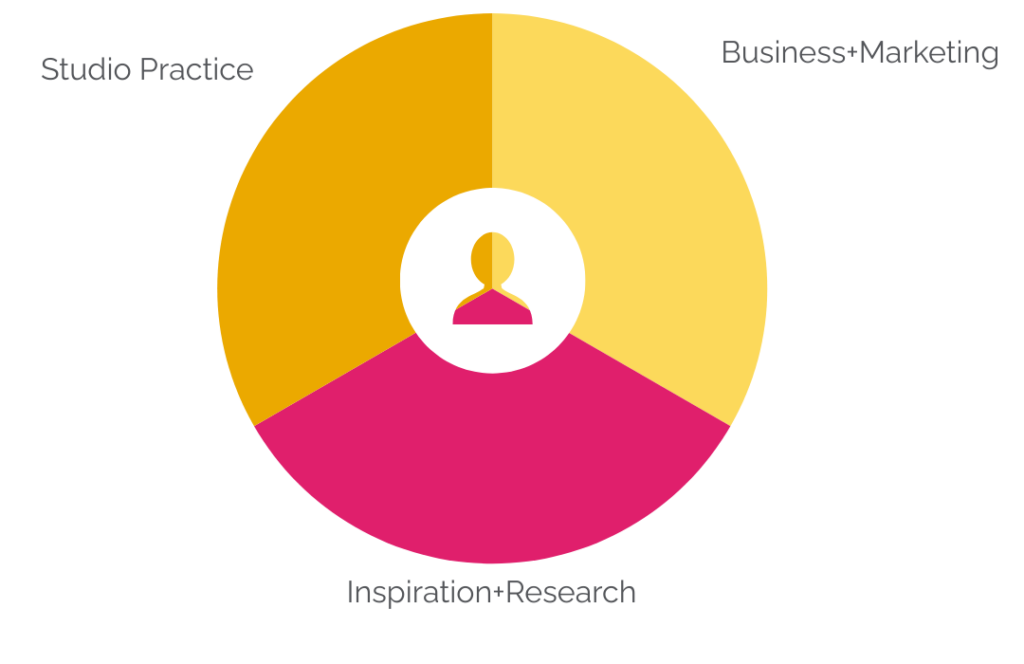
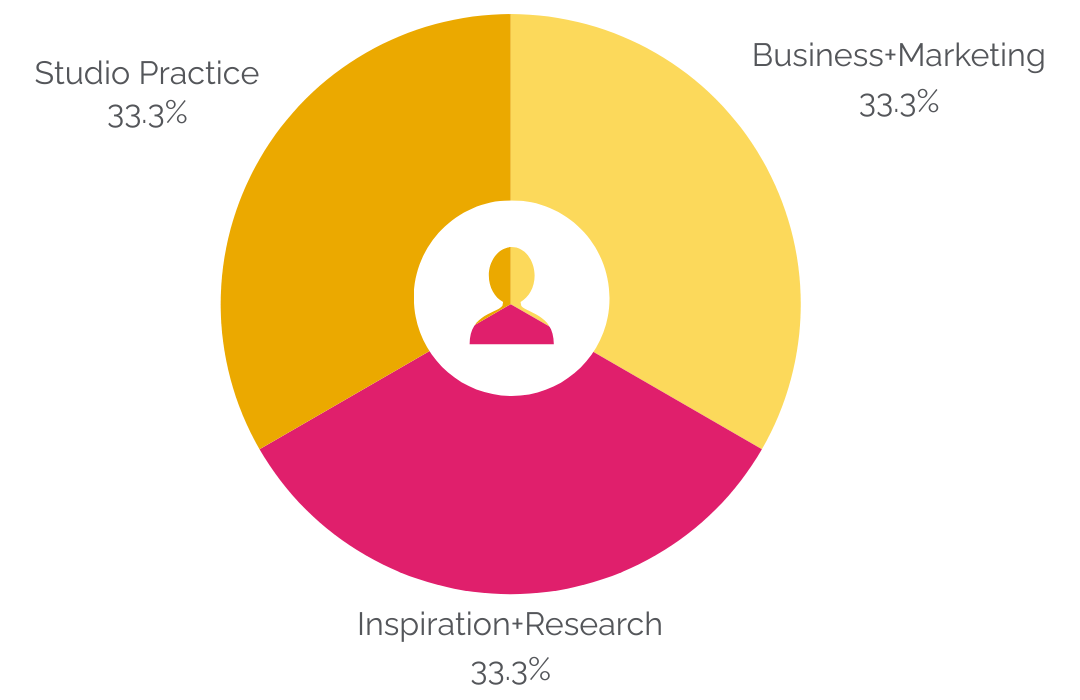
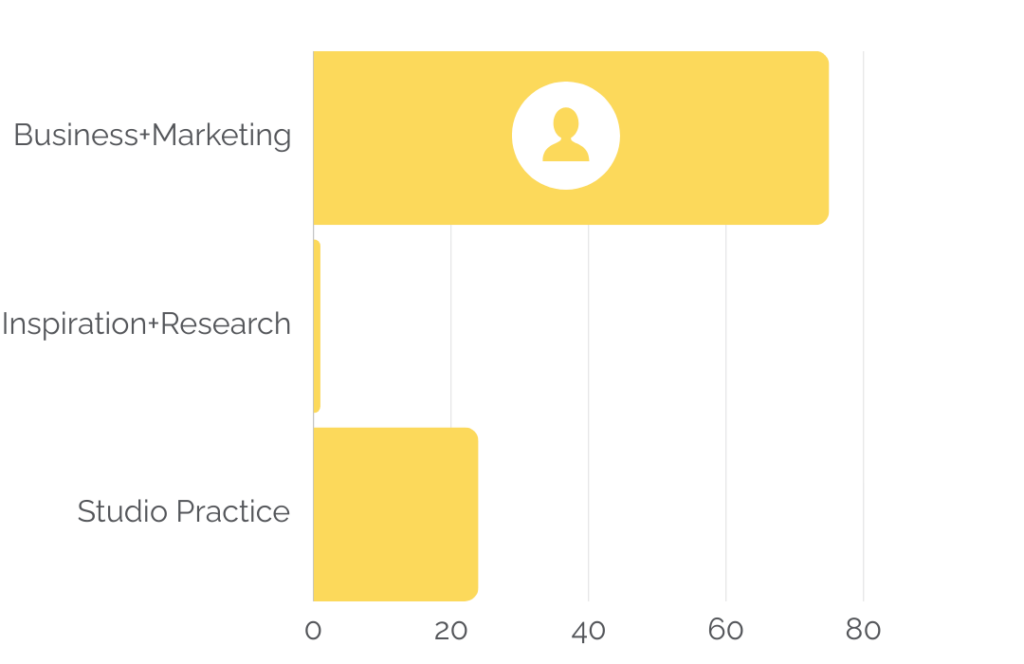
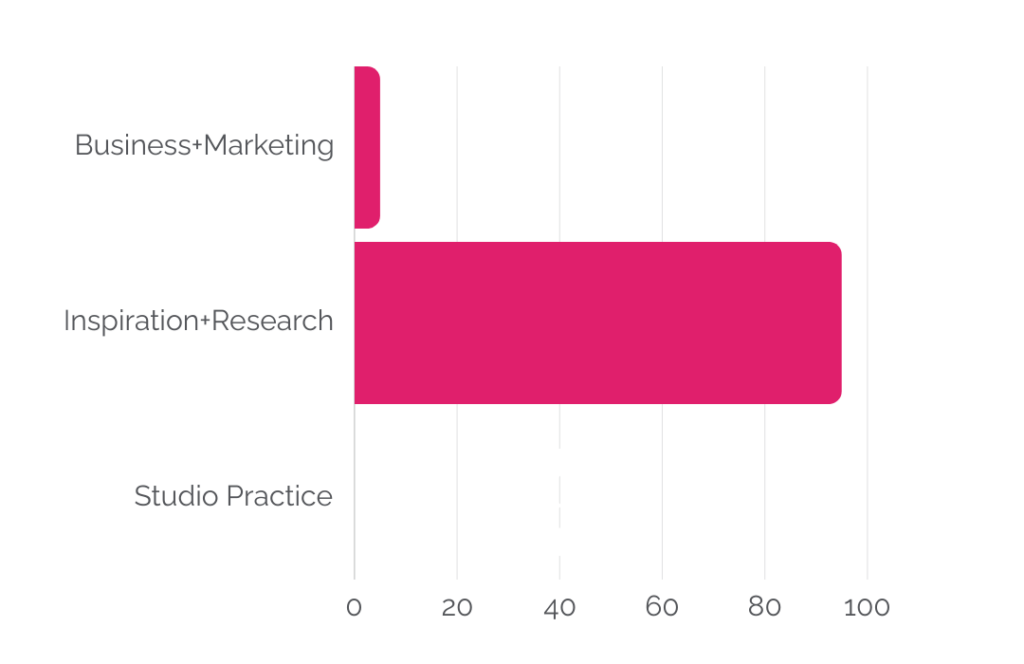
For fun, let’s say it’s a circular room. The room is divided like a pie chart with equal slices for the 3 primary areas that comprise an artist’s life and business: Inspiration + Research, Studio Practice, and Marketing + Business.

There are no walls between the sections, but you can see the difference because the carpet is a different color in each slice of pie.

Yes, carpet. (Go ahead, choose your favorite colors for this carpet lining your imaginary circular room. At what other time in your life will you be confidently committed to a magenta pile?)

Oh yeah, add some padded walls to your colorful, circular room. The plush surfaces aren’t an indication of your mental state. They’re to soften the blow because you’re bouncing from one area of your business and back again—from the studio, to your office, to the library, back to the computer, gotta get back to the studio …

You’re a life-size ping pong ball—a sphere within the circle—propelled by tremendous energy that comes from experimentation, luck, and promising results.

You are on a roll in the studio and engrossed in your latest area of research. Or you’re on a high from exhibition sales or enrollments for your workshop.

Then something happens and you lose momentum.

You come to a halt when you encounter rejection, criticism, health problems, and unforeseen personal woes. It’s easy for you, as said ping pong ball, to stop because, remember, the floor is carpeted—not a natural conduit for maintaining a high level of energy.

But I’m getting ahead of myself.

The 3 Primary Areas of Your Artist Life

Again, the 3 primary areas of your artist life are Inspiration + Research, Studio Practice, and Marketing + Business.

Inspiration + Research

Studio Practice

Marketing + Business

We could break down these large categories if we wanted.

Inspiration could be separate from Research, but where does one begin and the other end? Together, they are an arguably essential aspect to every serious artist’s studio practice, but they aren’t forgotten when you enter your den of making.

Inspiration + Research are mandatory to the continual push-pull process of creating. I’ve removed them from the Studio Practice area because I want to make sure all of my artist-clients and -students give enough of their time to I+R.

I+R is the fuel for whatever you make in the studio. It’s where you might return when things aren’t coming together as planned. It’s where you go when you are ready to begin a new work or series.

Let’s keep it simple and stick to these 3 areas and see what that looks like on a practical level.

Dividing Up Your Limited Time

Your imaginary padded and carpeted circular room has equal-sized pie slices because each of these areas of your artist life needs equal attention.

But that doesn’t mean that they are perfectly balanced. Ever.

It is rare that you would have a day or a week where you divided your time equally among your research, practice, and business. Don’t even try.

You move back and forth within the circle as your focus changes, depending on your goals and obligations. (Thus the need for something soft to land on.)

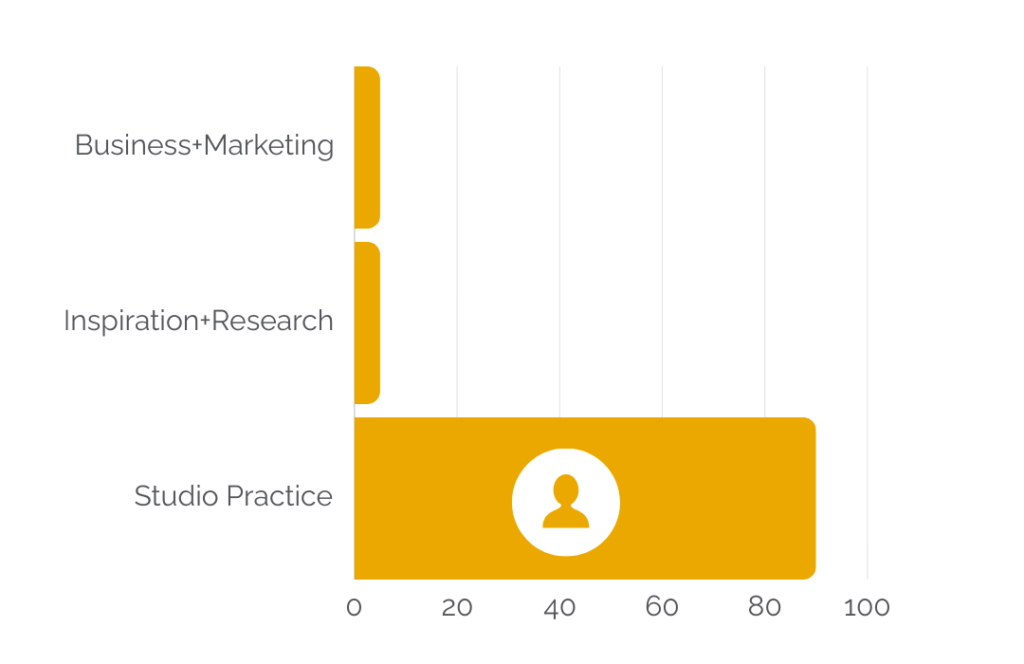
You might stay gleefully in studio mode for a week or two as you prepare for a show. Everything else gets minimal attention. (1)

It would be just as easy to find yourself frequently consumed by planning, learning, writing, marketing, and networking. (2)

1.

2.

3.

And don’t forget the times when, say, following a big show or event, you are depleted and need a vacation. Or you need to take a class or immerse yourself in a new subject to fill your well for new work. (3) You stay out of the studio, but publish your newsletter or post a couple of things to Instagram. Yay you!

Then You Do It All Over Again

Here’s thing. You are repeating the same tasks over and over. Regardless of where you are in your artist life.

This is why the learning modules in my Essentials for Artist Success classes were made so that they can be reused. You grow as an artist, but the tasks remain the same.

You need to rewrite your artist statement because your work has evolved. Or update your networking plan because your career growth demands that you connect with new people who can help you reach another goal. Or find new venues because you have outgrown the ones who are currently showing and selling your art.

The steps are the same, but the details are more customized and refined—reflecting the new artist you have become. 

Your Journey

To review … You don’t finish a marketing task and declare you’re done with it. You know you must return to it in the future. Ditto for inspiration and studio. You’re repeating many of the same things to build your business, month after month and year after year.

With this consistency and repetition, you become more sophisticated. You learn what does and doesn’t work, you adapt, and you add new tools, strategies, and technology. You expand.

So rather than looking like a ladder, your business growth looks like an expanding sphere (again, the sphere is you) within the circle.

You bounce around—backtracking, retracing steps, and searching for new paths that are more aligned with your current professional level and life circumstances.

The sphere gathers mass and gets larger. You’re growing as a result of all you have learned and accomplished within areas of your art business. And because you have new responsibilities.

You are moving forward and upward because you’re taking consistent action. Yes, there are still mistakes and failures, but the net, because of that consistency, is positive growth.

Each artist finds their personal trajectory. You will find your own way.

Again, I hope this helps you think about your art business in new ways—perhaps giving yourself a little grace with every misstep or inconsistency. Keep taking action.

This post was first published on March 26, 2014 and updated on April 11, 2018. It has been greatly expanded with the addition of a podcast episode. Original comments are intact.

The post The career journey of growth-minded artists (186) appeared first on Art Biz Success.

]]>
https://dy-online.com/growth-minded-artists/feed/ 41
Every Artist Is Designed Differently and What It Means with Jahje Ives (178) https://dy-online.com/human-design-ives/ https://dy-online.com/human-design-ives/#comments Thu, 15 Feb 2024 13:15:00 +0000 https://dy-online.com/?p=47723 We are each unique in our gifts and our approach to life and business.

What works for one artist might not be *just* a bad idea for another—it could also be a huge waste of time. Or even damaging.

Since learning Human Design, I’ve changed much of my approach to teaching and coaching to reflect the differences among artists—differences that they were born with. I wanted to share this tool with you.

The post Every Artist Is Designed Differently and What It Means with Jahje Ives (178) appeared first on Art Biz Success.

]]>
I want to share a tool I was introduced to a number of years ago that helps me in life and in my business. And it’s helped many of my clients.

It’s a life map, of sorts, called Human Design.

Jahje Ives Gate 11
©Jahje Ives, Tricia, Gate 11: Ideas. Watercolor and pencil on paper, 11 x 14 inches.

My guest for this episode of The Art Biz is Jahje Ives, an artist and a Human Design coach and guide. While I have worked with Human Design guides in the past, Jahje is the first artist I have met in this realm.

I wanted her insights as to how knowing your Human Design could help with your art and art business.

To get the most out of it, you have to have a little woo in you. As Jahje says, you might need to put on your tinfoil hat.

She’s going to tell you about the 5 different types of people according to Human Design (and Quantum Human Design):

  • Manifestor (Initiator)
  • Projector (Orchestrator)
  • Manifesting Generator (Time Bender)
  • Generator (Alchemist)
  • Reflector (Calibrator)

We discuss what each would mean for an artist. Human Design has taught me that there are no two people alike. We are each unique in our gifts and our approach to life and business.

What works for one artist might not be just a bad idea for another—it could also be a huge waste of time. Or even damaging.

Since learning Human Design, I’ve changed much of my approach to teaching and coaching, which is reflected in my Essentials art-marketing program and community conversations. I’ve started tuning in to the differences among artists—differences that they were born with—so that I can meet them where they will be able to thrive.

This episode probably isn’t for everyone, but if you’re open to the journey, please continue to listen. Maybe something will ring true.

Listen

Jahje Ives portrait project
Studio View of Jahje's Human Design 64 Gates Portraits Project.

Jahje Ives Quotes

“Can we just make this easy in life? Like can’t there just be a user’s manual for what I’m supposed to do?”

“Getting to see this map of who people were born to be was sort of the missing piece to why they were struggling to be somebody else.”

“It’s basically like being handed a map—an energetic map—to who you were born to be.”

“I’m telling you the story of who you were born to be.”

“[Human Design] is really a system that gets us out of our heads and back into our bodies and back in touch with like what our instincts are.”

“Why would you waste your precious energy on someone who’s not going to listen, who’s not going to shift, who doesn’t want it?”

“Instagram is great, because you can share it out on Instagram. You don’t need an invitation to be on social media.”

“It’s when you start to realize there’s nothing wrong with me—there’s actually so much right with me—and now I know what my gifts are and the things that I may have been ignoring are actually where I need to start concentrating that I can start feeling less unaligned.”

About My Guest

Jahje Ives is a Human Design Specialist, QHD Family Coach, and Transformational Artist who fuses her human design knowledge with her 15 years of experience as an artist, small business owner, and parent coach to help clients transform and re-align their lives with ease.

She is also a practicing artist with a studio just outside Philadelphia, PA. Her latest project exploring the 64 Gates in Human Design to create intuitive portraits of her clients to root them into the story of their Human Design.

Follow her on Instagram @jahjeives

Jahje Ives

The post Every Artist Is Designed Differently and What It Means with Jahje Ives (178) appeared first on Art Biz Success.

]]>
https://dy-online.com/human-design-ives/feed/ 2
Why you should raise the prices of your art and how to do it (177) https://dy-online.com/raise-prices/ https://dy-online.com/raise-prices/#comments Thu, 08 Feb 2024 14:04:11 +0000 http://artbizsuccess.com/?p=23370 Two things are clear when it comes to pricing.

First, it’s a struggle for most artists. And, second, there’s a good chance that your prices are too low.

The difficulty with pricing art is legendary. You’re not the only one who doesn’t have it all figured out.

Fear not! In this post and podcast episode, I give you 5 reasons to raise your prices and then thoughts on how to do it.

The post Why you should raise the prices of your art and how to do it (177) appeared first on Art Biz Success.

]]>
There isn’t much certainty around how to price your art, but two things are clear when it comes to pricing.

First, it’s a struggle for most artists. And, second, there’s a good chance that your prices are too low.

The difficulty with pricing art is legendary. You’re not the only one who doesn’t have it all figured out.

Even if you’re confident in your prices today, it’s almost guaranteed that you will question them again within a few weeks or months.

You heard it here first. You are not the only artist who has doubts about pricing.

And these doubts are compounded when your art isn’t selling. I’ll save that topic for another post.

Listen to this on The Art Biz

Anna Fine Foer collage
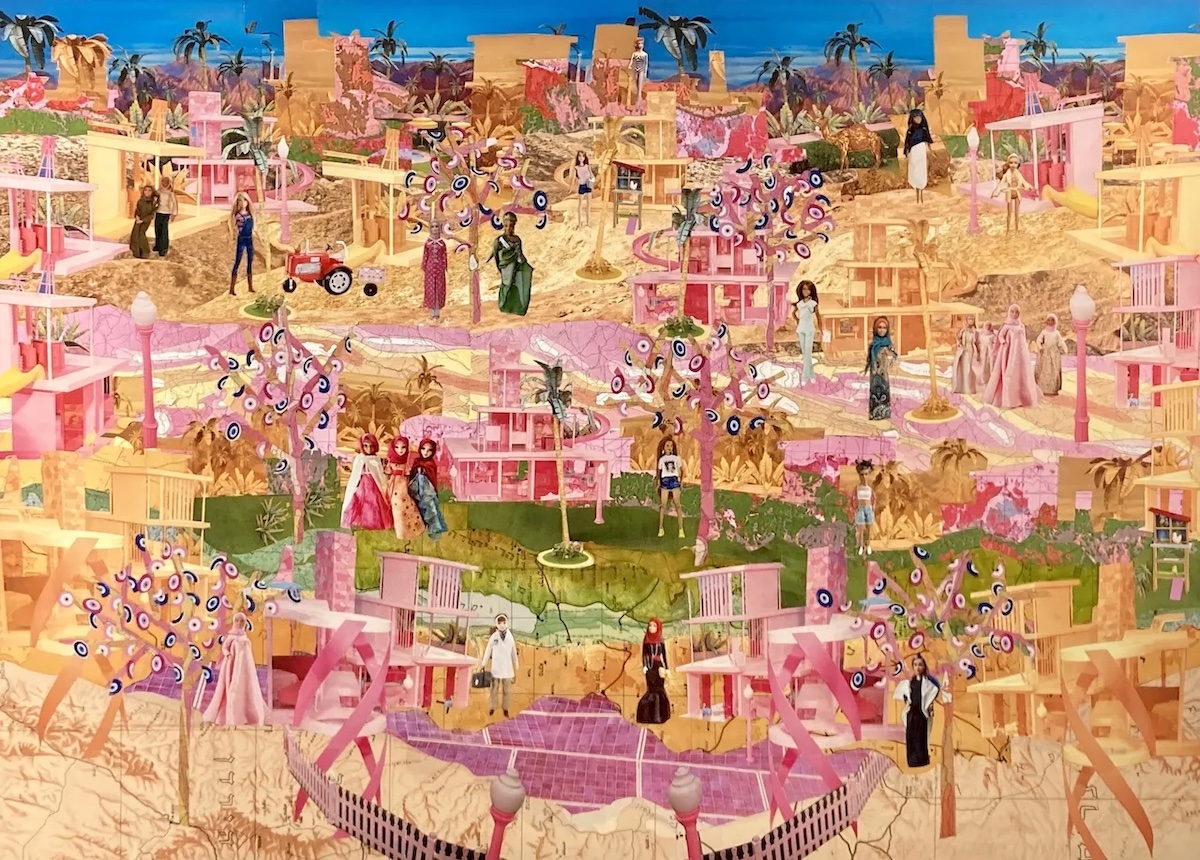
©Anna Fine Foer, Kibbutz Gan Barbie. Collage, 22 x 30 inches.

Your Prices Might Be Too Low

Knowing that the reservations about your pricing may always exist, let’s move on to that second thing. The probability that your pricing is too low.

Many artists—especially those who are just starting out—undervalue their art. Their work isn’t priced correctly to be able to split 50% of the sale with a gallerist, art consultant, or anyone else, let alone make a profit.

Artists who price their work too low are making things difficult for other artists who are pricing their work appropriately for the market and who need to make a living from sales.

It’s not good to be the “cheapest” artist.

I’m going to go out on a limb and assume that you would be happier getting higher prices for your art. But you don’t know if your art warrants it or if this is the right time. You’re scared to make the wrong move.

Fear not! Here are 5 reasons to raise your prices and how to do it.

5 reasons

to raise your prices.

1. The numbers reveal the depressing truth.

You’ve done the math and it’s depressing.

After taking into consideration everything that goes into making your art, you realize that you’re paying yourself next to zippo.

Nobody wins when you aren’t even covering your costs, let alone paying yourself. You must raise your prices.

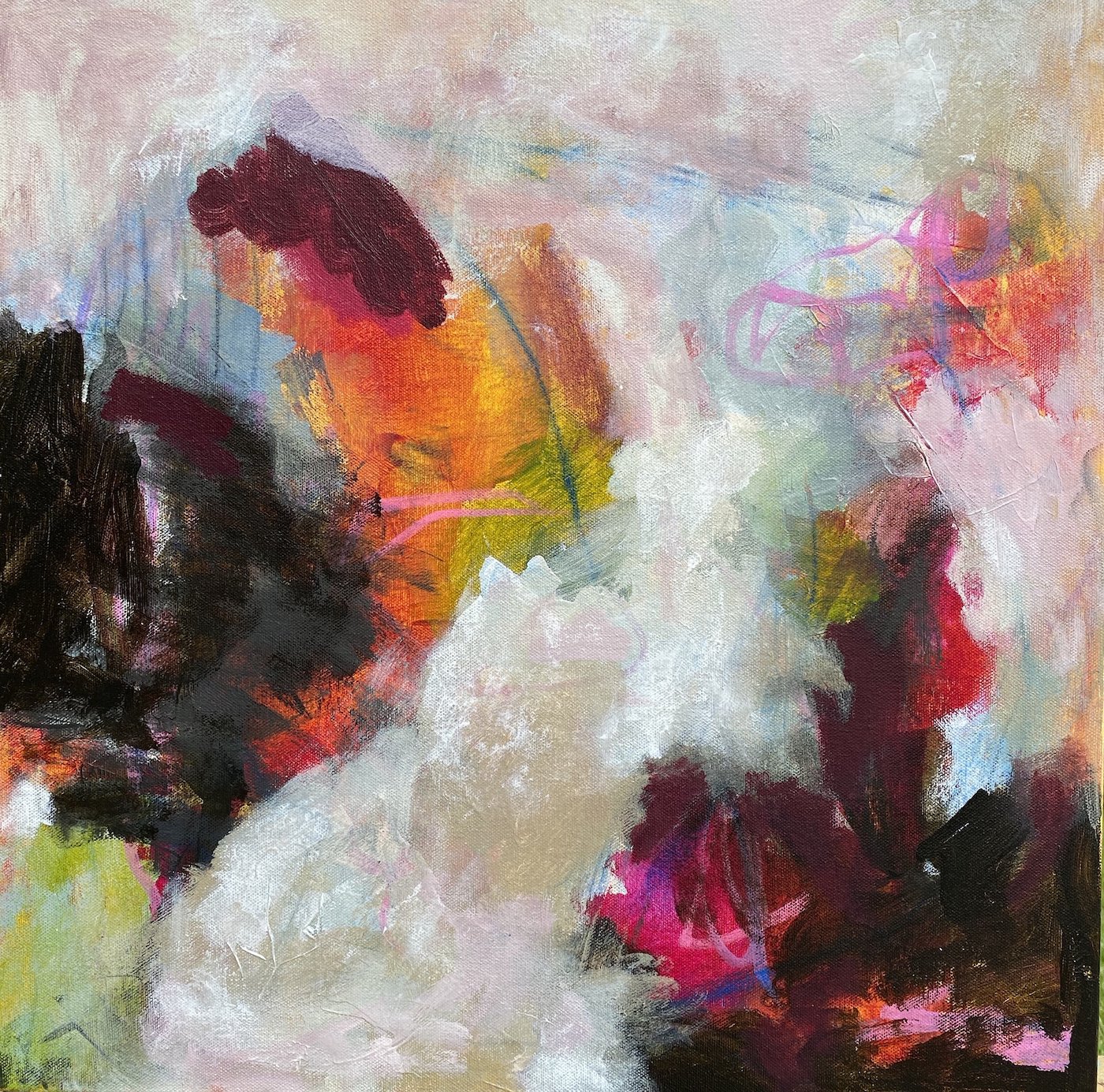
©Marli Thibodeau, Passionate Symphony V. Acrylic on canvas, 20 x 20 x 2 inches.

2. Your pricing is uneven.

If you notice that there isn’t enough difference between two sizes or two disparate mediums, consider raising the prices on those that seem too low.

It’s hard to account for different mediums. Or for work that needs framing and work that is on canvas, especially given that works on canvas often have a higher perceived value. (Don’t shoot the messenger!)

Yet, it’s easy, over time, for pricing to become skewed. Time to make adjustments and raise prices where necessary.

3. The cost of your materials has increased.

This is a no-brainer. If it costs you more to make it, you should be charging more.

Back in 2011, I followed an artist who was increasing her prices due to the soaring cost of silver. She wrote an explanatory email to her list, in which she shared a detailed graph showing the price of silver’s dramatic incline.

The graph made it much easier to understand. We can comprehend the big difference from $4.50 an ounce to $30 an ounce, but it’s even more dramatic to see a sharply ascending red arrow off the right side of a graph.

Aha! We get it. Her material prices have gone up.

If it costs you more to make it, you should be charging more.

Donna Levreault print
©Donna Levreault, Not Forgotten. Gelatin silver print, 12 x 12 inches.

4. You can't keep up with the demand for your art.

If you can’t make enough work to fulfill commissions and orders and maintain inventory to show at galleries or art festivals, you need to raise your prices.

It’s the law of supply and demand. (I retained some knowledge from Econ 101.)

Being in high demand sounds like a good problem to have, but it’s still a problem—especially when your prices are too low. You are justified in raising your prices when there is more work than you can handle.

5. You start selling through galleries or another new market.

You might be selling well on your own and come to the conclusion that you want your work to be in galleries. Or to be handled by a consultant. You realize that you must split the sale with someone else.

But (Doink!) you didn’t factor a commission into your pricing.

Best business practices warrant that you include a possible (future) 50% commission in all of your pricing. If you haven’t done that, you need to face the music and increase your prices tout de suite.

And … Let’s hope you don’t have to raise them 50% at once because that’s a shock to the system if they’ve been selling well at the lower prices.

Now, here’s how to put your new prices out there.

Shannon Amidon encaustic
©Shannon Amidon, Occhiolism. Encaustic on wood, 24 x 36 inches.

HOW TO RAISE PRICES

Commit. Take action.

If you sell through galleries, other retail spaces, or consultants and want to raise your prices, schedule a conversation with those in charge. You need their input because they know their market and what it will bear.

You want to know that they believe they can sell the work at higher prices.

If they agree, it’s a win-win. You make more and they make more.

When You Only Sell Directly to Collectors

If you only sell directly to buyers, you can raise your prices after doing your homework and meeting one of the criteria above.

Upon opting to increase your prices, make sure you have a plan to put all of the pieces into place.

Keep in mind that higher prices are usually only on new work. Will you stick to that rule of thumb or be raising prices on work you already have in inventory?

Rip off the Band-aid and go forward with confidence.

Always announce your decision first to previous purchasers of your work—giving them an opportunity to buy at your current prices.

They will understand your situation so there is no reason to be afraid of telling them.

Diane Leifheit pastel
©Diane E. Leifheit, Adirondack Bounty. Pastel on wallis paper, 30 x 40 inches.

What to Say to Collectors

Your collectors are the people who have been supporting you. You want to do everything to keep them happy and in the loop. Consider wording similar to this.

Things have been going very well for me, which is good news. On the flip side, I can’t seem to keep up with demand, so I need to raise my prices.

Because you’ve been such a valuable supporter, I want to offer my work to you at current pricing for the next 30 days. After that, my prices will increase by x%.

Of course you must be specific about which work the price increase will apply to.

Contacting them in advance and giving them an opportunity to add to their collection before your prices go up makes them feel special. It also build trust. They’ll have confidence, based on this one interaction, that you’ll always do right by them.

Collectors should feel good about investing in your art early on in your career. They’ll be delighted to know that you’re successful enough to raise your prices.

This post was originally published October 27, 2016 and has been updated with the edition of a podcast episode. Original comments left intact.

The post Why you should raise the prices of your art and how to do it (177) appeared first on Art Biz Success.

]]>
https://dy-online.com/raise-prices/feed/ 23
6 Ways to Be [Even] Happier About Running Your Art Business (155) https://dy-online.com/be-happier/ https://dy-online.com/be-happier/#comments Thu, 20 Jul 2023 12:34:25 +0000 http://artbizsuccess.com/?p=22522 Artists who embrace their role as CEOs of their businesses fare better than those who resist it.

Wishing away the responsibilities only leads to frustration and anxiety.

When you decide to turn your art into a business, do it wholeheartedly—finding joy in the journey rather than grumbling about the hard work. It's a matter of deciding how you want to navigate through life.

The post 6 Ways to Be [Even] Happier About Running Your Art Business (155) appeared first on Art Biz Success.

]]>
It’s no secret that we love some parts of our business more than others.

There is no way I can say with a straight face that I enjoy marketing and bookkeeping as much as leading my classes like Create Opportunities or coaching my dedicated private clients.

I don’t expect you to like everything you have to do.

I can, however, say with confidence that artists who happily embrace their role as CEO of their businesses do better than artists who fight it and wish they didn’t have to deal with the grind. Wishing won’t make it go away. It only makes you more frustrated, anxious, or resentful.

Pen drawing by Jennifer Mullin
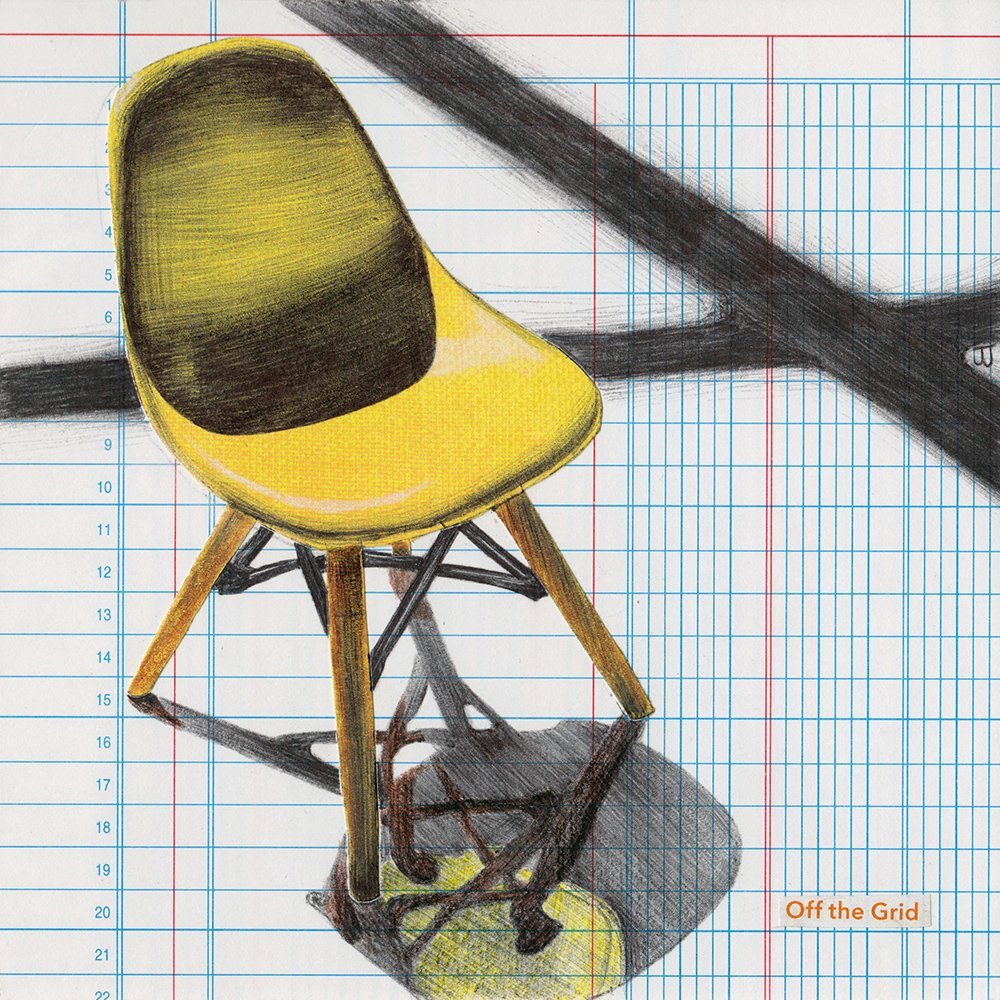
©Jennifer Mullin, Off the Grid. Collaged paper, ballpoint pen and white colored pencil on vintage ledger paper, 6 x 6 inches.

This doesn’t mean that you need to fake joy whenever you’re paying bills.

It means that you accept that it comes with the territory. You rise to the challenge because you know it’s a necessary step toward achieving your goals.

There are ways to be happier about running a profitable art business, but first you must decide that you want a business on top of making work in the studio.

I will continue to remind anyone who will listen that not every artist should turn their art into a business. It’s a whole different game when you start asking for money for your art, and many artists don’t feel the same about making art once they start offering it for exhibition and sale.

But if you choose to go the route of earning money from your art, do it wholeheartedly. Own it.

You can be pouty and grumble about all of the hard work necessary for something you said you wanted. Or you can find ways to enjoy the journey.

How would you rather go through life?

Listen

I choose to find ways to be happier, and to remind myself to be grateful for the incredible opportunity to control my destiny. To work with talented, generous, and inspiring artists.

I want to tell you what makes me happy about running my own business. What helps me get through the rough patches, and there are plenty of those! Then I’ll share some ideas for you.

On-demand workshop :: $37

ELEVATE YOUR ART

Museum-quality standards that convey higher values and allow you to confidently charge what your art is worth.

Young blonde woman sitting on a wooden bench in an art gallery. Looking at monochromatic artwork on the white wall.

What Makes Me Happy About Running My Business

Running a successful business means long hours and many sacrifices, but the rewards are unparalleled.

I am over the moon happy …

That I can work anywhere in the world and at any time of my choosing.

When Clients have Aha! moments. When they really get what I’m encouraging them to do or try. And then …

When students and clients implement what I’m teaching and start seeing results. We celebrate client results frequently as a team.

That I can introduce students and clients because I believe they might collaborate or inspire or motivate one another. And that later, sometimes years, I receive a photo from them after they finally meet in real life—often going out of their way to pay a visit on the other side of the country or even world.

When I receive an email or card full of gratitude from a client who took the time to write.

That I could go almost anywhere in the U.S.—and almost anywhere in the world—and meet up with someone who has read my book, listened to The Art Biz podcast, or been a student in one of my online programs.

All of these things make me ecstatic to have my business.

Oil painting by Tamara White
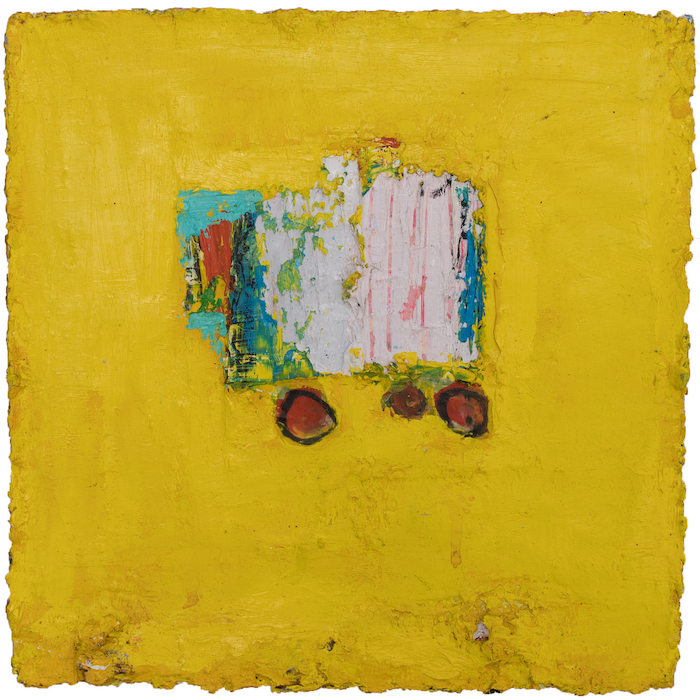
©Tamara White, Yellow Cart. Oil on canvas, 10 x 10 x 1.5 inches.

You Should Be Happy About

If you are listening to this you are likely an artist who can express yourself freely. Millions of people in the world face jail or worse for self-expression. Forgive me for should-ing on you a bit, but you should be a little happier to remember that you have this freedom.

Moreover, you should also be happy that you have the autonomy to start and run a business that focuses on something you have such a passion for.

If you have created a business from your art, you should be happy and extraordinarily proud that you took this initiative and built it from scratch. It’s a huge, brave step. You’re not just making money. You’re also building a legacy.

Many people will never have the guts to do what you’re doing.

Yes, there are things you have to do in your business that you won’t love, but avoiding them will only hold you back. Try to have fun along the way. Try to smile more, and remember your blessings and all you’re grateful for.

Discover the little things that bring you joy, and do more of them.

Because I’ve been working with artists like you for so long, I have an idea or two (6, to be exact) that might make you even happier about running an art business.

Acrylic painting by Jane Barefoot Rochelle
©Jane Barefoot Rochelle, #33 Lions. Acrylic, 24 x 30 inches.

1. Go complaint-free.

Stop complaining about being so busy or about doing work that you don’t like. It’s exhausting to be on the receiving end of this, and it feeds a negative mindset.

Complaining is an enormous waste of energy–yours and that of those around you. Nobody wants to be around a complainer, and the complainer just keeps digging a deeper hole for their woes.

It’s easy to jump on the whining bandwagon, and more difficult to ignore the noise and irritations. Notice the things that are riling you up and practice ignoring them. I say practice because this is a muscle you will build.

Stop complaining. Period. Then get to work.

On-demand workshop :: $37

ELEVATE YOUR ART

Museum-quality standards that convey higher values and allow you to confidently charge what your art is worth.

Young blonde woman sitting on a wooden bench in an art gallery. Looking at monochromatic artwork on the white wall.

2. Raise your prices.

There are few things more dispiriting than selling your art for a price lower than what it’s worth.

[ Free report: How to Price Your Art ]

You’ll be happier when you place a proper value on your time, talent, and effort. Low prices hurt other artists as much as they hurt you.

I love it that two members of my Art Biz Accelerator just held virtual hands and raised their prices 20%. Together. They each knew they needed to do this, but it was a  big deal for each of them. They took the plunge because of the extra support and accountability, and they’re both doing better than ever.

Abstract painting in blues, golds, and pale yellow by Pamela Hirsch.
©Pamela Hirsch, Paleochora. Oil and cold wax on a Baltic Birch wood panel, 12 x 12 x .5 inches.

3. Collaborate more often.

I seem to have to remind students and clients how important their network is, and that they need to make a point of seeking collaborations.

I use the term collaboration broadly to refer to working with other people to advance your goals as an artist. Any. Other. People.

Seeking collaborative relationships is some of the highest level thinking I’ve witnessed in the thousands of artists I’ve encountered over the past 2 decades.. Artists who collaborate simply have more ambitious goals.

I’ll give you four quick examples from The Art Biz.

In episode 27, Jill Powers talked about how she collaborated with volunteers, chefs, scientists, venues, and more for a single exhibition.

In episode 86, Jerry McLaughlin and Rebecca Crowell discuss how they collaborate on a learning platform for artists.

In episode 126, Willie Cole reveals how he collaborates with top brands.

In episode 153, Danielle SeeWalker discusses a long-running photo and film documentary with a fellow artist.

All very different collaborations designed to help the artists fulfill their creative visions.

I know it can sometimes be frustrating working with other people, but the potential reward is too promising to overlook. As curator Melissa Messina said in episode 136, your network is everything.

Not only will you be happier when you collaborate, you will also stretch your business muscles and expand your audience when you bring more people in on what you’re doing.

That brings me to my next idea for how to be happier about running your art business.

Photograph by Fred Newman
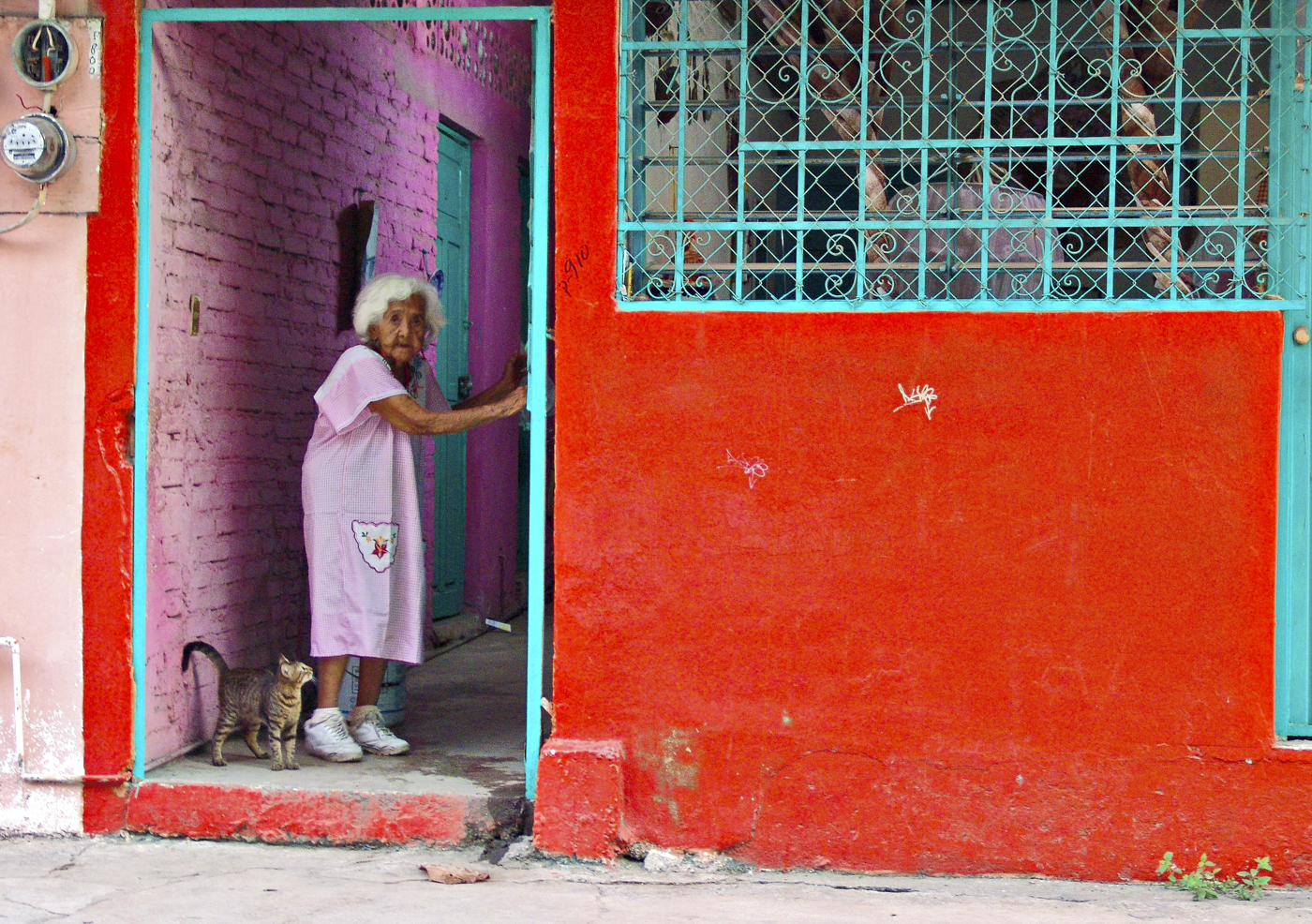
©Fred Newman, Woman in Purple with Cat. Photograph.

4. Find your (artist) people.

I don’t have to tell you that the artist’s life can be solitary. You might be okay with that. I know how much I value my alone time.

But there is no reason you should try to figure out all of the pieces of your art business on your own. Your people—other artists who get you—are out there somewhere.

Within the right artist community you will:

  • Learn about opportunities before they are ever made public.
  • Find understanding for your challenges.
  • Get help figuring out strategies for your next move.
  • Celebrate your wins with like-minded spirits.
  • Be inspired by artists you admire.

Artists’ communities are everywhere, but you must make the effort. It might be a local artist group or perhaps an online community like our Art Biz Connection, which you’ll find at ArtBizConnection.com.

As I like to say, it’s fine to DIY (Do It Yourself) but you don’t have to DIA (Do It Alone).

5. Encourage someone else.

Be happier by making a fellow human happy.

Send a direct message to tell someone what a great job they’re doing. Brag on your students. Brighten someone’s inbox, Facebook page, or mailbox with your art.

I’m not encouraging you to spam people with your art, but if you make uplifting art, send images of it along with sincere love and gratitude to your friends and family. Imagine their joy when they receive your message.

This should make you smile.

Acrylic painting by Jane Appleby
©Jane Appleby, Colourful Conversations 1/2. Diptych acrylic on canvas, 20 x 32 inches.

6. Get your art and yourself out of the studio.

There are stretches of time when you must disappear into the studio—laser focused on making new work. Eventually, you have to come out of hibernation.

Too much time alone in the studio isn’t good for your mental health, your creativity, or your prosperity.

What happens when you’re in the red and unfulfilled? Disappointment, negativity, gloom.

Getting your art out of the studio and in front of people gives you a greater chance of selling it. The circle of creation is complete because people are viewing and responding to it, and you are connecting with those people.

This leads to greater happiness.

Connection is the Strongest Theme

The strongest theme that emerges from this list of 6 ways to be happier about running an art business is connection.

Connecting with the right people can lift your spirits—whether you’re initiating collaborations or being a valued member of an artist community.

And remember that you don’t have to do all of this. It’s what you said you wanted.

You have freely created an art business where none existed before. Be proud of all that you have accomplished on your own while knowing that you don’t have to do it alone.

If you have been missing that community of artists, but haven’t found your people, we’d love to have you join us in the Art Biz Connection. 

This post was originally published on May 5, 2016, updated May 1, 2019, and has been updated significantly with original comments intact.

The post 6 Ways to Be [Even] Happier About Running Your Art Business (155) appeared first on Art Biz Success.

]]>
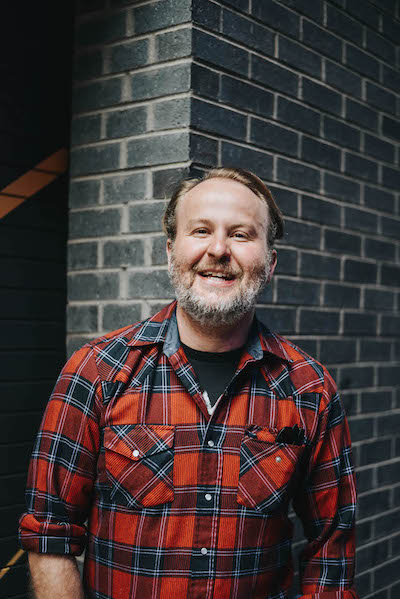
https://dy-online.com/be-happier/feed/ 28