planning Archives - Art Biz Success https://dy-online.com/tag/planning/ Trusted Art Business Coaching and Consulting Mon, 20 Jul 2026 21:07:29 +0000 en-US hourly 1 https://wordpress.org/?v=7.1.4 https://dy-online.com/wp-content/uploads/2022/02/favicon-2-150x150.png planning Archives - Art Biz Success https://dy-online.com/tag/planning/ 32 32 5 Timelines to help you plan https://dy-online.com/timelines/ https://dy-online.com/timelines/#comments Wed, 02 Apr 2025 16:52:48 +0000 http://artbizsuccess.com/?p=15748 Planning ahead can make all the difference in your art business.

In this post, I share 5 essential timelines to help you stay organized and reduce last-minute stress. From publishing a blog post to promoting a solo show, updating your website, and following up with contacts—these timelines give you structure so you can focus more on your art. Use them as-is or adapt them to fit your unique workflow.

The post 5 Timelines to help you plan appeared first on Art Biz Success.

]]>
If you’ve ever found yourself scrambling at the last minute to meet a deadline—or worse, completely forgetting something important—timelines might be your new best friend.

They provide structure and clarity so you don’t have to reinvent the wheel every time you plan a show, write a newsletter, or update your website.

I use timelines extensively in my Artist Planning Workshops, and today I’m sharing five of my go-to versions to help you sleep better at night, knowing your bases are covered:

  1. Timeline for Publishing a Blog Post or Artist Newsletter
  2. Timeline for Designing Your Artist Website
  3. Lead Times for an Art Show
  4. Timeline for Promoting Your Solo Show
  5. Schedules for Following Up with People
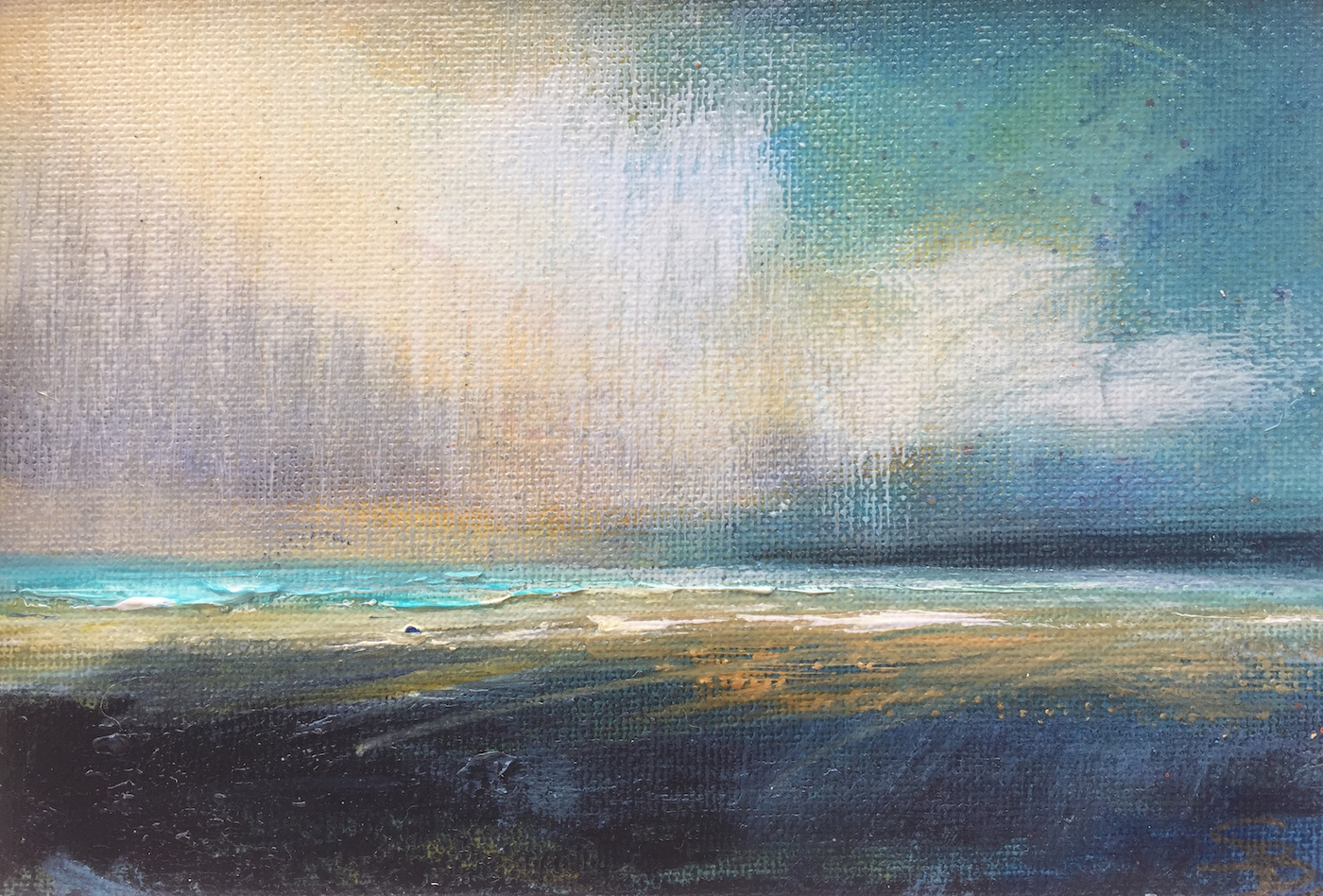
Sarah Jane Brown oil painting
©Sarah Jane Brown, Balanced. Oil on canvas, 13 x 18 centimeters.

1. Timeline for Publishing a Blog Post or Artist Newsletter

Publishing is a process. Nobody writes a publishable article on the first draft.

Even seasoned writers need plenty of time and space, so give yourself a break and acknowledge the amount of time you need.

Schedule your writing and editing time wisely.

  • Ongoing :: Gather content ideas. Don your journalist cap and be on the lookout for things to write about.
  • 1 Week out :: Write your first draft.
  • 2 Days before publishing :: Edit your draft.
  • 1 Day before publishing :: Do your final edit. Schedule your post or email for delivery.
  • Publishing day :: Share on social media.

2. Timeline for Designing Your Artist Website

While sites like SquareSpace and FASO make it easy to build a functional, attractive artist DIY website, you might decide your time is better spent elsewhere. If so, your first step to a new website is interviewing (then hiring) a designer.

Designers have lots of other clients and need to squeeze you into their calendars.  Simultaneously, begin researching sites so that you know what you want and like.

The schedule below is an example. You will need to  agree with your designer on deadlines and adhere to them. Once you miss a deadline, the designer will move on to another client and put you at the back of the queue. 

  • 2-3 Months from launch :: Finalize design, navigation, and page content. Everything you add after this point will be an additional charge if working with a designer.

    [ See Presenting Yourself Professionally on Your Artist Website with Jessica Burko ]
  • 7 Weeks from launch :: Rewrite or update text.
  • 5 Weeks from launch :: Give final text and images to the designer.
  • 2 Weeks from launch :: Review draft pages that designer has created. Make any suggestions for improvements.
  • 1 Week from launch :: Review final pages, read all of the text, and test all links. Your designer is responsible for the design. You are responsible for making sure it works as you would like.
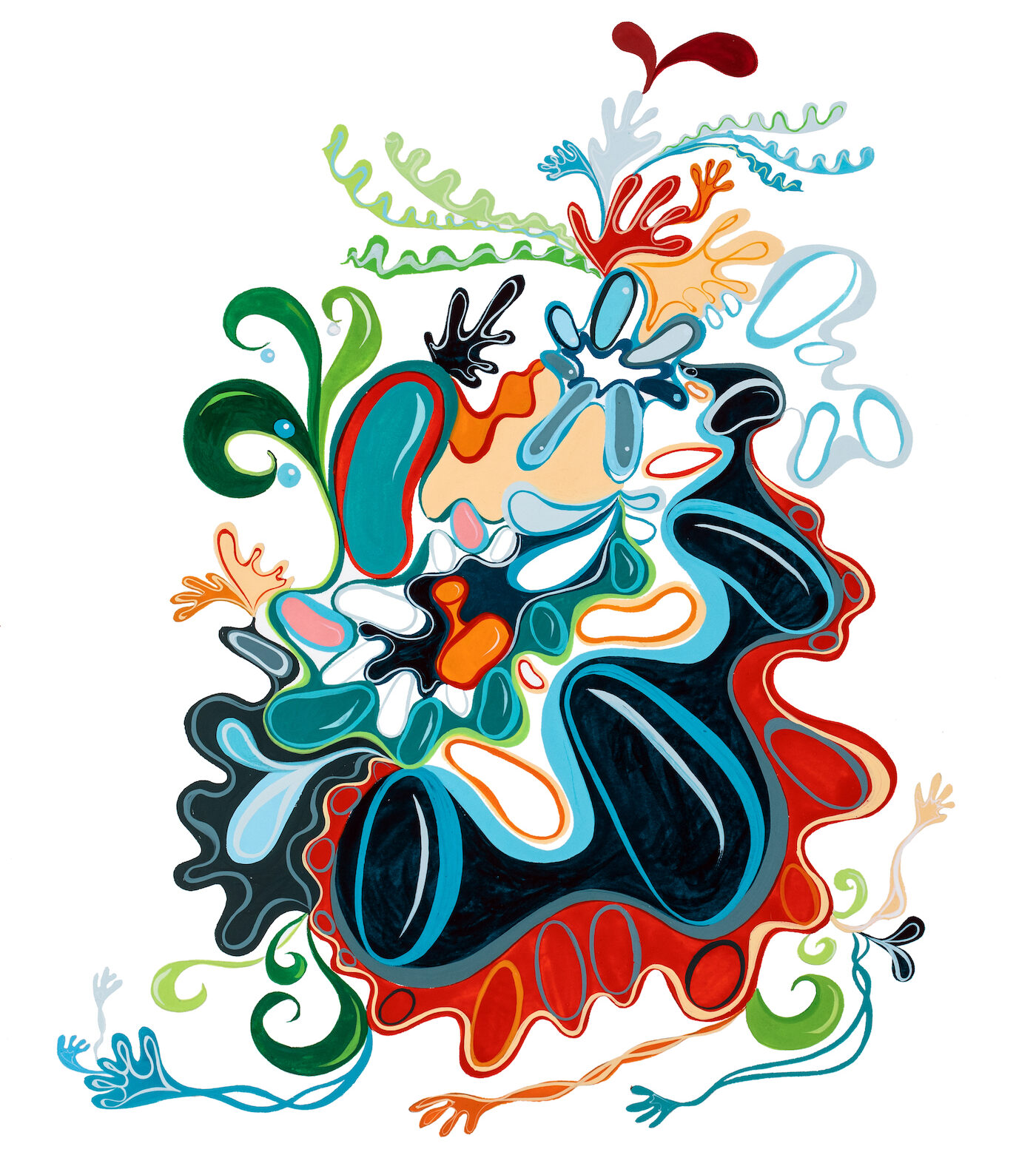
Cynthia Mosser gouache painting
©Cynthia Mosser, Muffy I. Gouache on museum board, 12 x 9.5 inches.

3. Lead Times for an Art Show

This is more of a list for various venues, than a timeline as there are too many variables at play. There are some venues that might allow you to schedule and install a show next month. Others have more rigorous schedules and require advanced planning. 

  • Alternative venue :: This might include a coffee shop, restaurant, hospital, library, or other public space. Your lead time for these venues varies based on how organized the person in charge is.
  • Art venues :: Co-op galleries, nonprofit spaces, smaller galleries, and public spaces with a defined art program may schedule their shows at least 1 year in advance.
  • Top tier galleries :: The most in-demand galleries will likely have their shows scheduled out for 2-3 years so that their artists have plenty of time to create a new body of work.
  • Museums :: Smaller museums may schedule shows 18-24 months out, but larger ones will look at 3 years or longer. Museums need time to write grants and raise funds, which contributes to the longer lead time.

How curators work.

Art center curator Collin Parson talks about how he plans exhibitions and works with artists.

The Art Biz episode 116

3. Timeline for Promoting Your Solo Show

Most artists don’t promote their shows enough.

They send one announcement and trust that it registers with all recipients. You have to be more vigilant than this, but it doesn’t mean that you treat all shows equally.

This timeline is for a solo show, which deserves much more attention than group shows.

  • ASAP :: Segment your list. This is a key module in my ESSENTIALS program, and is needed so you can target those most likely to attend.
  • 1-2 Months out :: Announce it in your newsletter (your entire list).
  • 1 Month out :: Send a save-the-date postcard or email to those most likely to attend and VIPs who need to know about it. Post the same info to social media.
  • 2 Weeks out :: Email the official invitation to your local segment. Reach out with a personal email, text, or DM to those you’d really like to attend or at least know about it. (Everything from this point on is to only those who are most likely to show up.)
  • A few days before the opening :: Send an email that “it’s this week.”
  • 1 Day before opening :: Send “it’s tomorrow” email.
  • Ongoing :: Post to social media. Here are 22 ideas for sharing news about your show.
  • 1 Week before closing :: Send email that there’s 1 week remaining to see the show.
Cheryl Berech oil painting
©Cheryl Berech, Keisha I. Oil on canvas, 12 x 9 inches.

5. Schedules for Following Up with People

This is a different type of timeline—a list of various people you will come across and the attention they should be given. You can’t neglect follow-up when you are trying to make a living.

  • New acquaintances :: Send an email or handwritten note within 3 days of meeting, with the message “it was nice to meet you.”
  • Potential buyers :: Anyone who expresses interested in your work should command your prompt attention. Respond immediately.
  • Interested media people or writers :: Ditto above. Anyone who wants to share your art in an article, video, or podcast needs swift follow-through.
  • New email subscribers :: Send 2 warm “here’s what I’m all about” emails within the first week as this is when they are most excited to hear from you. After that, a  monthly newsletter is good.
  • Buyers :: Send a thank-you note within a week and make a plan to stay in touch on a regular basis if they aren’t on your email list.

Listen to this to improve your follow-up.

I hope these timelines help you feel more grounded and prepared as you plan your next steps. They’re meant to take the guesswork out of your process and free up more energy for your creative work.

I walk artists through creating their own timelines in my Artist Planning Workshops, which I offer three times a year. If you need extra support and structure, I’d love for you to join us.

And I’d love to hear from you—how are you using timelines in your art business? Share your thoughts in a comment below.

This article was originally posted on June 26, 2013, was updated on July 25, 2019, and has been updated again with original comments intact.

The post 5 Timelines to help you plan appeared first on Art Biz Success.

]]>
https://dy-online.com/timelines/feed/ 11
The artist’s guide to confident decision-making (219) https://dy-online.com/decision-framework/ Thu, 13 Mar 2025 14:25:09 +0000 https://dy-online.com/?p=53154 As an artist, you’re constantly faced with choices—whether to take on a project, collaborate, or invest time in new opportunities.

In this episode of The Art Biz and accompanying post, I walk you through a step-by-step decision-making framework designed to help you evaluate opportunities with clarity and confidence. You’ll learn how to prioritize, set boundaries, and trust your choices so you can move forward with certainty in your art career.

The post The artist’s guide to confident decision-making (219) appeared first on Art Biz Success.

]]>
You are in charge of your art career. That means you get to decide what’s worth your time and energy. But let’s be real—that kind of freedom can feel overwhelming.

How do you know what’s the right move? How do you trust yourself when every opportunity sounds promising?

Self-employment freedom sounded ideal until you realized how hard it is to prioritize your life and business by yourself.

You might have been previously accustomed to a boss telling you where to focus your energy. No more. That boss is now you.

And let me tell you … The hardest thing about owning your own business isn’t marketing, sales, or making the art. It’s making decisions.

This post and episode of The Art Biz are to help you DECIDE.

Alex Sax The Jar Project
©Alex Sax, The Jar Project, installation at Whitney Art Works, Portland, Maine. 60 art-filled jars by 60 artists with connections to Maine, the jars vary in size, color and texture, and contain a range of genres and mediums including drawings, paintings, photographs, sculptures, and mixed media.

Certainty Is a Myth

I teach a planning workshop three times a year, in which I ask members to decide on and commit to no more than three focus projects at a time—in addition to everything else it takes to keep an art business afloat.

Over the years, I’ve noticed something: some artists hold off on making decisions because they’re waiting for certainty. They want to be absolutely sure of positive results before committing to a project.

That certainty is a myth.

If you wait until things are perfect—until you have all the information, until you feel completely confident—you’ll stay stuck. Decision-making isn’t about knowing for sure. It’s about trusting yourself and moving forward.

On my shelf is The Decision Book: 50 Models for Strategic Thinking by Mikael Krogerus and Roman Tshäppeler (2008). It’s fascinating, but most of these models aren’t how my brain works.

That said, one framework stands out: The Eisenhower Matrix. You’ve probably seen it, even if you don’t know it by name. It’s a simple tool that can help artists (and all business owners) prioritize their time and energy more effectively.

Listen

The Eisenhower Matrix: A Tool for Prioritizing

This matrix, named after President Dwight D. Eisenhower, is based on a principle he supposedly lived by: “The most urgent decisions are rarely the most important ones.”

Picture a square in 4 quadrants. Starting in the upper right and going clockwise, label each quadrant in this order:

  • Urgent and Important: Do it immediately.
  • Urgent but not important: Delegate it to somebody else.
  • Not important, not urgent: Do it later.
  • Important, but not urgent: Decide when you’ll do it.

Most of us get caught up in the Urgent & Important quadrant—rushing to meet deadlines and reacting to last-minute opportunities. But the real magic happens when we carve out time for the Important but Not Urgent tasks—things like long-term planning, relationship-building, and creative growth.

Because if we don’t? They’ll eventually become urgent, and we’ll find ourselves scrambling.

Katrina Thorstensen pastel
©Katrina Thorstensen, Blue in Winter. Pastel on archival paper, 7 x 10 inches.

Deciding Faster with Policies

Even with a tool like the Eisenhower Matrix, some decisions will still feel tough. This is where policies come in.

In my Essentials for Artist Success program, I start the discussion of building strong business systems by helping artists create formal policies. These policies aren’t just business rules—they are commitments to yourself about what you will and won’t do. They protect your time, energy, and focus so that every opportunity doesn’t feel like a new decision-making crisis.

When you have strong policies in place, decision-making gets easier.

  • Is this aligned with how I want to work? (If not, your policy says no and so do you.)
  • Does this fit within my pricing structure? (If not, no negotiation needed.)
  • Am I willing to take on this type of project? (If your policy says no commissions, the decision is already made.)

Policies help you say Yes with confidence and No without guilt.

If you don’t have clear policies yet, I highly recommend taking the time to create them. In Essentials, we go through this process step by step, ensuring that artists feel more empowered in their decisions and don’t waste time on things that don’t serve their long-term vision.

When you have policies in place, your decision might be right in front of you. But what if you haven’t yet created a policy for a particular situation? 

Don’t miss new articles, podcasts, programs, and some of my favorite discoveries.

Sign up for my weekly newsletter.

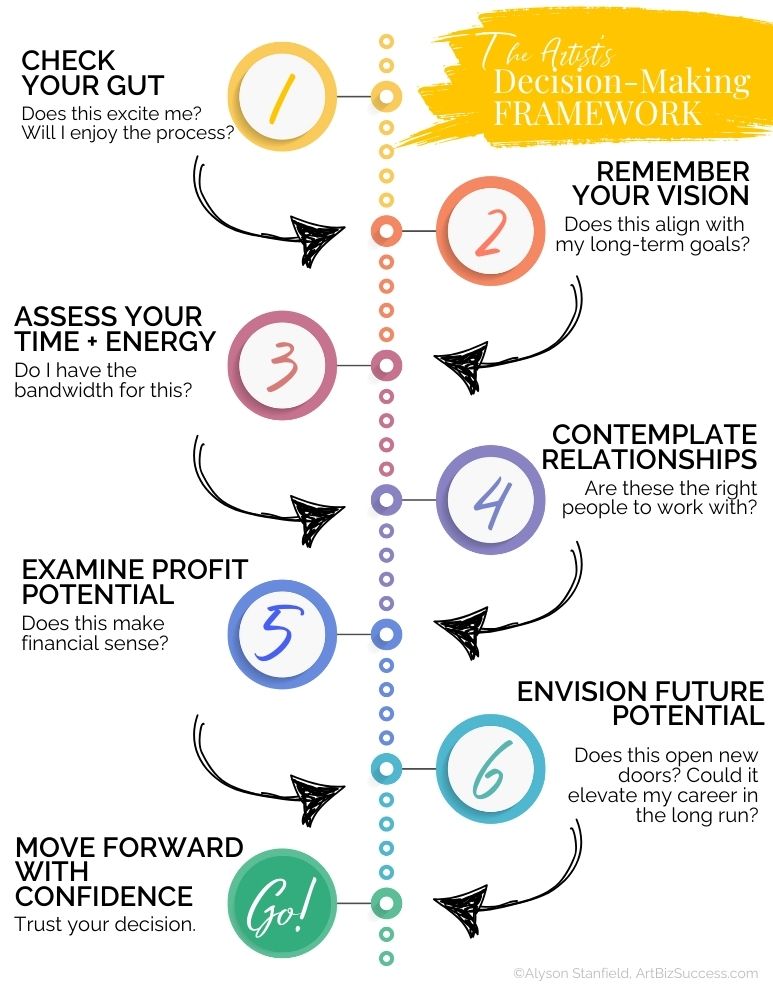
The Artist’s Decision-Making Framework

If you don’t already have a policy in place for a particular situation, I’ve got your back!

This is where The Artist’s Decision-Making Framework comes in handy. 

I’m going to walk you through these six steps one at a time, and I’ve also provided an info graphic for you to download (no optin required 😇). 

Click to download the PDF →

It’s probably worth printing, laminating, and hanging in your studio and office. 

Okay, let’s look at these in more depth.

Step 1: Take It for a Spin

Do a gut check around your creative priorities.

Does this excite me, or does it just sound good on paper?

Will I enjoy the process, or just the outcome?

Would I take this on if money weren’t a factor?

If it feels like a bad fit → STOP HERE

Example: Someone asks you to paint a pet portrait but you are an abstract collage artist. (Huh?) The pet portrait might sound like a fun challenge (see Step 6) or the thought of it might make you want to pull your hair out.

On the other hand, it’s deeply satisfying for artists and entrepreneurs to challenge themselves to learn a new technique, technology, or medium. If you’re bored or stuck, the siren call of a challenge might be just what you need.

Jennifer Winship Mark watercolor painting
©Jennifer Winship Mark, Orange Victorian. Watercolor on paper, 9 x 12 inches.

Step 2: Remember Your Vision

Does this align with my long-term goals?

Will this move me forward, or will it pull me off track?

Will I regret saying yes?

If it doesn’t fit your vision → TURN IT DOWN

Unless, you are ready for and open to a new vision.

Sometimes it is wise to change course when opportunity knocks. That’s how Art Biz Success came about. If I had stubbornly pursued the path I started, I would never have discovered such rewarding work with artists like you.

Step 3: Assess Your Time & Energy

Review your current commitments, future availability, and energy levels.

Realistically, how much time will this take?

What will I have to say NO to in order to say YES to this?

Is this worth the time investment?

If you don’t have or can’t adjust to find the bandwidth → SAY NO (or adjust scope)

Time is the great mystery, which is why you must always err on the side of overestimating your time. Some productivity experts suggest estimating your time and then doubling it for a more realistic view—a tactic I have come to embrace.

Trinita Waller bronze sculpture
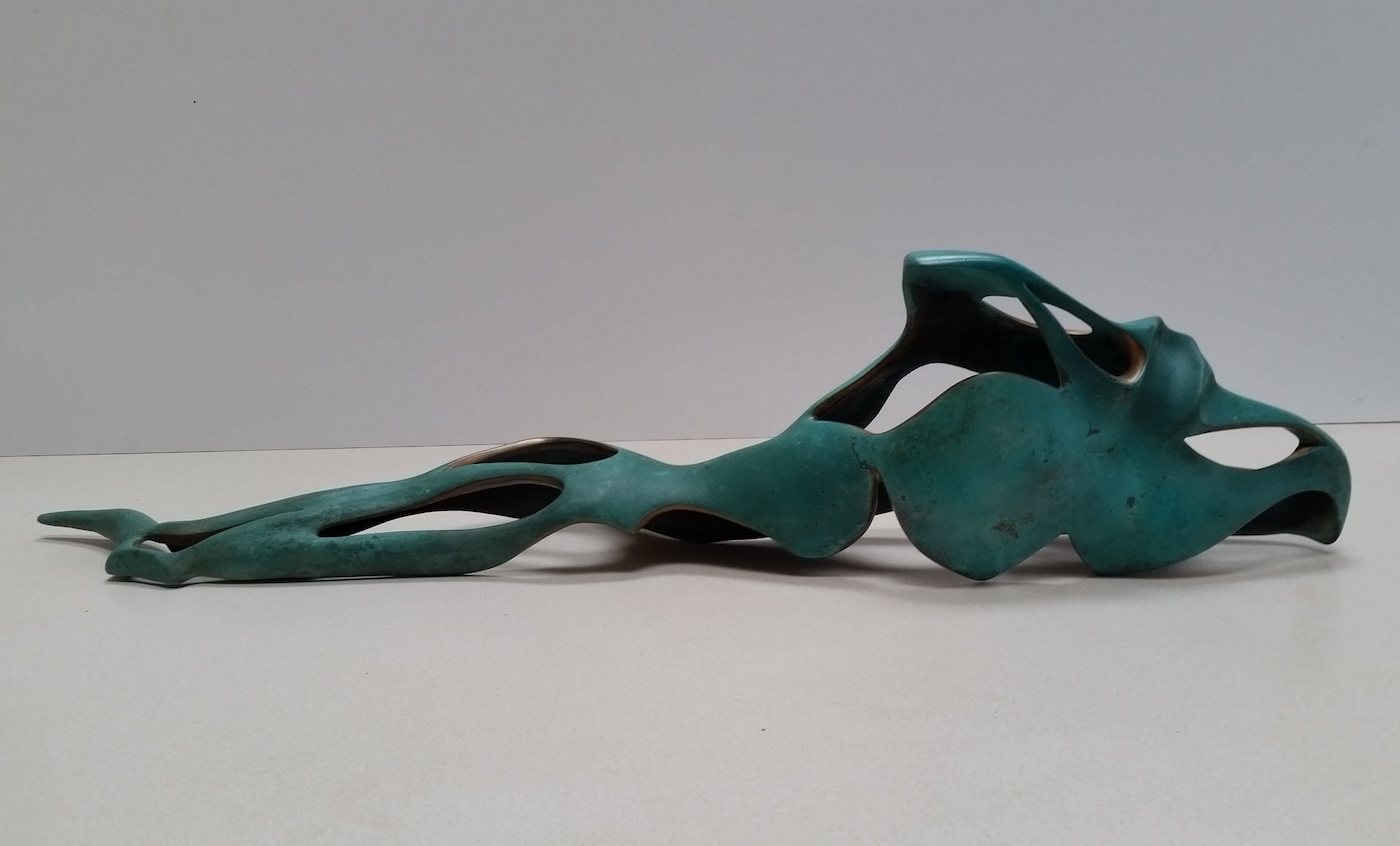
©Trinita Waller, The Swimmer. Bronze sculpture, 31 x 7 x 5 inches.

Step 4: Contemplate Relationships

Networking is key to a successful art career, but partnerships with the wrong people can be more trouble than they are worth.

Do I want to work with these people?

Are they professional and communicative?

Could this connection open future doors for me?

If the people involved are a red flag → WALK AWAY

Step 5: Examine Profit Potential

There are times when earning more income must be a priority, but enter a new commitment with your eyes wide open.

What is the best- and worst-case financial scenario?

Will this lead to bigger opportunities down the road?

Does this help me build financial stability?

If it’s a financial drain with no upside → RECONSIDER

It might be worth earning less if it leads to future opportunities that have bigger payoffs. For example, many of my artist-clients don’t do well at an open studio or art festival, but those events lead to commissions and future sales for them. As long as they have a plan to nurture relationships, these lower-profit events can make good business sense.

That brings us to the final consideration.

Linda Clark Johnson cyanotype
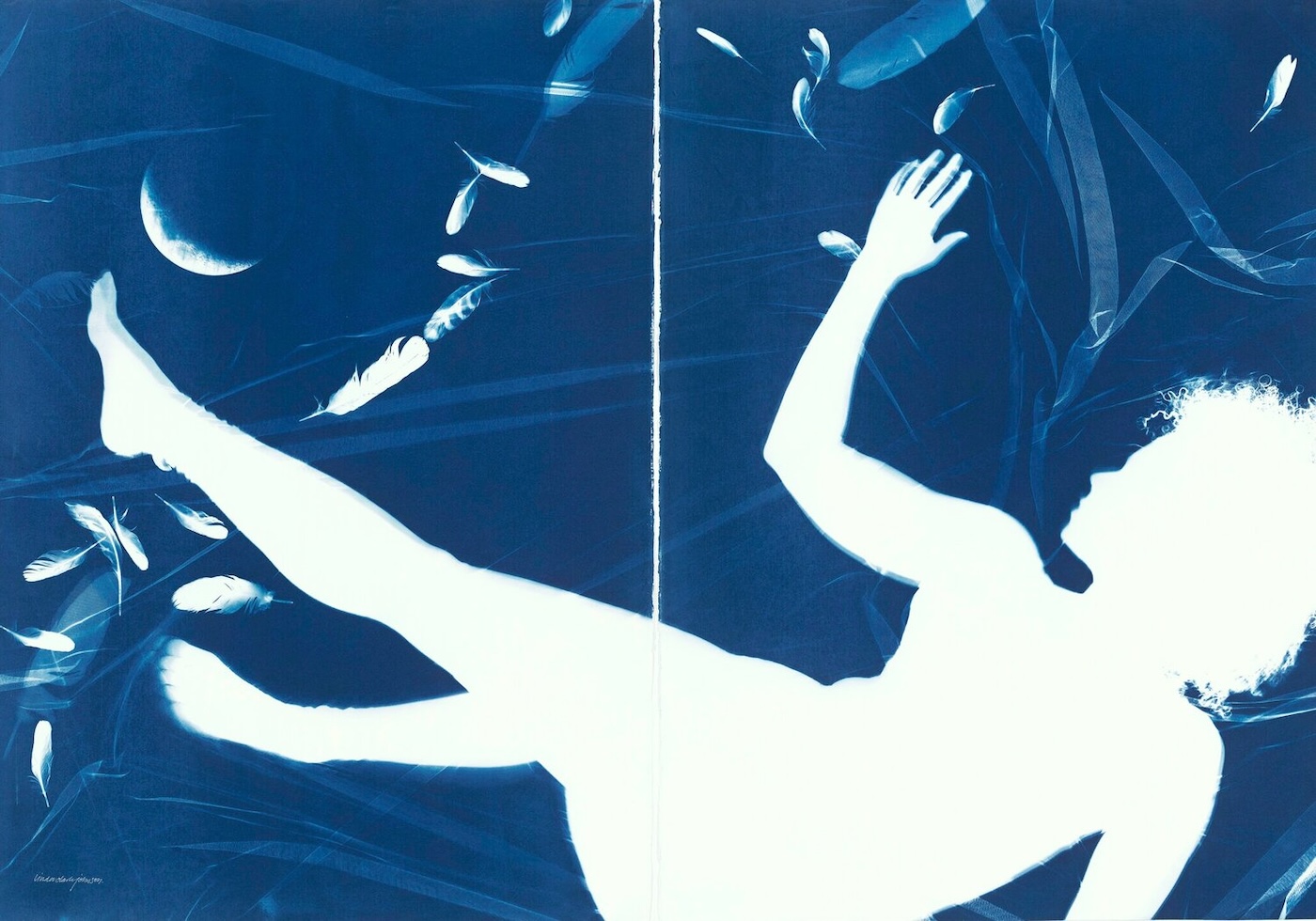
©Linda Clark Johnson, I Dreamed I Was Falling. Cyanotype diptych on 300# Fabriano Artistico watercolor paper, 41 x 60 inches.

Step 6: Envision Future Potential

Will this give me valuable exposure, connections, or credibility?

Will I regret not taking this?

Is this a stepping stone to something greater?

As I said, I work with a number of artists who think long term. They know where they want to end up (their vision) and strategically consider options that will get them there.

If you’ve made it through all six steps and it’s a YES—go for it with confidence and trust in your decision!

Owning Your Decision

In the end, making decisions about your art career or business isn’t about being right or wrong. It’s about taking ownership of your choices, trusting yourself, and moving forward with confidence.

The more you practice making intentional decisions—whether it’s about opportunities, projects, or where you invest your time—the easier it becomes.

No decision is ever set in stone. The beauty of being an artist and entrepreneur is that you get to adapt, pivot, and refine as you go. Trust yourself. Trust your process. And know that every decision you make is shaping your journey in a way that’s uniquely yours.

I hope you find the framework useful when it comes to figuring out your next steps.

Here’s that PDF download again. →

Don’t miss new articles, podcasts, programs, and some of my favorite discoveries.

Sign up for my weekly newsletter.

The post The artist’s guide to confident decision-making (219) appeared first on Art Biz Success.

]]>

A Fresh Start: Actions To Take Before January 1 https://dy-online.com/looseends/ Thu, 28 Dec 2023 19:41:37 +0000 http://artbizcoach.com/newsletter/?p=267 Seeing January 1 on the calendar is enough to get almost anyone’s blood pumping.

The thrill of starting fresh! The anticipation of creating new benchmarks and attaining new dreams!

Oh, but wait. There’s a lot of crap that you need to get rid of --stuff that might get in your way if it doesn’t drive you crazy first.

What would it be like if the New Year felt . . . well . . . felt truly new?

The post A Fresh Start: Actions To Take Before January 1 appeared first on Art Biz Success.

]]>
Seeing January 1 on the calendar is enough to get almost anyone’s blood pumping.

The thrill of starting fresh! The anticipation of creating new benchmarks and attaining new dreams!

Oh, but wait. There’s a lot of crap that you need to get rid of –stuff that might get in your way if it doesn’t drive you crazy first.

What would it be like if the New Year felt . . . well . . . felt truly new?

Make this week and next just for you.

If you can, resist the urge to add anything new to your calendar so you can focus on tying up loose ends and preparing for the New Year. 

Here are some ideas.

Review Your Tasks

What has been on your to-do list for too long?

If you’re procrastinating, do you really need to do it?

If it’s not a definite Yes, it’s a No. If it is a Yes, take care of it. 

Scan The Studio

What’s broken?

What materials aren’t being used that you could store or give away?

What emits negative energy and stifles your creative juices?

What artwork needs completing?

File

Get those papers off your desk and off the floor and put them into a usable system.

Make digital and hard copy financial files for the New Year. 

Archive (usually a digital folder) any files you no longer need to refer to.

Back up your computer.

Recycle anything you don’t use or could find online.

Update Your Mailing List

Have you been saving names and contact info for anyone? Perhaps you made a note on your phone, wrote it in your planner or on a scrap of paper, or maybe you even got a real business card😲!

They aren’t doing you any good in their current form. Add that contact info to your database. 

While you’re at it, send a quick “thinking of you” note to that person to stay top of mind. (See more under Send Correspondence below.)

This is an ESSENTIAL step for a successful art business. 

See more of them in Establish Yourself: Essentials for Artist Success—a foundational business training program for beginning and emerging artists (and artists who never implemented the fundamentals).

Send Correspondence

Write your Thank You notes from holiday gifts.

Send New Year’s greetings to the important people in your life—especially people who might be lonely and need to hear from you.

Inventory Your Supplies

Pore over your office and art supplies.

What are you running low on? For my office, I primarily check my printing paper stash and printer ink. I don’t want to run out of those—especially with my planning workshop coming up.

Give Your Personal Space Some TLC

Done with the business stuff or just not in the mood?

Tying up loose ends doesn’t have to be just for your art biz.

You’ll enjoy your art business tasks more when you have a more hospitable personal space.

Clean out cabinets, drawers, and closets. Donate and recycle what is no longer needed. Schedule a home pick-up for the big stuff.

The post A Fresh Start: Actions To Take Before January 1 appeared first on Art Biz Success.

]]>
The Art Biz ep. 152: How to Squeeze More Time from Your Busy Calendar https://dy-online.com/time-management/ https://dy-online.com/time-management/#comments Thu, 22 Jun 2023 13:37:48 +0000 http://artbizsuccess.com/?p=19543 As an artist and business owner, you're constantly juggling responsibilities. It's easy to feel overwhelmed, but take solace in knowing that you're not alone. In this episode, I share 8 tips for and 2 truths about time management.

Optimize your schedule and increase efficiency—not so you can do more, but so that you make the most out of your limited time and enjoy life.

The post The Art Biz ep. 152: How to Squeeze More Time from Your Busy Calendar appeared first on Art Biz Success.

]]>

As an artist and 1-person business owner, you are the talented maker, gregarious promoter, delightful conversationalist, and head honcho. All. At. The. Same. Time.

It’s easy to be overwhelmed by all of these simultaneous roles.

Landscape painting by Kim T. Richards
©Kim T. Richards, Morning Dunes. Oil on aluminum panel, 11 x 14 inches.

You’re juggling all of the moving pieces of your art business along with the responsibilities and joys of your personal life.

Perhaps … Just maybe … It might be heartening to remember that you are no busier and no more overwhelmed than the next artist. Everyone has something that steals their energy.

On the home front, it might be school-aged kids, struggling adult children, or aging parents. I also have clients whose work is sidelined by moving and building projects. And artists who deal with chronic pain, illness, and life-threatening health issues.

These are all real reasons for lower productivity.

Every artist I have ever worked with would like to squeeze more time from their busy calendars. After all, you are overflowing with ideas. You’ll never have time to make everything you want to make, and that is incredibly frustrating.

In this post and episode of the Art Biz, I’ll share 8 tips for time management along with 2 truths to consider.

Listen

Recovering Productivity Geek

Before we get deep into productivity tips, I must confess that I am a recovering productivity geek.

I used to read everything about the topic that came into view—subscribing to productivity newsletters and investing in more productivity courses. I still get caught in that trap.

But my interest in productivity has evolved since reading Oliver Burkeman’s book Four Thousand Weeks: Time Management for Mortals. I find myself recommending this book to everyone. (affiliate link)

His introduction is titled “In the Long Run, We’re All Dead.” Sounds fatalistic, but he speaks the truth. We’ve been given an average of 4,000 weeks on this big blue marble called Earth, but we act and work like we have infinite amounts of time. Trying to get more done, adding more to our calendars, isn’t necessarily the best way to spend our time.

Burkeman writes, “Productivity is a trap. Becoming more efficient just makes you more rushed, and trying to clear the decks simply makes them fill up again faster.” Chew on that for a while. Preferably while sipping a watermelon margarita by the pool.

Acrylic painting by Sierra Bailey
©Sierra Bailey, Confessions of a Domestic Failure. Acrylic on museum cradled panel, 24 x 30 inches.

Time Management Is a Lie

In sharing these time management tips, I’m not encouraging you to do MORE. I’m encouraging you to be more efficient so you can enjoy, as Mary Oliver wrote, this one precious life.

I’m just going to jump in with the first truth, which is this: Time management is a lie.

It’s impossible to manage time. The clocks keep ticking and the sun continues to rise and set. There’s nothing you can do about that.

Rather than talking about Time management, you need to focus on Self management.

Use these 8 tips to help with self-management and stick with me until the end because I’m certain you’ll be comforted by the second truth.

1. Make time for planning.

Planning time is your best friend.

If you think you’re too busy to set aside a couple of hours a week to plan, you will have no one to blame but yourself when you lose sleep. You’re likely feeling swamped because you didn’t make time to plan … when you stumbled from task to task because you had so much to do.

In my experience, overwhelm happens when everything is up in my head. I don’t know what happens up there and who is responsible for such shenanigans, but my brain in overwhelm gear is pretty worthless. It’s unfocused, directionless, fearful, and anxious. This makes it impossible to get anything constructive accomplished.

The solution is to get out the calendar and task list and map out everything on my plate.

I am speaking from experience as I’ve been in this state recently. It happens! In fact, it happens more often than I’d like to admit. But I can always find my way out of the overwhelm when I set aside time to plan.

Quick tool: The Brain Dump

2. Understand your natural rhythms.

When do you do your best work?

If it takes you 2 hours and 4 cups of coffee to wake up in the morning, don’t attempt your most valuable work during that time. Know when you are your most productive self and hold that time sacred for your art or writing.

As a corollary, if you aren’t currently productive in a particular area, monitor your calendar and figure out what you might need to switch around to make the most of your days.

3. Honor your calendar.

If it’s important, schedule it. Block out time on your calendar to take care of tasks that need significant amounts of uninterrupted time.

My calendar not only has my timed appointments with clients and coaching groups, but also blocks of time for creating content and making connections with people.

Review your calendar at the end of each day and again before you begin work in the morning.

4. Turn repeated tasks into systems.

Stop reinventing the steps it takes to publish a newsletter or blog post, or to promote an exhibition. Create reliable systems for every task you undertake on a regular basis. Well-defined systems will save your behind and help you rest easily.

A system is a series of steps that answer the following questions.

  • What, precisely, do you want to happen?
  • What tools and technology will you use?
  • Who else will be or needs to be part of it?
  • What are the repeatable steps—exactly?
  • What kind of review process will you put into place to make sure the system is working?

In his book, Atomic Habits: An Easy & Proven Way to Build Good Habits & Break Bad Ones, James Clear encourages us to focus on systems instead of goals—systems comprised of tiny (atomic) improvements. He writes, “You do not rise to the level of your goals. You fall to the level of your systems.” (affiliate link)

5. Group similar tasks together.

You have heard this advice before, but it might be time to revisit it when it comes to your art business.

Use the momentum you create from starting a single task to complete other tasks that are similar.

For example, write four article drafts in one sitting rather than doing one a day. It’s easier, I promise! It sounds crazy, but it’s true. Something happens when you devote a couple of hours to focused writing. It’s like your ideas start having babies. They multiply and feed off of one another, so pretty soon that one little idea becomes four.

Same thing happens when you schedule social media posts for an entire week or month of content.

Other tasks that you might group together include the following:

  • Run all of your errands or do all of your online shopping in one, dedicated, afternoon.
  • Process email in your inbox during two daily sessions rather than “checking it” throughout the day.
  • Save packing and shipping for dedicated time slots rather than doing it as orders come in. When I used to sell copies of my book directly from my website, I had text right there on the order page that said I shipped every Tuesday and Friday. The automated email buyers received included the same notification.
Acrylic painting by Francesca Bandino
©Francesca Bandino, Mystification. Acrylic on canvas, 12 x 16 x .8 inches.

6. Stop multitasking.

Multitasking is working on diverse tasks simultaneously and, usually, doing them all half-heartedly: responding to email while attending a webinar, texting while trying to write a newsletter, or just moving back and forth between your inbox and another open window on your computer.

Research shows that only about 2.5% of college students can multitask effectively.

And get this: Switching from task to task and back again adds as much as 25% more time to what it would normally take to complete each task. Twenty-five percent!

You don’t have 25% more time to waste.

If you want to save time and be a better self-manager, stop multitasking.

With so much demanding our attention these days, we all fall into this bad habit. When you catch yourself, feel free to snap out of it by reciting a mantra I devised for these moments: I do one thing at a time to completion.

7. Automate everything possible.

What happens when someone signs up for your email list? And then what? And then what? 

You can automate those responses when you use an email marketing platform.

Also consider automating:

  • Savings. Take 10% out of every payment and put it in a separate interest-earning savings account or retirement fund.
  • Meals. I love to cook, but we went through a meal-delivery period. My favorite thing about meal delivery isn’t the meals themselves, though they are delicious, but that it removed the need to make a decision about what to eat. (See #4.)
  • Orders for supplies you use regularly. For example, I love that Amazon sends us a package of 2 electric toothbrush heads every 3 months.
Oil painting by Jessica Pisano
©Jessica Pisano, The Kiss. Oil on panel, 24 x 24 inches.

8. Learn to say No (and mean it).

I saved the most difficult for last.

Invitations bombard you from every direction, and you have to have the strength to know what is critical to add to your calendar and, more importantly, what doesn’t deserve a place on your schedule.

It’s fairly easy to say No to what isn’t palatable or what doesn’t sound fun. It’s harder to turn down the things that are more enjoyable in order to give your best effort to long-term progress.

Clarity is key.

When you are very clear about your direction, it’s easier to say No to the opportunities and requests that don’t serve your best interests. This is the toughest lesson you’ll learn when trying to build your art business. 

If you master saying No, you’ll master yourself and your business.

If you find it difficult to manage yourself and your time, support and accountability might help. I give you that inside the Art Biz Accelerator. It’s a community of trusted artists who are on a similar journey and get you. I lead the coaching and conversations

Check it out and join us if it’s right for you.  You can join anytime but the sooner you join, the sooner you’ll reap the benefits.

The Second Truth

Those are the 8 tips.

I promised you a 2nd truth around time management, which I hope you’ll find comfort in. And that is this:

The important stuff always gets done.

Somehow, magically, amazingly.

It gets done because it’s important! You recognize its value and somehow manage to make it happen. Knowing this truth is a relief.

Remember: You have an average of 4,000 weeks on this planet. Don’t try to do more. Try finding ways to enjoy what you’re doing and to make time for the things that feed your soul.

First published August 6, 2015 and updated February 7, 2019. Updated and podcast episode added with original comments intact.

Related Episodes

These episodes focus on business systems.

The post The Art Biz ep. 152: How to Squeeze More Time from Your Busy Calendar appeared first on Art Biz Success.

]]>
https://dy-online.com/time-management/feed/ 50
Your decision filter for marketing and other projects (139) https://dy-online.com/your-marketing-mix/ https://dy-online.com/your-marketing-mix/#comments Fri, 20 Jan 2023 18:20:00 +0000 http://artbizsuccess.com/?p=17484 We all have a trusted process for making decisions, whether or not we’re aware of it. In this episode, I’m going to reveal something that has helped me enormously when making decisions.

But, first, I want to share my list of 8 criteria you might consider before making a decision about whether or not to steer your art business in a certain direction.

The post Your decision filter for marketing and other projects (139) appeared first on Art Biz Success.

]]>


Every day you are faced with new opportunities.

Should you invest in social media advertising? Or should you focus on being more consistent with your posts? Or maybe devote your time to learning how to use Pinterest more effectively?

Should you approach galleries to represent your art? Or organize a series of open studios? Or enter that show that seems like a long shot?

Should you create an online workshop to teach what you know best? Or double down on selling your art?

They all sound great! You’ve seen them work for other artists. You start shoulding on yourself.  There is so much you should do! So much you want to do!

How do you decide?

[ I’ve since refined these considerations into The Artist’s Decision-Making Framework ]

copper hanging mobile Antje Roitsch | on Art Biz Success
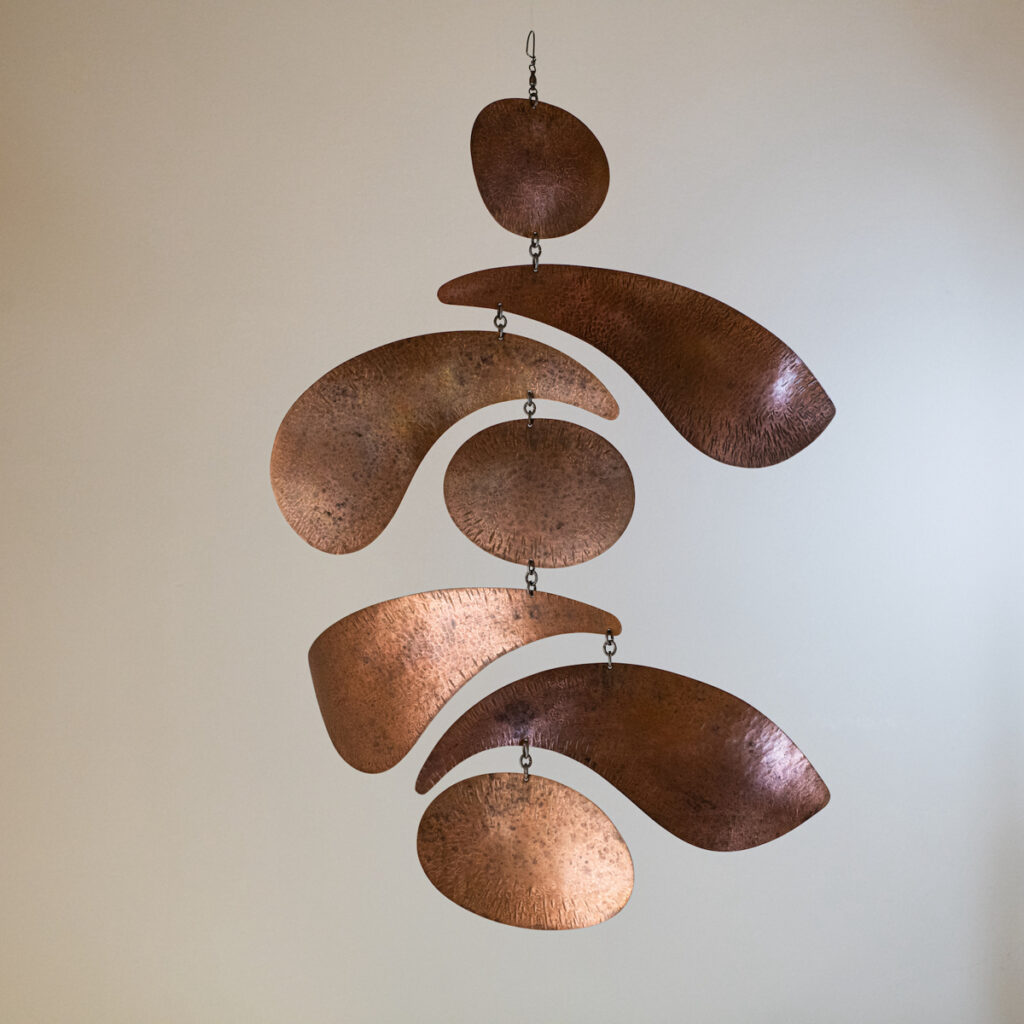
©Antje Roitzsch, Moon Shadow. Hammered copper mobile, 20 x 15 x 15 inches.

In this solo episode of The Art Biz, I want to talk about your decision filter: How you make decisions about what projects to take on and where to spend your time, energy, and financial resources.

If I could wave a magic wand and make one part of my business easier, it would be around making decisions. Specifically, I’d like to have to make far fewer decisions than is required.

Seriously, I would call upon the goddesses to remove this burden from my daily operations. Pleeeeeez. Now. 

But why should I get a pass? The whole world is grappling with decision fatigue. I recently read that we make as many as 200 decisions per day about food. Just. Food. Two-hundred decisions.

That’s exhausting! If we can’t decide what to eat, then how can we expect to have clarity about the potential of new opportunities like those I mentioned in the opening?

We all have a trusted process for making decisions, whether or not we’re aware of it. At the end of this article, I’m going to reveal something that has helped me enormously when making decisions.

But, first, I want to share my list of 8 criteria you might consider before making a decision about whether or not to take on a new project or steer your art business in a certain direction.

I previously had 6 criteria, and have to give a nod to Katie Hunt, who, in episode 138, gave me a couple more good ones to add to my list.

Listen Now

Kerry Schroeder acrylic painting | on Art Biz Success
©Kerry Schroeder, Released. Acrylic and graphite on panel, 52 x 52 inches.

Here are my 8 considerations for taking on a new project. 

Your task or project doesn’t need to—and won’t—meet all of these criteria. It would be weird if it did. But they are all things that can be considered.

Maybe just 1 or 2 of them is enough for you to say Yes to something or to write it off completely.

1. You understand WHY you are doing it.

Make sure you have a reason to devote time and energy to a project. This has the most weight of all criteria.

Your Why needs to be authentic to you, not you shoulding on yourself or taking on a project because of fear of missing out.

Why do you want this? What might it give you in the end?

2. You are willing to devote the time and energy to it.

Now that you know your reason, you have to ask whether or not you are willing to devote the time and energy.

At the beginning of the artist planning sessions, I ask students to add up how much time on their calendar is currently spoken for. This is an eye opener for many. Then, after they have created a plan for the upcoming months, I ask them to estimate the time their tasks would take.

The artist-planners begin to realize that they aren’t accounting for vacations, down time, or artist dates, let alone actual time they need to spend in the studio.

Yikes! You can see that this is a problem.

If you aren’t working with a coach or someone who is asking you about such things, you have to do it for yourself. Only you know what your priorities are and where you’re willing to negotiate your commitments.

©Kathryn Hansen
©Kathryn Hansen, For Lease. Graphite pencil on paper, 7.5 x 9 inches.

Notice this criterion is that you are willing to devote the time and energy, not that you have the time and energy.

You will never have time. And there will never be the right time. To add another complication, we always overestimate how much energy we think we have and underestimate how much time a task will take.

You have to know, based on your decision-making process, that you are willing to make this project a priority.

By example, at the time of this writing, I am preparing for the first member mixer of my new Art Biz Accelerator coaching group and community.

I’m absolutely thrilled with the group we have together so far, and I also know that there are others who will be joining in the future. They had major life commitments that would have prevented them from fully participating as an Accelerator member right now. They’re going to take advantage of the fact that they can sign up at any time and join us later.

They weren’t willing to devote the time and energy to this program.

It takes some higher level thinking for artists to get to this point. To understand the kind of control you must exert over your life and schedule. And to not give into a fear of missing out but, instead, to trust your decision filter.

I can’t be upset that they didn’t join me now because this is exactly what I’m looking for in members of the Art Biz Accelerator. Members who are accepting responsibility for their lives and art careers. They’re curious, open to new possibilities, and thinking strategically about their next steps.

Quick aside … If you feel like you are just taking the same business courses over and over again, take a look at the Art Biz Accelerator and see if this coaching group is something that could be helpful and is something you’re willing to devote time and energy to.

Acrylic painting Carlos Schmitt | on Art Biz Success
©Carlos Schmitt, Intermit. Acrylic on canvas, 48 x 48 inches.

3. You enjoy it or are excited about starting.

The right plan should inspire you to jump out of bed and get to work.

You can’t enjoy every task on your plan. Hopefully you will enjoy most of the process or at least appreciate the potential benefit from doing the work.

Enthusiasm, while it may wane over time, can give you a hefty dose of momentum toward progress.

4. You have the systems in place to support it.

Or, you can make the creation of the support systems part of your plan.

You want to make sure you’re setting yourself up for success. That you have processes and technology and people in place to help you implement your plan.

For example, if one of the projects you’ve defined for yourself is to create an online course, but you don’t have a social media following or email list, you’d be wise to have a different focus project for the foreseeable future. Work on becoming a credible expert on your topic and building a following so that you have people to sign up for your course when it’s ready.

Then you need to consider what is required of teaching an online program of any kind. Technology! So much of it. There’s the teaching platform itself, but then the components for delivering it: the student outcomes, lesson writing, and video production.

And don’t forget the customer service required. What kind of payment processing will you use? How do you follow up with new students to make sure they feel welcome and confident with the lessons? Are you going to be the one to respond to technology problems from students?

By all means, start creating that course, but maybe your current project is something different—a system or part of a system that will support the success of it.

©Deanna Krueger
©Deanna Krueger, Oceanus. Acrylic monotypes on recycled medical diagnostic film (X-Ray/MRI film), staples, 45 x 63 inches.

5. You are already doing it and are seeing results.

Or, you’ve done something similar in the recent past and it worked well.

After you have implemented a project, consistently over time, are you benefiting from it? I talked previously about enjoying the project, which might be considered a benefit. But what I’m talking about here are measurable benefits.

Are you selling more art or enrolling more students?
Are more people visiting your website or signing up for your email list?
Are you attracting more followers?

All of these are benefits that can be measured. Dig into the numbers to see what’s working.

When we get results, we are more likely to enjoy the task and improve at it, which is why it’s so important to track progress and results. 

6. It plays to your strengths.

I don’t want you to only take on projects that are easy for you. There’s no fulfillment in sticking to what comes easily or seems less scary.

But I do want you to recognize your strengths and use them. Don’t jump on what everyone else is doing. It might not suit your personality, talents, or ultimate goals.

Here are some examples of playing to your strengths (or not).

If you are good in person and enjoy meeting new people, think about spending more time at live events like art openings. Working behind the computer screen is necessary, but, in this instance, you could really move the needle if you’re there in person.

If you love to write, consider starting a blog or publishing articles.

If you love to collaborate, bring artists together for a group exhibition, open studio tour, or holiday sale. On the other hand, if you are absolutely hopeless at staying organized and have no intention of getting help to keep you on track, then don’t initiate collaborations that have many moving parts. With a disorganized person at the helm, the logistics required will lead to frustration for all involved. Especially you.

If you don’t mind being in front of a camera, take advantage of the power of video and think beyond YouTube or Instagram. Maybe send personal videos to collectors or students.

Priscilla Stadler cheesecloth | on Art Biz Success
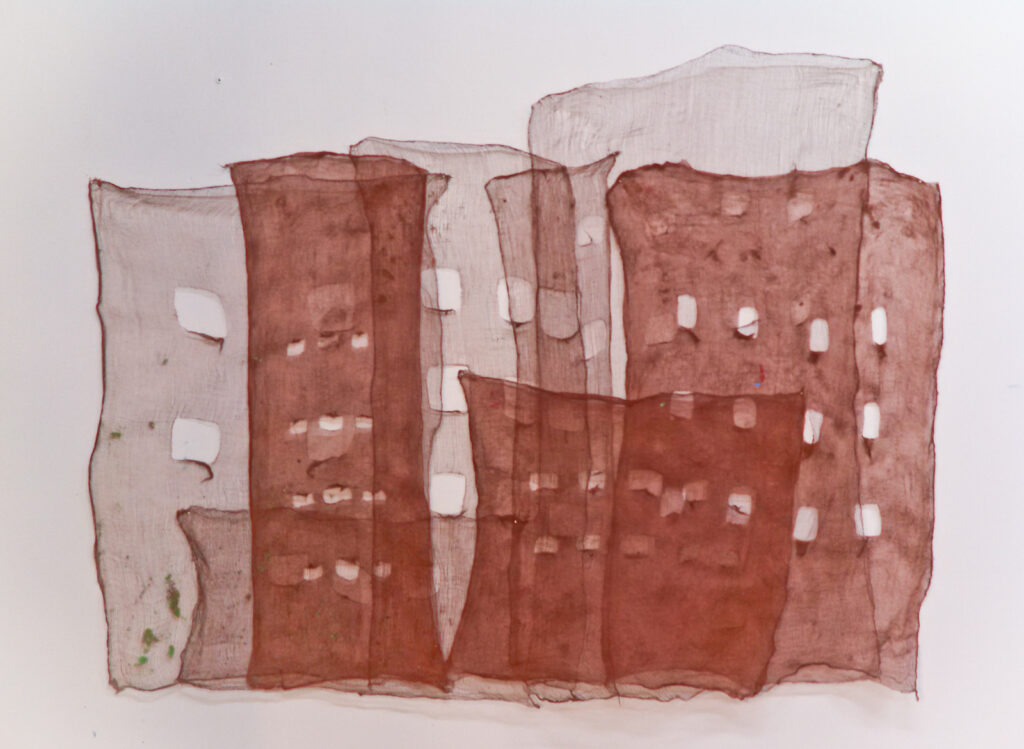
©Priscilla Stadler, Fragile City: Sandstone and Brick. Hand-dyed cheesecloth, 64 x 96 inches.

7. It has potential for the biggest long-term payoff.

You are pretty sure that if you commit to this and stick with it, you’ll eventually see results.

Nurturing relationships with galleries, collectors, consultants, and curators falls into this category. It will always pay off to give a little love and attention to the people who can buy from you or connect you with others to do the same. You don’t want to allow those relationships to grow cold.

Likewise, if you want to put a lot of energy into teaching, you would be well advised to spend more time developing videos for YouTube than posting to Instagram. Why? Because people go to YouTube to learn and YouTube is second only to Google in the search engine game.

I’m not saying you have to choose between YouTube and Instagram. I just want you to think of the long-term payoff and YouTube’s powerful search engine wins this round.

On the other hand, you might need to consider …

8. It has potential for the biggest immediate payoff.

You really need fast results and can sense promise in a particular direction.

The great pivot of the 2020 pandemic was an example of this. A lot of artists lost income and needed to replace it fast. They looked for projects that had a higher opportunity for an immediate payoff. Or just projects that satisfied them while in lockdown.

There is nothing wrong with needing to speed up potential results. Life happens and we need money. Fortunately, we’re our own bosses and can make these decisions.

That’s it. My 8 criteria for taking on a new project.

You can apply these criteria to both the project and the associated tasks that need to be done to complete the project—deciding for yourself which ones have more weight for you at the moment.

Remember: You will never have something that meets all 8 criteria.

©David Paul Bayles
©David Paul Bayles, Falling Tree #15. Photograph.

How much weight you give each of these is up to you. As much as you might be uncomfortable in the role, you are the decision-maker in your art business. You must be able to discern what is right for you rather than relying on someone else to choose for you.

One criterion is not necessarily more important than the rest, although I believe you always need to have the first one (your Why) before going forward. Other than that, you get to assign the level of importance to each one.

I have a little share here about bringing all of this together in order to make a final decision.

I have dipped my toes into studying the Human Design system. From my Human Design reading, I have learned that I make decisions by writing or talking. To myself or to others.

[ Listen: Every Artist is Designed Differently and What That Means with Jahje Ives ]

It made so much sense when I saw this on my Human Design chart. I can look back on key moments and situations in the past when the clarity came through writing or speaking.

Now I know I need to write in my journal or talk with someone else: a colleague, client, team member, or my husband. Weirdly, the other person doesn’t have to say a thing. I only need to articulate it.

I can’t tell you how helpful it was to see this tendency of mine confirmed.

According to Human Design, there aren’t a lot of people who make their best decisions the same way I do. The majority of people make decisions by trusting their gut. Others sit with the question and feel into it over time.

Fascinating stuff. It’s been so helpful to know my design, how I find my way through the world, how others, including clients, are wired, and how I relate to others. I know it’s not for everyone, but if you’re curious, you can go down the Human Design rabbit hole by visiting JovianArchive.com. If it’s your first encounter with Human Design, I encourage you to get a professional reading of your chart.

As an aside, I am a Projector for those of you who know about Human Design.

And even if you know how you best make decisions, there is still much to consider when you’re faced with a new opportunity. You have to have the facts even before you can call upon your gut, trust in how you feel over time, or, like me, discover through writing or speaking. You have to have the input, and that’s why you use the 8 considerations for taking on a new project.

This article was first published January 31, 2018. It has been updated significantly, with a podcast episode added, Original comments have been left intact.

The post Your decision filter for marketing and other projects (139) appeared first on Art Biz Success.

]]>

https://dy-online.com/your-marketing-mix/feed/ 48
Prepare for 2023: 5 Things to Do Right Now https://dy-online.com/prepare-for-new-year/ https://dy-online.com/prepare-for-new-year/#comments Sun, 01 Jan 2023 15:41:10 +0000 http://artbizsuccess.com/?p=18184 It’s time to tie a bow around 2022 and organize your systems for 2023.

Buy yourself some peace of mind by updating the copyright on your website and newsletter, making new folders for the New Year, and reviewing the projects ahead.

These tasks should take less than 1 hour.

The post Prepare for 2023: 5 Things to Do Right Now appeared first on Art Biz Success.

]]>

It’s time to tie a bow around 2022 and organize your systems for 2023.

The tasks below should take less than 1 hour, and they will bring peace of mind to your New Year.

Organized Shelves


1. Update copyright notices.

What’s the date in the footer on your website? In your newsletter?

Nothing says “neglected” like a website with an old copyright notice in the footer. You want your website and newsletter to look fresh.

Your hosting service or email marketing program might update the copyright automatically, but, if they don’t, you need to take charge and do it yourself.

See that everything says ©2023 rather than 2022 or, gasp!, earlier.

Please note that I’m not talking about the copyright notice on individual images. 
[ See Checklist for Crediting Your Art ]

I’m referring to the copyright statement on the site, which is typically located in the footer of your pages.

2. Make new folders.

Whether you organize something digitally or using paper, you’re going to need new files for items you store by date. 

In my business, it’s financial and tax records that are primarily organized by date. For paper versions, I clean out the old folders, archive them, and make nicely labeled folders for the New Year.

I keep as much as I can on the computer to eliminate the paper. I’ll share two different ways I have done this in case they give you ideas for your own finances.

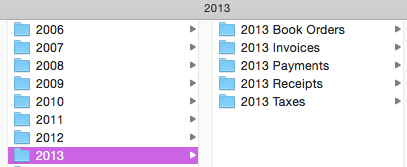
First, here’s an old screen capture for how I organized financial records on my computer when I first wrote this article back in 2015.

The financial archives on my computer. The year 2014 will be archived soon and join this folder.

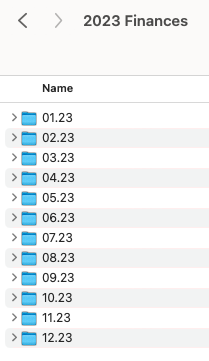
Now I throw old years into an “Archives-Finances” folder, but not until after tax time. I know I’m going to need last year’s records for the next few months. (image below left)

My filing system for e-receipts these days is much simpler. 

I have the 2023 Finances folder, with a separate folder for each month. (image above right)

I do the same for my personal finances, always keeping business and personal separate.

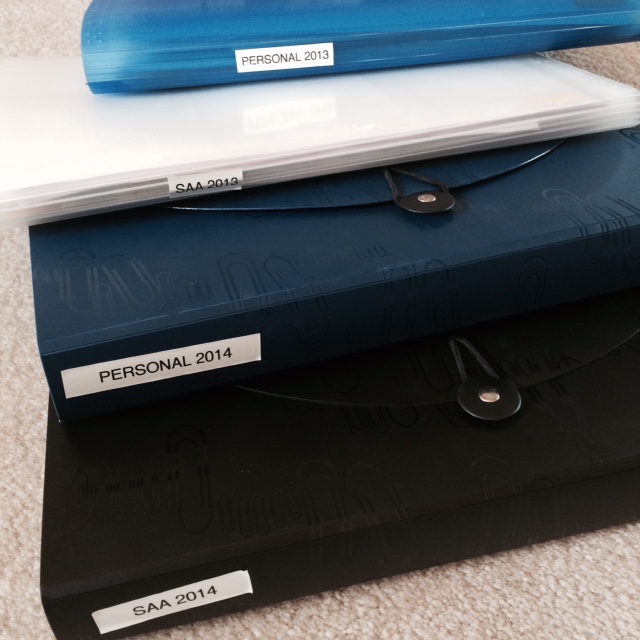
I’m a fan of accordion folders for paper receipts, as evidenced by this old photo. Because I don’t want to contribute to anymore plastic waste, I have been reusing these folders and archiving the older ones in manilla envelopes.)

2014 Accordion folders

3. Practice writing 2023.

Pull out your checkbooks (if you still use them!) and write 2023 on a bunch of new checks. They’ll have the correct year when you’re ready to use them.

4. Capture all of your projects.

Spend a couple of hours assessing all of the projects on your plate. This is time well used.

Projects are undertakings that require multiple steps to complete. For example: overhauling a website, creating a new body of work, moving, organizing an exhibition, and writing a book are all projects that can’t be completed in one sitting.

You probably have 10-15 projects at any one time, and you need to stay on top of all of them. Two or three of these are new or more involved and the rest (such as teaching or studio work) are ongoing.

Make a list of the projects and then start filling in the tasks required for completing each one.

5. Join me in the Art Biz Accelerator.

The Art Biz Accelerator is for ambitious artists who want a little extra feedback and support from me and interaction with others who are committed to their artist lives. 

All new for 2023!

This post was first published January 1, 2015 and has been updated with original comments intact.

The post Prepare for 2023: 5 Things to Do Right Now appeared first on Art Biz Success.

]]>
https://dy-online.com/prepare-for-new-year/feed/ 28
The Circular Business Plan for Artists https://dy-online.com/circular-plan/ https://dy-online.com/circular-plan/#comments Thu, 19 Nov 2015 12:00:13 +0000 http://artbizsuccess.com/?p=19825 Most business and marketing plans are linear, and most artists are anything but linear.

What if, instead of having a traditional business plan, you nurtured a holistic approach to your art career?

That’s what I want to help you do with The See Plan, a new tool to help you see your art career in total. I want you to see that a successful business is not all about making and marketing (the M’s).

The See Plan: 8 C’s for Getting Your Art Seen is circular rather than linear. You need all of the C’s for a healthy business and balanced life, however you define these.

Let me tell you about the 8 C’s.

1. Creativity

Everything begins with the art. Without the art, you are not an artist.

The post The Circular Business Plan for Artists appeared first on Art Biz Success.

]]>

Most business and marketing plans are linear, and most artists are anything but linear.

The See Plan

What if, instead of having a traditional business plan, you nurtured a holistic approach to your art career?

That’s what I want to help you do with The See Plan, a new tool to help you see your art career in total. I want you to see that a successful business is not all about making and marketing (the M’s).

The See Plan: 8 C’s for Getting Your Art Seen is circular rather than linear. You need all of the C’s for a healthy business and balanced life, however you define these.

Let me tell you about the 8 C’s.

1. Creativity

Everything begins with the art. Without the art, you are not an artist.

You need inspiration to be your best creative self.

But your creativity doesn’t end with the art-making. You can also benefit by spreading your creativity into your marketing and every corner of your business.

Terry Parker's Glaze Buckets
©Terry Parker. Terry Parker’s glazes at Loma Prieta Pottery. Used with permission. Terry’s Instagram feed is inspirational. Follow her @lomaprietapottery.

2. Commitment

Commitment isn’t something you can get from a book or a class. It has to come from within you.

Being a successful artist and entrepreneur requires that you make hard choices about how you spend your time. This discipline piece is opposed to how many artists think of their work: joy, pleasure, and play.

Once you wholeheartedly commit, things start happening. The Universe knows you are ready and works to help you attain your goals.

3. Clarity

Clarity is the planning piece. It’s getting clear where you are and what you want. You don’t have time NOT to plan.

Planning is crucial for a successful business and requires that you set aside time to look at an annual calendar, systems, income projections, and marketing strategies.

Planning at Art Biz Breakthrough - for clarity. Photo by Regina Mountjoy.
Planning at Art Biz Breakthrough – for clarity. Photo by Regina Mountjoy.

4. Community

Every artist-entrepreneur needs a support system, which is your community. It includes the people who love you when you’re cranky and frustrated (family and friends).

It also includes the mentors and other artists who nourish you with inspiration and from whom you learn about opportunities.

5. Connection

The more people who see your art, the more people there are to follow you and to buy your art.

Connection is the self-promotion piece. Once you make your work, you have to get it out of the studio and into the world. Your most powerful way to connect with the world is through your art.

Antonia Ruppert takes the mic at Art Biz Breakthrough. Photo by Regina Mountjoy.


6. Confidence

Confidence doesn’t automatically show up when you put your art into the world. It happens over time and as a result of a continuous path toward improvement.

Confidence expands when you take courageous action. Challenge yourself as you’re making art and sharing it with more people.

7. Completion

Creatives are notorious for starting projects and never finishing them. This is fine UNTIL you have to earn money from those creative projects.

Complete the art, complete the book, or complete the coursework. It doesn’t count until it’s finished.

8. Celebration

Celebrations don’t have to be large or cost money, but you should have some kind of ritual in place that helps you add closure to your project.

For some people, it’s a manicure, a massage, or a shopping excursion.

Buying something special is often a celebration ritual for me, but so is vegging out, watching movies, and ignoring email for a couple of days.

Your Turn

The See Plan is a tool I am using with clients to make sure they aren’t forgetting anything, to see that they are completing the circle. How are you doing on the 8 C’s?


The post The Circular Business Plan for Artists appeared first on Art Biz Success.

]]>
https://dy-online.com/circular-plan/feed/ 12
Powerful Questions That Lead to Progress https://dy-online.com/powerful-questions/ https://dy-online.com/powerful-questions/#comments Wed, 21 May 2014 10:28:00 +0000 http://artbizsuccess.com/?p=17629 Questions, when used in business planning, are more powerful than statements because they make us think and formulate our own answers. They encourage us to consider our situation, environment, abilities, and resources. See if any of these serve you at the moment.

The post Powerful Questions That Lead to Progress appeared first on Art Biz Success.

]]>
In reviewing the 20+ pages of notes from my business retreat last week, I was struck by how many questions I had written down.

Questions, when used in business planning, are more powerful than statements because they make us think and formulate our own answers. They encourage us to consider our situation, environment, abilities, and resources.

See if any of these serve you at the moment.

questions-effort

Questions for Low Mojo

What do I need to do more of?
What do I need to do less of?
Where am I not making my best effort?

Questions for Mismanaged Self-Management

If I make this choice, how will it serve me 3 months from now? 1 year from now? 5 years from now?
What if I pass on this opportunity? What if I agree to it?
What’s the worst that could happen? The best? Which is easier to live with?
What 1 thing on my task list will have the biggest impact on my success?
What is my motive for doing this?
What’s the best use of my time at this moment?

Questions for Sluggish Marketing

Who needs to know about this event/exhibition/product?
Who haven’t I been in touch with lately?
Have I outgrown this space/exhibition/event?
Who needs to know about my art?

Questions for Negative Mindset

Who can I send a Thank You card to today?
What are my blessings?
What do I need to do to fill the creative well?
What am I tolerating?
Who can I help today?

Questions for Challenging Actions

What obstacles will I need to overcome?
Where am I playing it too safe?
What makes me uncomfortable, and how might my business expand if I overcome that discomfort?
By when can I make that happen?
Where is there opportunity that I’m ignoring?
Am I all in?

Which questions can you use right now to revitalize a less-than-desirable situation?


The post Powerful Questions That Lead to Progress appeared first on Art Biz Success.

]]>
https://dy-online.com/powerful-questions/feed/ 29
Mind Mapping Your Ideas and Events https://dy-online.com/mind-mapping/ https://dy-online.com/mind-mapping/#comments Fri, 13 Dec 2013 15:17:00 +0000 http://artbizsuccess.com/?p=16812 I seem to be recommending mind maps to artists with great frequency these days, so I thought it would be useful to review what they are and how you can use them in your art business. A mind map is a tool for brainstorming or organizing your ideas. Mind maps are great for creatives and artists because they put words and ideas in a visual format.

The post Mind Mapping Your Ideas and Events appeared first on Art Biz Success.

]]>

I seem to be recommending mind maps to artists with great frequency these days, so I thought it would be useful to review what they are and how you can use them in your art business.

A mind map is a tool for brainstorming or organizing your ideas.

Mind maps are perfect for creatives and artists because they put words and ideas in a visual format.
In contrast to the way we write (linear, left-to-right, up to down), mind maps explode from the center. Related thoughts branch out from the core. It’s easier to explain with an image.

mindmap
A mindmap I created in my notebook when I was considering content for a single lesson in a class I used to teach. You can see that “Blog Posts” was the topic I was brainstorming.

When to Use a Mind Map

Mind maps can be used to generate ideas for anything. Consider creating mind maps for:

  • Your next piece of art
  • A class you’re teaching
  • A marketing campaign
  • A talk you need to give
  • A blog post
  • Your newsletter

But mind maps can also be used to organize something you’ve already created in order to help you understand it better. I mind-mapped the content on ArtBizCoach.com when I wanted to revamp the site.

website-content
Old Art Biz Coach Website Content

I used to use a program called My Thoughts for Mac to create mind maps on the computer. It’s good to start with pen and paper, but I find that I like to move things around quickly, which this program allows me to do. (Sadly, they no longer make this program and I haven’t found a good replacement.)

I’m sure you can find similar programs for PCs, but I would caution anyone who wants to use the computer for mind mapping to look for the simplest program available. There are many out there that are too complicated.

Mind mapping should be EASY. You should be able to do it quickly to keep the brainstorming process fluid.

The resulting map might look complicated, but it shouldn’t be difficult to get to that point.

To Mind Map an Idea

Follow these steps to use mind-mapping in your brainstorming session.

1. Draw a circle in the center of the page. Inside the circle, write the topic under consideration.

2. Start your branches from the center. Your first branches will be the main subtopics of your idea.

3. Add additional thoughts to the ends of these branches until you’re out of juice.

You can see that this could go on forever!
Use your mind map to create detailed outlines for your writing or plans for your events.

The post Mind Mapping Your Ideas and Events appeared first on Art Biz Success.

]]>

https://dy-online.com/mind-mapping/feed/ 16
Create Anticipation By Promoting Your Art Event Early and Often https://dy-online.com/anticipation/ https://dy-online.com/anticipation/#comments Wed, 19 Jun 2013 10:31:57 +0000 http://artbizsuccess.com/?p=15722 It’s never too early to start promoting your open studio, book launch, event, or exhibition. Creating anticipation means you are building expectation, excitement, and suspense! If you have a major event in the future, don’t wait until a month or two before it begins to tell people about it. Start dripping information about it now.

The post Create Anticipation By Promoting Your Art Event Early and Often appeared first on Art Biz Success.

]]>
It’s never too early to start promoting your open studio, book launch, event, or exhibition.

Creating anticipation means you are preparing people for something big. You are building expectation, excitement, and suspense!

If you have a major event in the future, don’t wait until a month or two before it begins to tell people about it. Start dripping information about it now.

But, and here’s the clincher, add variety to your missives to ensure the news is never stale. “Come to my exhibit!” gets old real fast.

Jeanne Bessette shares an image in April that will be in her June show in Santa Fe.

People follow you because they want to hear from you. There is a strong element of trust between you and them, so they expect to be among the first to know when you have something going on.

You are letting people in on a secret when you share news of your event in the planning stages. People love to know secrets!

TIP: Your earliest mentions should be less promotional and more informative or entertaining.
You don’t want your first messages to pitch something that isn’t ready. Instead, you are opening up, being a little vulnerable.

Use your newsletter, blog, and social media connections to get the job done. Weekly mentions on social media aren’t too frequent.

Here are some thoughts.

The Venue

Shoot photos of the venue, preferably with you in them: you pointing to a sign or inside talking with the staff.

Share on Instagram, Facebook, Pinterest, and your blog.

The Art

Show photographs of your inspiration on Instagram or Pinterest.

Write about your inspiration on your blog.

Reveal the work in progress on your blog and share on Facebook.

The Artists

Write blog or Facebook posts about the other artists included in the event.

Compliment the other artists by posting a comment on their Facebook pages that says you’re looking forward to exhibiting with them.

The Temptations

What else might be happening near your event that would pique interest in your followers? Special food? A nearby outdoor concert?

Share this information on all of your platforms (i.e. social media, blog). People are more likely to come from a distance if they know they can make a full day or evening of the effort.

Is there a cohesive theme around your event? A location, a subject, a color, or a season?
Make a pin board on Pinterest to reflect the theme!

Golden, Colorado on Pinterest
My favorite things around Golden, Colorado – all on a Pinterest board. Click to see the details.

Based on advice from Beth Hayden in an earlier audio program about Pinterest, I created a pin board to share information about Golden, Colorado, where my events are held. Check it out! This is my favorite use of Pinterest so far.

How do you create anticipation?

The post Create Anticipation By Promoting Your Art Event Early and Often appeared first on Art Biz Success.

]]>
https://dy-online.com/anticipation/feed/ 7