In this episode of The Art Biz, I give you 5 lists (a list of lists!)and tell you where to keep them and how to use them: good ideas, absolute no’s, things someone could do for you, 10-30-minute tasks, and done—your accomplishments. Don’t skip that last one.
The post 5 Lists every artist needs to keep (282) appeared first on Art Biz Success.
]]> 
The post 5 Lists every artist needs to keep (282) appeared first on Art Biz Success.
]]>Georgie is a National Board certified health coach specializing in ADHD in adults, especially women diagnosed later in life. We unpack executive function, time blindness, and what helps when your systems keep failing.
The post You know what to do but you’re not doing it: ADHD and your art business with Georgie Coote (273) appeared first on Art Biz Success.
]]>

The post You know what to do but you’re not doing it: ADHD and your art business with Georgie Coote (273) appeared first on Art Biz Success.
]]>The thrill of starting fresh! The anticipation of creating new benchmarks and attaining new dreams!
Oh, but wait. There’s a lot of crap that you need to get rid of --stuff that might get in your way if it doesn’t drive you crazy first.
What would it be like if the New Year felt . . . well . . . felt truly new?
The post A Fresh Start: Actions To Take Before January 1 appeared first on Art Biz Success.
]]>
Have you been saving names and contact info for anyone? Perhaps you made a note on your phone, wrote it in your planner or on a scrap of paper, or maybe you even got a real business card !
They aren’t doing you any good in their current form. Add that contact info to your database.
While you’re at it, send a quick “thinking of you” note to that person to stay top of mind. (See more under Send Correspondence below.)
This is an ESSENTIAL step for a successful art business.
See more of them in Establish Yourself: Essentials for Artist Success—a foundational business training program for beginning and emerging artists (and artists who never implemented the fundamentals).
The post A Fresh Start: Actions To Take Before January 1 appeared first on Art Biz Success.
]]>Optimize your schedule and increase efficiency—not so you can do more, but so that you make the most out of your limited time and enjoy life.
The post The Art Biz ep. 152: How to Squeeze More Time from Your Busy Calendar appeared first on Art Biz Success.
]]>






The post The Art Biz ep. 152: How to Squeeze More Time from Your Busy Calendar appeared first on Art Biz Success.
]]>You aren't checking boxes and crossing items off of a list, but you are feeling more in control. You begin to see possibilities that weren't previously evident.
When you are overwhelmed, I suggest starting the process by moving some energy around and then doing a brain dump.
The post A Proven De-stressing Technique to Eliminate Overwhelm appeared first on Art Biz Success.
]]>You’re feeling like you can’t get all of your tasks done in the time you have, and God bless the poor person who asks you for a favor right now. Oh, boy! Will they ever get an earful!
You’re probably also unfocused. You know that you have a lot to do, but can’t decide what is the best use of your time in this moment. So maybe you open up your inbox or scroll through Instagram because it feels like you’re doing something.
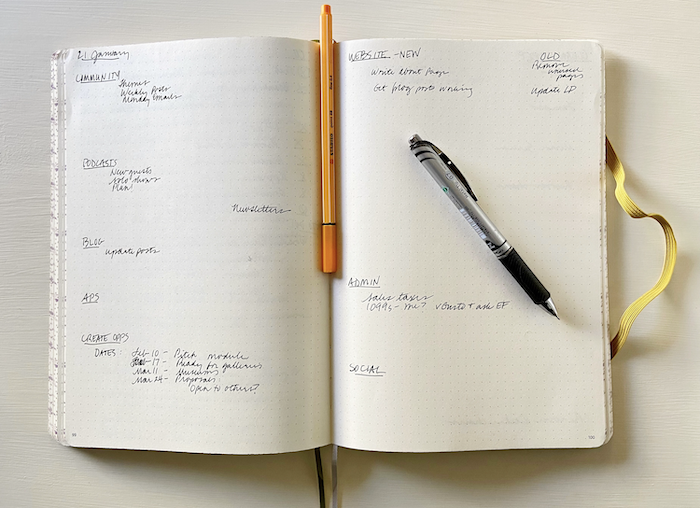
This is where I’ve been for the past couple of weeks—except for the Instagram scrolling. I didn’t have time for that. Chaos. Technology meltdowns. Imminent deadlines with demands for my attention coming from all angles. Extreme irritability. Don’t even come near me!
As we like to say in our Art Biz Connection community, I’ve been so busy working in the business that I haven’t been able to work on the business.
Working in the business is the daily work that you carry out on behalf of your boss (probably yourself). It’s nose-to-the-grindstone. You have blinders on because of this busy-ness, which often means you’re in the muck and can’t see the future and possibilities. Busy work might be absolutely necessary to keep things rolling along, but it is rarely fulfilling.
I recently talked about working in v. working on your business this on an Instagram livestream.
View this post on Instagram
Working on the business means evaluating your busy-ness—taking time to look critically at your next steps, if only briefly.
Instead of staying the course without looking up, you’re acting as the CEO you signed up to be and analyzing, questioning, and strategizing. Is it the right direction? What else is possible? What do you need to address? It’s taking a deep breath and giving yourself enough space to make wiser decisions (and check to see that past decisions are still right for you).
There is a deep sense of satisfaction when working on your business. You aren’t checking boxes and crossing items off of a list, but you are feeling more in control. You begin to see possibilities that weren’t previously evident.
When we’ve been working in the business for too long, we’re in dire need of a reset.
Here’s how you can begin the process of eliminating your current state of overwhelm.
Move The Energy Around
As a first step, move some energy around by trying any of the following.
- Take a walk, do a workout, stretch, or just move your body.
- Tidy up your physical space by decluttering.
- Tidy up your computer desktop, files, or inbox.
- Recycle or throw away whatever is in eyeshot that you don’t need.
- Move the furniture, change your view, or switch out your pillows or throw blanket.
Any of these can forge a path for higher vibrations to enter. Now you’re ready for your brain dump.
Prepare For Your Brain Dump
If you have more warning than I did … In other words, if you didn’t have a total meltdown and feel the need to cancel everything else on your schedule immediately … You can prepare for your brain dump (Brain dumps rarely make it to my calendar as I tend to need them for immediate relief).
You’re going to need a good hour for the process. When the time comes, close your computer windows, light a candle, play mood music, say a prayer, try EFT tapping, or perform whatever ritual you require in these moments.
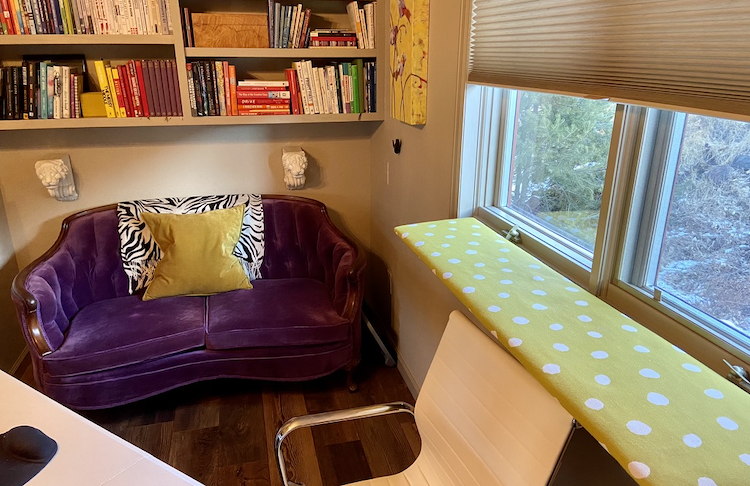
You’ll need a couple of pieces of paper or, my preference, a 2-page spread in your journal or notebook.
I like to begin tasks with focused intention and name the task: Now, I am sitting down to get whatever is in my head onto this piece of paper. Sometimes I even say it out loud.
Naming it provides space. You’re not doing anything else at this time. You’re only working on this one thing.
Lay Out Your Projects
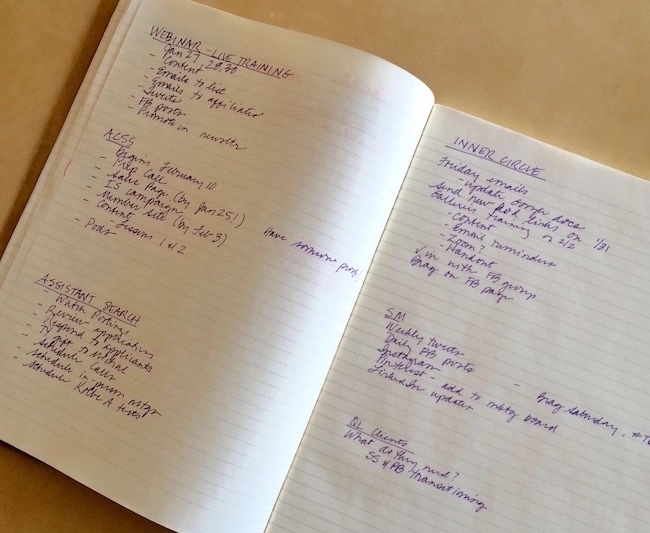
In the Artist Planning Sessions, I define a project as a goal that contributes to your vision and takes place in a defined period of time. It consists of multiple steps (tasks) that must be completed in order to be successful.
Your projects might look like any of these.
- Planning an upcoming exhibition
- Developing a new workshop
- Promoting a class or workshop you are teaching
- Ongoing marketing
- Completing a commission
- Writing a grant or residency proposal
- Gaining gallery representation
- Overhauling your website
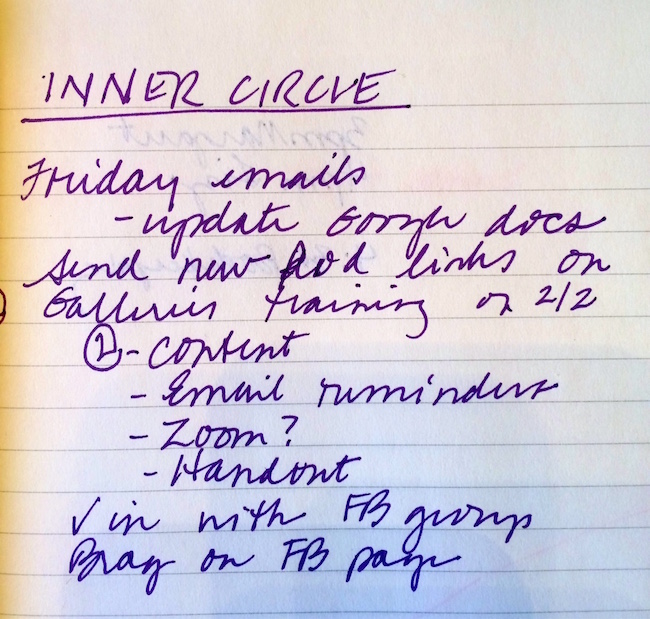
On your two pages, make headings for specific projects that are on your plate at this moment, leaving plenty of space in between each.
If you find your attention is wandering away from the objective of completing your brain dump, get up and run in place for 1 minute, walk up and down a flight of stairs, or lift your free weights for 10 reps. Physical movement should jolt you into an improved mental state.
You understand, don’t you, that you’re in real trouble if you can’t focus long enough to do a brain dump that will help you focus?
Identify Sub-Projects
Under each heading, make a list of smaller projects that contribute to the success of your bigger project.
For example, if your larger project is ongoing marketing, your sub-projects might include any of the following.
- Posting to Instagram
- Sending monthly emails
- Making 2 videos a month
- Networking
- Giving public talks
There’s no such thing as perfection here. Your mission is to document everything that is in your head right now.
You might also want to prioritize the sub-projects. Which ones must be done first? Either they have to be completed before you can move on to other tasks or the deadline is closest.
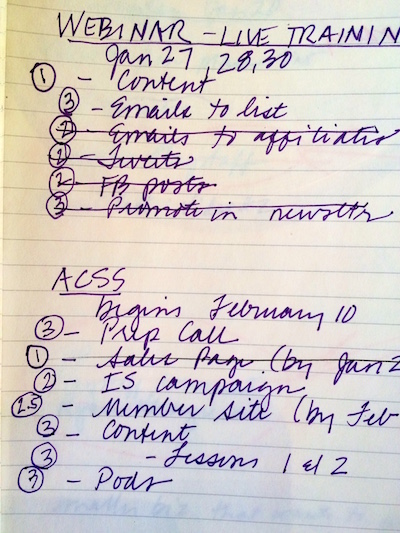
I sometimes label mine with a 1, 2, or 3 (and sometimes add a decimal point if I need to squeeze something in between two digits).
Add Tasks to Your To-Do List
You can use your brain dump paper as a to-do list only briefly. It’s too nutty to use it for more than a couple of days.
From your sub-projects, you should be able to identify related tasks and deadlines. Add these to your master to-do list.
Work The System
Your final step is to maintain this level of control for as long as possible. You have to work the systems you have put in place.
[ How to Increase Your Productivity with Art Business Systems ]
You have to look at your task list, review your projects, work on your business.
As hard as you try to stay in control, the overwhelm is likely to show up again. You’ll recognize it. And then you’ll have a proven process to get back on track.
This post was first published on January 28, 2016. It has been updated with original comments intact.
The post A Proven De-stressing Technique to Eliminate Overwhelm appeared first on Art Biz Success.
]]>This topic came up back in episode 96 when I talked with Jill Soukup about what she has done to increase profitability and happiness while reducing the things that lead to frustration and stress.
I think we unnecessarily complicate our businesses because we lose focus. We get distracted by social media posts and emails. The next great invention makes it to our line of vision and we suddenly wonder how we ever did without it.
Before we know it, we've typed in our credit card number, ordered or downloaded the professed solution to all of our problems, and upended the momentum we had built.
This insight that you are distracted by the latest and greatest isn't my clairvoyance into your world. It happens to me. All. The. Time. I am not immune to searching for magic tools that will make my life easier, help me be more productive, or increase my bottom line. And during this month that we're working on improving productivity, it's even more tempting to search for solutions outside of ourselves.
The truth is, you probably already have everything you need except, perhaps, community, support, and accountability, which you can find in Art Biz Success programs.
To help me unpack this idea, I'm joined on this episode of The Art Biz by Amelia Furman, who says that her to-do list was out of control before she took charge and started eliminating obligations from her life. She tells us why simplifying has become a way of life for her, what, exactly, she has simplified, and how she has done it. But first, let's hear about how she got to this point.
The post The Art Biz ep. 101: Simplifying to Improve Your Productivity with Amelia Furman appeared first on Art Biz Success.
]]>This topic came up back in episode 96 when I talked with Jill Soukup about what she has done to increase profitability and happiness while reducing the things that lead to frustration and stress.
I think we unnecessarily complicate our businesses because we lose focus. We get distracted by social media posts and emails. The next great invention makes it to our line of vision and we suddenly wonder how we ever did without it.
Before we know it, we’ve typed in our credit card number, ordered or downloaded the professed solution to all of our problems, and upended the momentum we had built.
This insight that you are distracted by the latest and greatest isn’t my clairvoyance into your world. It happens to me. All. The. Time. I am not immune to searching for magic tools that will make my life easier, help me be more productive, or increase my bottom line. And during this month that we’re working on improving productivity, it’s even more tempting to search for solutions outside of ourselves.
The truth is, you probably already have everything you need except, perhaps, community, support, and accountability, which you can find in Art Biz Success programs.
To help me unpack this idea, I’m joined on this episode of The Art Biz by Amelia Furman, who says that her to-do list was out of control before she took charge and started eliminating obligations from her life. She tells us why simplifying has become a way of life for her, what, exactly, she has simplified, and how she has done it. But first, let’s hear about how she got to this point.
Highlights
- Amelia shares her artist’s journey. (2:19)
- The breaking point that revealed that Amelia’s to-do list was out of control. (4:53)
- For Amelia, making big changes begins with a deliberate start to every day. (9:58)
- Why is simplifying so important? (13:29)
- Focusing on one goal or one word each year can help you recall what matters most. (15:05)
- Setting boundaries and saying no helps Amelia reach her main goals. (22:00)
- Doubling her gross income doesn’t mean that Amelia is doing more of everything. (24:17)
- How to schedule your time in more productive ways. (26:08)
- What does your ideal day look like? What about an ideal week or month? (29:45)
- Bullet journaling, calendaring, and planning your life. (35:32)
- How to create a loose monthly flow that allows you to meet your goals. (37:38)
- Simplifying, eliminating, and focusing have increased Amelia’s productivity. (40:18)
- The value of participating in a business owners group. (42:00)
- Amelia’s advice for simplifying a complicated artist’s life. (45:26)
- A look at what is up next for Amelia. (46:30)
Mentioned
Amelia Furman Quotes
- “A to-do list can help you get all the things done, which is awesome until it’s the end all be all. Then it’s not awesome anymore.”
- “Organizing what needed to happen for that day only really helped to focus in and start this journey toward simplicity.”
- “Now I’m not saying yes to things just because I can do them. I’m saying yes to things based on my goal.”
- “So much of this is being honest with myself about how much time something actually takes.”
- “I have no further plan beyond each day, and that really helps me stay focused on that day and simplifies it so much in my mind.”
- “Be brave and start taking stuff out.”
About My Guest
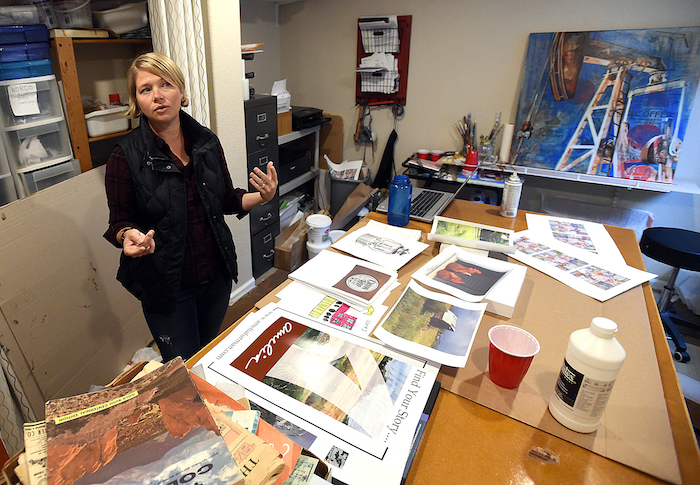
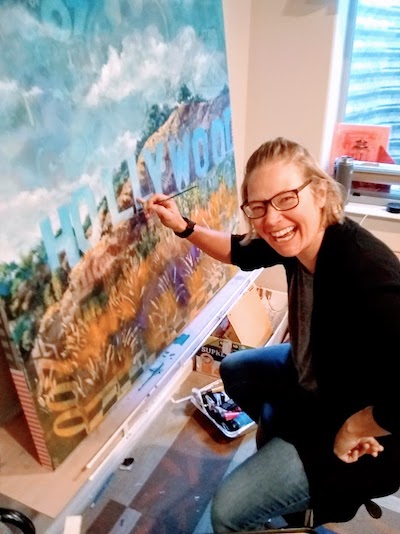 Amelia Furman grew up in rural, central Pennsylvania amidst pastoral scenes of farms, fields, and forests, and now calls Colorado home. Nature has captured her attention for as long as she can remember. The visual arts were also a dominant force in Amelia’s life from an early age. After graduating with a degree in visual art from Indiana Wesleyan University in 2003, Amelia began to explore how she could use paint to express her love of the natural world.
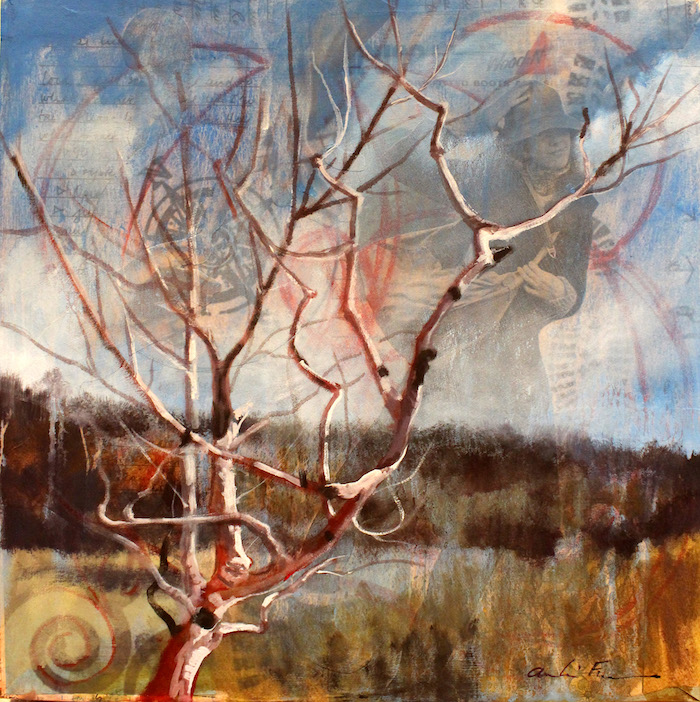
Amelia’s background in printmaking and illustration has heavily influenced the direction of her work. She works in a combination of paper collage, text, and thin layers of acrylic paint. Using a selection of documents, vintage images, handwritten text, and symbols associated with the painted image, Amelia reminds the viewer that places and objects have many layers of meaning, memory, and beauty.
Follow Amelia on Instagram: @ameliafurmanmixedmedia
Related
This IGTV is about getting realistic about your time.
View this post on Instagram
The post The Art Biz ep. 101: Simplifying to Improve Your Productivity with Amelia Furman appeared first on Art Biz Success.
]]>Sometimes it's about doing less by being discerning about what you take on and where you invest your energy.
This is extremely difficult to do when you are trying to show and sell your art. You want to do more. To add new income streams and the latest marketing platforms. The ads and social media posts are encouraging you to do more.
But more is exhausting.
Jill Soukup, who has been a student and client of mine over the past decade, is my guest on this episode of the Art Biz Podcast. There are at least three things that I admire about Jill:
- She, above all, is dedicated to becoming a better artist. To methodically improving her work.
- She knows what she wants. How she wants her career, business, and life to be.
- She knows what she doesn't want.
To this list I would add that she is generous, open, and an all-around nice person.
In this conversation, Jill and I discuss how and where she sells her work, how teaching fits in with her income plan, how she makes sure she remains profitable, and why it's important for her to keep things simple.
The post The Art Biz ep. 98: Being Profitable Doesn’t Have to Mean Doing More with Jill Soukup appeared first on Art Biz Success.
]]>Sometimes it’s about doing less by being discerning about what you take on and where you invest your energy.
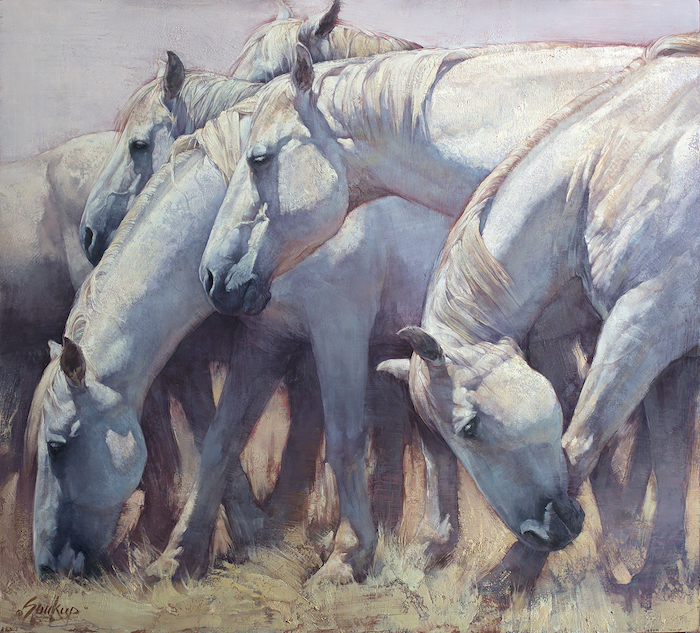
This is extremely difficult to do when you are trying to show and sell your art. You want to do more. To add new income streams and the latest marketing platforms. The ads and social media posts are encouraging you to do more.
But more is exhausting.
Jill Soukup, who has been a student and client of mine over the past decade, is my guest on this episode of the Art Biz Podcast. There are at least three things that I admire about Jill:
- She, above all, is dedicated to becoming a better artist. To methodically improving her work.
- She knows what she wants. How she wants her career, business, and life to be.
- She knows what she doesn’t want.
To this list I would add that she is generous, open, and an all-around nice person.
In this conversation, Jill and I discuss how and where she sells her work, how teaching fits in with her income plan, how she makes sure she remains profitable, and why it’s important for her to keep things simple.
Music by Wildermiss
Highlights
-
- Jill’s transition to full-time artist and where she shows and sells her art today. (1:51)
- The inspiration behind Jill’s Western-themed art. (5:56)
- Selling on Instagram is changing the dynamics of Jill’s work. (8:39)
- Logistics of selling prints and giving customers what they want. (11:34)
- Spending money to make money. (15:25)

- The strategies that allow Jill to get work done without working harder. (19:31)
- For Jill, doing less has resulted in even more success in her art business. (23:47)
- The hallmark of an exceptional artist: dedication to your craft and honing your skills. (29:10)
- Teaching, raising prices, and decreasing her painting output keeps Jill’s income steady. (30:45)
- Bookkeeping details and how Jill knows she is profitable. (37:24)
- Why is simplifying so important in Jill’s business—and life? (40:56)
- Insights from Jill’s typical work day and what she’s working toward now. (46:14)
Mentioned
Coors Western Art Exhibit & Sale
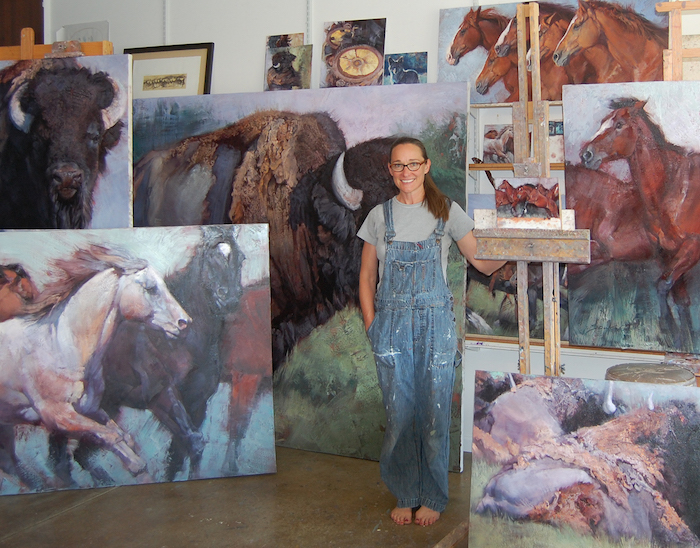
Jill Soukup Quotes
“As artists we ebb and flow in our process and what we’re producing.”
“This experience is teaching me to dig deeper and to see things that I wasn’t seeing before.”
“At that point I recognized that I was so overwhelmed. I wasn’t making any decisions because I had too many decisions to make.”
“At that moment I realized what really was important to me, and that all of the other things on my list were not even necessary.”
“Everything I chose to do had to meet one of my three goals and it just simplified everything. And it was such a beautiful thing.”
About My Guest
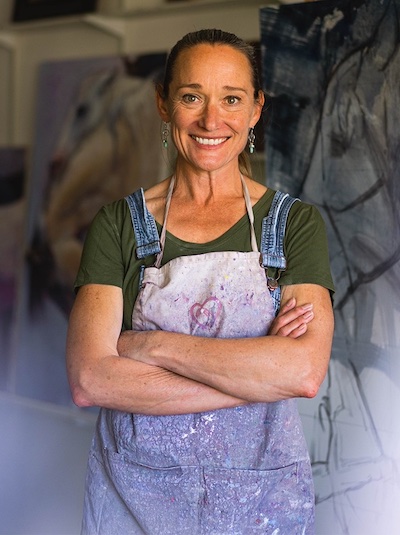
Jill Soukup was born in Buffalo, New York. Shortly thereafter, her family moved to Colorado, where she still resides. Jill’s affinity for horses as a young girl resulted in countless drawings and studies of them, which made for a strong drawing foundation. As a teen, she started a pet-portrait business, acquired jobs painting murals, and designed logos for local organizations.
Jill graduated from Colorado State University in 1991 with a Bachelor of Fine Art. There, she received awards for illustration and design and worked as an illustrator and designer for the university. She initially pursued a career in graphic design while continuing to paint part time. After 11 years as a designer, she made the switch to full-time painting. Her work continues to gain recognition as she receives awards, appears in national publications, and shows in important juried and one-woman exhibitions.
Follow Jill on Instagram: @jillsoukup
Music by Wildermiss
The post The Art Biz ep. 98: Being Profitable Doesn’t Have to Mean Doing More with Jill Soukup appeared first on Art Biz Success.
]]>How can you make really good art when you’re worried about where you stored the image the reporter is requesting or wondering what you did with that exhibition contract that’s due tomorrow?
The solution to this problem might be as simple as how you name things.
Naming Conventions in Your Art Business
I suggest using these five naming tips to help you find anything when you need it.
1. Title your artworks.
Titling your art differentiates this piece from that piece. This keeps you sane whether you’re trying to identify a piece for someone, organizing numerous works for an exhibit, or updating your inventory records.
Titling isn’t just for you, it’s also helpful to collectors and writers who want to refer to your art.
Referring to the piece titled Tense Moments is much easier than calling it "the one that’s mostly orange with a little green line about one-third of the way down" or "the fourth one from the top."
2. Title your exhibitions.
Like the titles of your art, the titles of your exhibitions
The post How to Find Anything When You Need It appeared first on Art Biz Success.
]]>How can you make really good art when you’re worried about where you stored the image the reporter is requesting or wondering what you did with that exhibition contract that’s due tomorrow?
The solution to this problem might be as simple as how you name things.
Naming Conventions in Your Art Business
I suggest using these five naming tips to help you find anything when you need it.

1. Title your artworks.
Titling your art differentiates this piece from that piece. This keeps you sane whether you’re trying to identify a piece for someone, organizing numerous works for an exhibit, or updating your inventory records.
Titling isn’t just for you, it’s also helpful to collectors and writers who want to refer to your art.
Referring to the piece titled Tense Moments is much easier than calling it “the one that’s mostly orange with a little green line about one-third of the way down” or “the fourth one from the top.”
2. Title your exhibitions.
Like the titles of your art, the titles of your exhibitions differentiate them from one another.
Have you ever read an artist résumé that looks like they repeat the same show every year? An artist’s list of accomplishments looks juicier if the exhibitions have varied names.
3. Standardize your digital filenames.
Name your files with enough description that you can find what you need in a list and are able to conduct a successful search on your computer.
If you have certain files you use for every show or exhibition, devise a standard. For example:
Contract – Art Center December.docx
Labels – Art Center December.docx
Statement – Art Center December. docx
Timeline – Art Center December.docx
4. Label your paper files with titles similar to your e-files.
Once you have a system in place for e-files, why would you invent a separate one for your paper files? Don’t fix what isn’t broken.
You’ll be able to get your hands on a file quickly if you stick with the system.
5. Identify your tasks with colorful detail.
Keep your to-dos on an electronic task list. In contrast to paper, e-lists allow you to repeat, sort, and change tasks with ease. An e-list also gives you a lot more space to articulate each task.
There’s no comparison for maintaining a master to-do list.
When adding a new task to your list, start with a verb (Write, Email, Deliver, Mail) and add details that clearly define the action needed.
If you are mindful of how you title, label, and name things, you’ll be able to find them when you need them most. How do you name things?
This post was originally published on July 31, 2013 and has been updated with original comments intact.
The post How to Find Anything When You Need It appeared first on Art Biz Success.
]]>Gwen left this comment in our Art Career Success System private group. I was struck by her insight because I had been reading about this at the time. “Decision fatigue” is a real phenomenon in contemporary society.
According to researchers, we make over 200 decisions per day about food alone. Just food decisions! I don’t know about you, but all of these decisions wear me out.
As an example, I spent 3 months last fall researching espresso machines – dreaming of holding the perfect cup of coffee while still in my jammies. But I could never click the button to buy.
My husband took me out of my misery. He decided on one, bought it, wrapped it, and put it under the tree. Best. Gift. Ever. No decision (on my part) was required.
Don’t get me started on making travel reservations. I can't stand to make plane reservations or to find a hotel. What if I book "the wrong" flight or land at the wrong airport? Don't laugh. I recently did this when I was confused about a small airport name, and it cost me a lot of extra driving time.
I contend that we’re happier when
The post Overcome Decision Fatigue by Automating and Systematizing appeared first on Art Biz Success.
]]>Gwen left this comment in our private community. I was struck by her insight because I had been reading about this at the time. Decision fatigue is a real phenomenon in contemporary society that wreaks havoc on our productivity.
According to researchers, we make over 200 decisions per day about food alone. Just food decisions! I don’t know about you, but all of these decisions wear Gwen and me out.

As an example, a number of years ago I spent 3 months researching espresso machines—dreaming of holding the perfect cup of coffee while pecking out some brilliance on these keys. But I could never bring myself to click the button to buy. I was too overwhelmed by all of the choices.
Researchers know that we grow increasingly indecisive as the day wears on. We begin to act impulsively and look for shortcuts. For me, this fatigue shows up in a single phrase that I repeat often when I’m tired of making decisions: I don’t care.
I don’t care whether the espresso machine is chrome or black or polka-dotted. I don’t care if it grinds its own beans or I have to use a separate grinder. I don’t care if … You get the picture.
While I truly don’t care in the moment, the wrong choice could lead to a bad case of buyer’s remorse. Not. Good.
My husband took me out of my misery. He selected an espresso machine, bought it, wrapped it, and put it under the tree. Best. Gift. Ever. No decision (on my part) was required.
Don’t get me started on making travel reservations. I can’t stand to make plane reservations or to find a hotel. What if I book “the wrong” flight or land at the wrong airport? Don’t laugh. I did this when I was confused about a small airport name, and it cost me a lot of extra driving time. WTH?

I contend that we’re happier when we have fewer decisions to make, and that we’re better with the important decisions if we don’t spend time on the little ones. That’s why I’m encouraging you to create routines, automate as much as you can, and turn repeated tasks into systems so you don’t wear out your decision motor.
What can you do without thinking? Consider the following.
Time Management
Preparing for your day.
There’s a better way to start your day than jumping out of bed and checking email messages before doing anything else. It’s worse yet if you’re checking email while still in bed.
Develop a morning routine that sets the tone for the entire day.
Ending your day.
There’s no better way to get a good night’s sleep than to create space between your work, chores, and hectic evening. Here are some suggestions:
- Plan the next day, making sure you’ve captured all of your to-dos.
- Step away from all digital screens at least one hour before going to bed.
- Stretch.
- Meditate or write in your journal.
Art and Service Sales
Sending thank-you emails.
When someone signs up for your list or one of your classes, they should receive an email with your gratitude. Set up autoresponders in your sales process to take care of this for you.
Suggestion: Subscribe yourself to make sure you know what they’re getting. Even if it’s automated, you still want it to feel personal.
Responding to donation requests.
Every artist should have a policy for handling requests for donations of their art that triggers subsequent steps.
You receive a request, and, because you have a policy in place, you know whether it’s worth entertaining or you can say No outright. You have a standard reply instead of spending time deciding what to say.
[ Limits for Donating Your Art ]
Completing a work of art.
There are certain things that must be done when you finish a work. You sign it, give it a title, add it to your inventory, and photograph it.
What else is part of your routine after a work is finished? Write your procedure down and refer to it after you complete a new work.
Packing and shipping your art.
When I used to receive online orders for hard copies of my book, they were automatically sent to my assistant on the other side of the country who prepared the shipping labels. We could go online, print the labels, and ship.
It was a small step in the process, but it saved loads of time.
What part of your packing and shipping can you automate or do without thinking?
Marketing
Following up with someone who buys a piece of art from you.
When someone buys a piece of art, when and how do they next hear from you? And then what? And then what? Turn it into a system so that you don’t waste time and energy trying to choose how you should stay in touch.
Is your system different if they buy online than if they buy in person?
Promoting a class, workshop, or other program.
Next time you teach or lead a program, write down everything you do to promote it. Do the same for subsequent events. You will soon have a replicable framework for promoting in the future.
Sure, they’ll be tweaked each time, but there will be numerous steps that don’t require a lot of brainpower.
Scheduling social media.
If you are devoted to regular posting on Instagram, Facebook, or Twitter, consider using a social media scheduler like Later, HootSuite, or Buffer. It’s not fully automated (you still have to do some of the work), but seeing your images and ideas in one place makes the decision about what to post seem that much less onerous.
Finances
Lucky you! Your finances can be automated in many ways. For example:
- Contributions to your retirement or savings account
- Notifications for low balances
- Reminders for payment deadlines
- Quarterly tax payments
- Balances on a credit card
Is it time to set up additional automation for handling your money?
We still use that espresso machine every day, but it wasn’t my husband’s last research job. Whether he likes it or not, he continues to be tasked with making decisions about major appliances because I need to use my brain cells elsewhere. To date, he has selected, over time, an oven-stove (gas with 2 ovens, please), a dishwasher (I selected the brand and he did the rest), and the refrigerator (bottom freezer was my only demand).
If you have a significant other who can perform these tasks for you, congratulations! Throw a little more appreciation their way. If not, do whatever you can to lessen the negative impact of decision fatigue.
Reserve your energy for the important decisions required around making art and running a business.
What do you do without even thinking? What can you do without thinking?
In Context: The Capsule Wardrobe
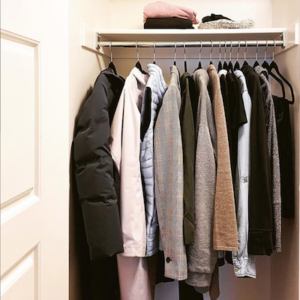
Have you discovered during quarantine that you need a lot fewer clothes than you thought you did?
Consider embracing the idea of a capsule wardrobe.
Susie Faux birthed this idea in the 1970s. A capsule wardrobe is built from a small number of simple, versatile pieces that can be mixed and matched. By deliberately limiting your closet selection, you eliminate many woes around what to wear.
[ How to Build a Capsule Wardrobe by Courtney Carver ]
Those Things You Never Get Around To
 I love how your challenges MAKE us do things on our list that we never seem to get to … and make it seem so much simpler! —Christine Aaron
Christine and other members of our community have been working on weekly challenges to improve photos and videos for marketing their art. I selected specific tasks that I knew were a stretch for many members, but all quite doable. At the end of the month, I’ll select a single person who participated most fully throughout the month to receive a complimentary consulting session with me. Up for a challenge or two?
This was originally published on September 8, 2016. It has been updated with original comments intact.
The post Overcome Decision Fatigue by Automating and Systematizing appeared first on Art Biz Success.
]]>If you want to be a more productive artist, you must embrace your role as the CEO of your art business. In that capacity, you understand that every decision you make impacts your income, influence, and legacy. Every decision.
When you are productive … when you are fully in charge of your art business … you know which tasks are most important and which can wait.
A Productive Artist's Profile
Before I get too deep into this topic, I have to fess up to having more than my fair share of unproductive days. My productivity seems to come in cycles. Maybe it’s the change of seasons or the promise of the New Year, but, lately, my productivity has soared.
I am still trying to figure out the productivity puzzle. I read plenty about the topic. I listen to productivity podcasts. I, like you, want the secret sauce that will help me eke out one or two more tasks in a day. (I’ve also discovered that one can, ironically, be incredibly unproductive while researching productivity.)
I’m in the process of holding individual video conferences with every single member of my coaching programs to reflect on their year with us. After asking about their accomplishments, I want to know about the challenges they continue to face.
Those who have been working with us longer have higher level and focused challenges. Those who are newer consistently list time (lack thereof) and prioritizing as their biggest challenges.
You are not alone in your drive to become a more productive artist. But the good news is, it’s a skill you can learn.
How You Spend Your Time is a Reflection of Your Priorities
Becoming more productive is a process you need to put in place and, here’s the clincher, follow for months and years. You must be committed to the process, and you won’t be unless you’re also committed to your art business and career.
You get to choose how to spend your time, and how you spend your time reveals what you prioritize in life.
How you spend your time tells the rest of the world what is important to you.
The post Productivity for Artists Isn’t About Doing More appeared first on Art Biz Success.
]]>If you want to be a more productive artist, you must embrace your role as the CEO of your art business. In that capacity, you understand that every decision you make impacts your income, influence, and legacy. Every decision.

When you are productive … when you are fully in charge of your art business … you know which tasks are most important and which can wait.
A Productive Artist’s Profile
Before I get too deep into this topic, I have to fess up to having more than my fair share of unproductive days. My productivity seems to come in cycles. Maybe it’s the change of seasons or the promise of the New Year, but, lately, my productivity has soared.
I am still trying to figure out the productivity puzzle. I read plenty about the topic. I listen to productivity podcasts. I, like you, want the secret sauce that will help me eke out one or two more tasks in a day. (I’ve also discovered that one can, ironically, be incredibly unproductive while researching productivity.)
I’m in the process of holding individual video conferences with every single member of my coaching programs to reflect on their year with us. After asking about their accomplishments, I want to know about the challenges they continue to face.
Those who have been working with us longer have higher level and focused challenges. Those who are newer consistently list time (lack thereof) and prioritizing as their biggest challenges.
You are not alone in your drive to become a more productive artist. But the good news is, it’s a skill you can learn.
How You Spend Your Time is a Reflection of Your Priorities
Becoming more productive is a process you need to put in place and, here’s the clincher, follow for months and years. You must be committed to the process, and you won’t be unless you’re also committed to your art business and career.
You get to choose how to spend your time, and how you spend your time reveals what you prioritize in life.
How you spend your time tells the rest of the world what is important to you.
What productivity looks like to me now is very different than how I saw it 15, 10 or even 5 years ago. Ten or 15 years ago, productivity meant checking off tasks on a list. The more I checked off, the more productive I was. Write, write, write. Make, make, make. Send, send, send.
Now I see productivity holistically—the way it should be. I look at my purpose, vision, and goals rather than zeroing in on tasks. Don’t get me wrong, eventually the tasks need to become a focus, but they must always be connected to the big picture.
This is one of the first lessons I teach in the Art Biz Accelerator.
If you don’t look at your art career holistically, you are likely to be distracted by every new idea tossed your way. Forgive yourself! You’re an artist whose senses lead to inspiration and experiences that become the seeds of the work you make. You are blessed with more ideas than most people will have in a lifetime.
But when you want to sell your art … when you want to share it with more people … when you want to be recognized for your work … you must know which ideas are meant for you at this time. You can’t allow yourself to be distracted by all the noise.
The Secrets of Highly Productive Artists
I’ve been working with artists since 2002. Thousands of artists have read my book and blog, listened to my podcast, attended my workshops, enrolled in my courses, and been supported by my coaching programs. My point is that I’ve had the pleasure of working with lots of artists.
The artists whose careers I’ve witnessed run the gamut in terms of their approaches to their businesses. I’ve observed plenty of artists struggling to hang on while others, sadly, give up entirely. I’ve also, blessedly, had the privilege of watching many of them thrive.
There’s a clear distinction between committed, ambitious artists and those who are half-assing their way to what they hope will lead to something interesting.
I’ve said it hundreds of times, but it must be repeated. There is absolutely nothing wrong with making art for pure enjoyment. But when you try to show and sell it—especially when you want to make a living from it—you owe it to yourself and to other artists to be serious and professional.

In order for high-achieving artists to reach their goals, they must distinguish themselves. For every ambitious artist I’ve worked with, this means approaching their art, business, and career with utter devotion. Unwavering seriousness.
They have committed to a life as a working artist. They make hard decisions about the opportunities they encounter. They learn what to say No to and what to say Yes to. More to the point, they know that if it’s not an absolute Yes, it’s a No.
High-achieving artists also know that their chance of success increases dramatically when they have support. It’s much easier to go off course when you have no accountability. When you work by yourself it’s easy to let things slide by telling yourself that it won’t matter because nobody will know.
Trade-Offs are Required
Will you spend your morning on email and social media? Or will you focus on writing that grant application or finishing your latest commission?
You’re going to have to make some trade-offs. To be your most productive self, to be fully in charge of your business, you must come to terms with the fact that you can’t do everything you want. Nobody has that much time.
What are you willing to give up to reach your goals?
What habits do you need to change or enact?
Start Your Day With Intention
Don’t tell me you’re too busy and can’t let go of a single thing. Everybody is busy. Everybody is distracted. Everybody wants to do more.

Being busy is boring. Regardless of the work you do, you’re juggling personal and professional demands on your time. You want (and need) to stay connected to the world, your creativity, and your one precious life.
What’s more interesting is being an artist who is committed to growth and improvement, one day at a time.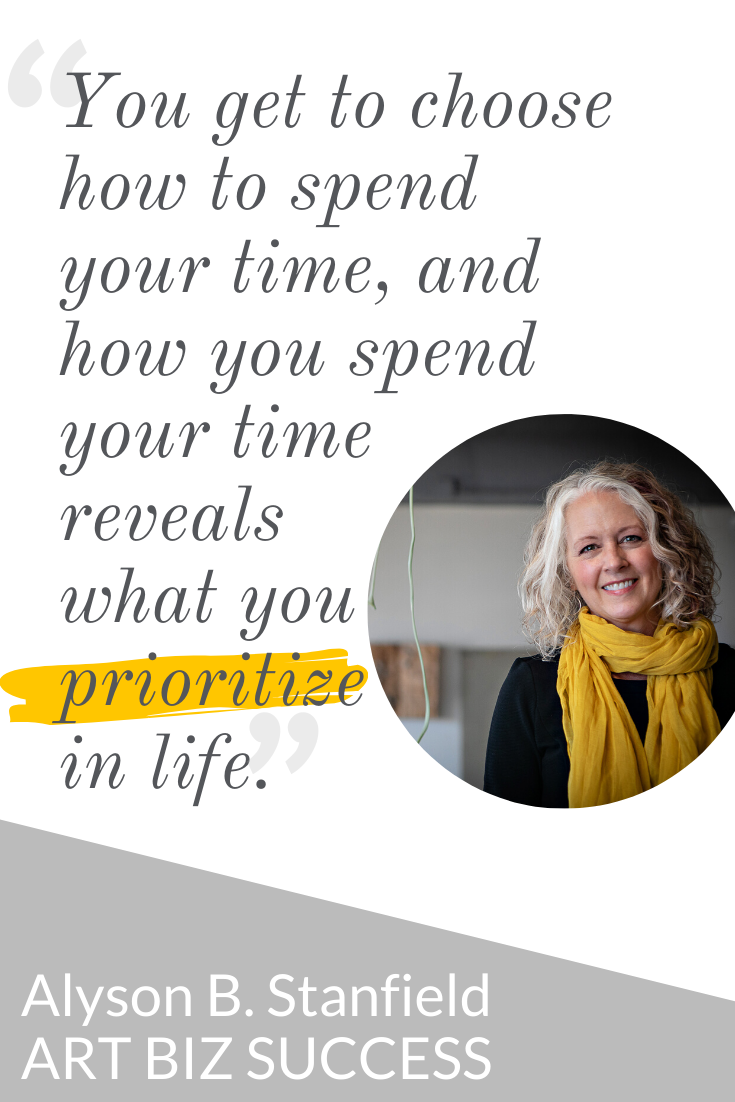
A productive day starts the night before when you decide that you’re going to have a productive day. Be determined that you won’t allow outside forces to impede your progress. Visualize taking back control when those forces try to spoil the productivity party.
You are committed to your art career.
You are in charge of your time.
You understand there are trade-offs on the path to your goals.
You are not afraid to say No.
You are the freakin’ CEO of your art business.
The post Productivity for Artists Isn’t About Doing More appeared first on Art Biz Success.
]]>